
PerMark
Read what your AI writes. Write what it reads.
PerMark is a free, open-source Markdown app for Windows, macOS and Linux, built for the reader. It opens any .md file as aclean page, keeps notes that save themselves, and turns a project folder into an IDE where you follow, review and steer whatyour AI agents write. It works with any AI tool, or with none.
Created and maintained by Edelmar Schneider.
Get PerMark: Microsoft Store (Windows) · GitHub Releases (Windows, macOS, Linux)
Features · Install · Usage · Shortcuts · Roadmap · Contributing
[!NOTE]TrailMark is now PerMark. Same app, same logo, a name of its own. If you already have TrailMark, the next update brings thenew name and keeps everything: your
.trailmark/project folders become.permark/the first time you open them, and yoursettings, recent folders and notes carry over. The command is nowpermark(permark mcp,permark context); if an AI agentis set up with the oldtrailmarkcommand, run the setup lines from Settings → Agent connection again.
Where to start
Build with AI agents?
Your agents write the plans, specs and reports. Your job is to read them, judge them and steer. PerMark is the IDE for thatjob: open the project folder and keep it next to your terminal. It doesn't run your agent; it shows you what your agent writes.
- Watch. Changed passages glow as your agent writes, removed ones leave a marker, and a live feed lists every file ittouches, across git worktrees too. A reload keeps your place.
- Review. Unread dots mark every document that changed since you last read it, like new mail. Git badges and a "since yourlast visit" view still work after the agent has committed.
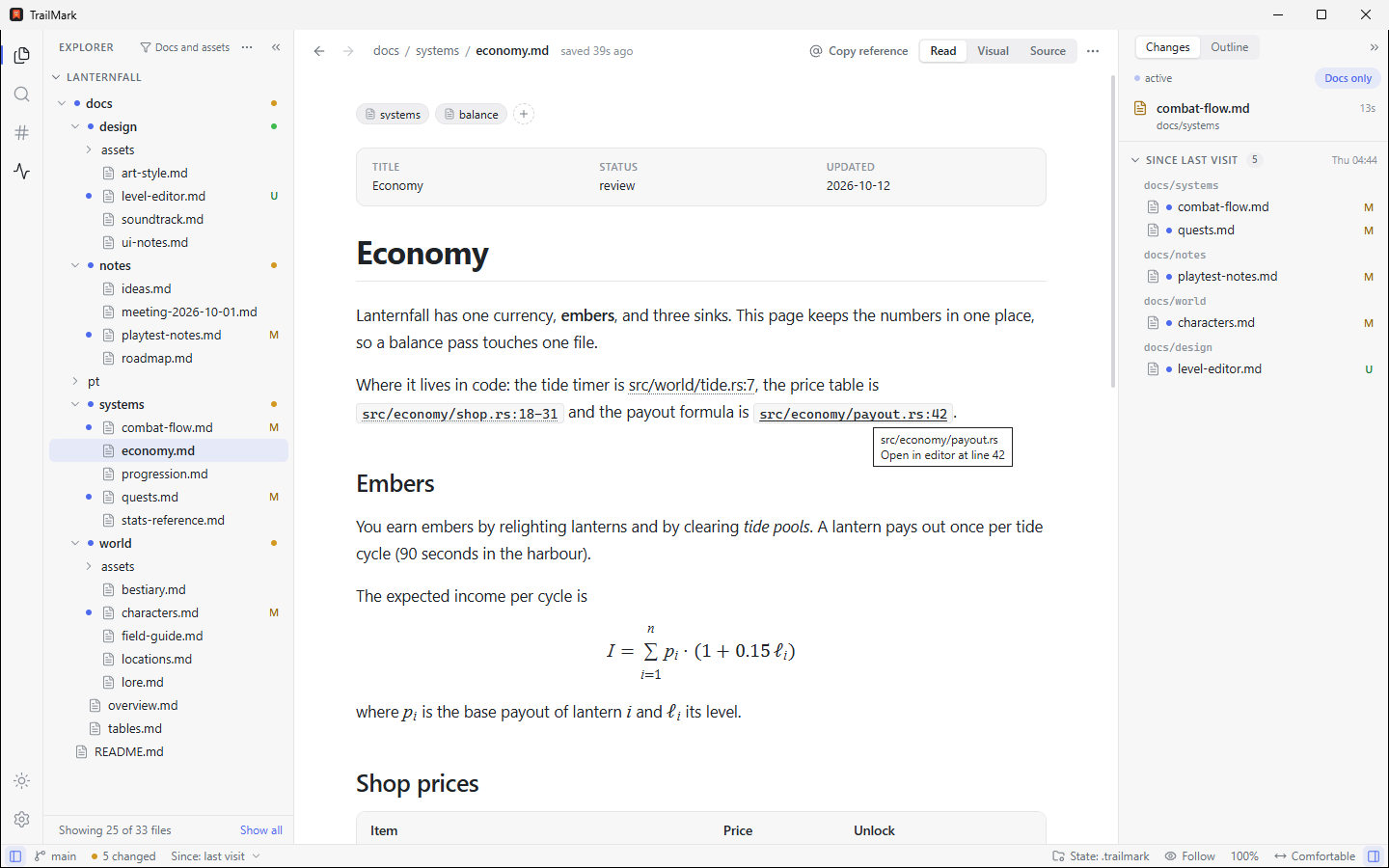
- Find. One search for every file, section, tag and command, and code references like
src/main.rs:42that open at theline in the editor you choose. - Steer. Select a passage, press
Cand write a comment. With the optional agent connection (MCP),your agent reads your open comments, marks them done with a reply, and knows which document, section and words you mean whenyou say "rewrite this". - Edit next to it, safely. Only the blocks you change are rewritten, and if your agent changes a file while you edit it, youchoose Reload theirs or Keep mine.
More in Follow your agents live and Use with an AI agent.
Got a .md file?
Your AI, a colleague or a download gives you a .md file. Open it with PerMark and read it as a page, not a wall of symbols.
- It reads like a page. Tables, checklists, highlighted code, Mermaid diagrams, math, alerts and footnotes, in light or dark,with three reading widths and a focus mode.
- Links work. Relative links and anchors open in the app, with back and forward and an outline of the headings.
- You can fix it. Edit visually, with a toolbar, or in Source. Only the blocks you changed are saved, and the rest of the filestays exactly as it was.
- Notes that save themselves. Press
Ctrl+Shift+Nin PerMark and type. No name to choose, no folder to pick, and closingnever asks. Pin the notes you keep, bring back an earlier version, and copy a drafted prompt to your AI as clean Markdown. - Your files are safe. A file you open is listed next to your notes and written only when you press
Ctrl+S. PerMark islisted under Open with for Markdown files and never makes itself your default app: that choice stays yours.
More in Reading that feels like a book and Notes.
Either way, PerMark only relies on your filesystem and git. It works the same with Claude Code, opencode, Cursor, Aider,Codex or Gemini CLI, or with none.
Why Markdown
Markdown was made for readers. So is PerMark. It was designed in 2004 so that plain text reads well as it is. Twenty yearslater, AI adopted it for the same reason: it is structured enough for a machine and clear enough for a person. PerMark is thereader's tool for it.
It is also an opinion: many documents that live in Word or PDF today would be better as Markdown. They would be smaller,comparable line by line in git, readable by any AI, and never locked inside one app.
Features
📖 Reading that feels like a book
- GitHub-flavored Markdown: tables, task lists, footnotes, alerts (
> [!NOTE]), description lists - Mermaid diagrams, KaTeX math, syntax-highlighted code with copy buttons
- Code blocks are highlighted for about 190 languages. Name the language after the opening backticks, for example
```python, andthe block is colored and labelled in its corner. The usual short names work (js,ts,py,sh,ps1,c#,c++,yml,rs...),and so do fences with attributes (```rust title="main.rs"). A block with no language is colored only when its language isunmistakable, and is then labelled auto; otherwise it stays plain. Visual and Source color the code too while you edit - Frontmatter shown as a clean metadata card
- Light and dark themes (with a softer paper, sage or gray tone for the light one), adjustable zoom, and a focus mode with both side panels collapsed
- Three reading widths: Comfortable (a book-like column), Wide and Full. Wide tables, diagrams and images take the roomthey need while the text stays at a comfortable measure
- JSON, XML and plain text through an extensible renderer registry
🧭 Navigate like a wiki
- Open a folder for IDE mode (tree, search, live feed) or a single file for a distraction-free reader
- Relative links, anchors and images resolve inside the app, with back and forward history. Right-click (or press and hold) Back orForward to list the documents on that side and jump straight to one, like in a browser; Go to a recent place... in the commandpalette (
Ctrl+Shift+P) lists your whole trail - An Outline of the open document's headings (
Ctrl+Alt+O): the section you're reading is marked, click a heading to jump,collapse sections you don't need. It keeps working while you edit, and a dot marks the sections an agent just changed - A filter for the Explorer (Documents, Docs and assets, Everything, or your own patterns) keeps a code repository's tree to thedocuments that matter, and tells you how many files it hides
- Workspaces that collect several repositories show each one, even when the parent's
.gitignoreleaves it out. Hiddenfiles and files ignored by git have their own switches in the filter, off by default - The window opens where you left it, with its own size and place for each project, and its title names the document and the project,so several windows are easy to tell apart in the taskbar and
Alt+Tab - The Explorer follows the file you open, however you got there: quick open, a link, search, the feed, back and forward
- Quick open (
Ctrl+P), find in page (Ctrl+F), session restore and recent projects - Code references are links.
src/main.rs:42,lib.rs#L10-L20or`docs/plan.md`in a document opens the file at the line:Markdown in PerMark, anything else in your editor (VS Code, Cursor, Zed, Sublime Text, JetBrains IDEs or a command of your own,in Settings → External editor). Only names of files the project really has become links - One process per project:
permark ~/code/my-project
🖼️ Pictures, sound and video
- Images open in the pane. PNG, JPEG, GIF (animated), WebP, AVIF, BMP, ICO and SVG. A picture is fitted to the window; click it, or use thebutton, to see it at 100%, and
Ctrl+=,Ctrl+-andCtrl+0zoom it the way they zoom text (Ctrl+0fits it again). A checkerboardshows through transparency, in light and dark. The header gives the size in pixels and on disk. A picture that changes on disk(an agent regenerating a screenshot) reloads by itself. An SVG is drawn as an image, never inline, so nothing in it can run. - Audio and video play in the pane, in the window's own player: MP3, WAV, OGG, Opus, FLAC, M4A, AAC and WebM audio; MP4, M4V, WebM,OGV and MOV video. A long file is read in parts as it plays, so it starts at once, seeks freely and is never loaded whole. A format orcodec the window cannot play (MKV, AVI, WMV and the like) says so, and offers the program your system has for it.
- Documents can use them.
<video>and<audio>tags play in place, next to the document, and a link to a media file opens it in thepane. Nothing starts by itself:autoplayis dropped, and a player only reads the length of its file until you press play. - Open with default app hands a file the pane cannot show to the program your system has for its type: a button in the pane, an itemin the Explorer's right-click menu, and a command (
Ctrl+Shift+P). Programs and scripts (.exe,.bat,.ps1,.sh,.app,.lnk, installers, Office documents that can hold macros such as.docm,.docand.xls, and the like) are never opened from a click; PerMark says which kind of file it refused and offersto show it in the file manager. Files outside the open folder are never served, and a link that leaves it is not followed. - Open in browser for
.htmland.htmfiles: in the Explorer's right-click menu, in the ... menu of the open page, and in thecommand palette. The page opens in the application your system uses for web pages (your browser, on almost every computer); PerMarkdoes not draw web pages itself. - The Explorer filter has an Audio and video category. Docs and assets shows them by the same rules as images: next to a document, ina folder named like
assets,images,video,audioorclips, or when a document links to them. Quick open and Search everywherefind pictures, sound and video by name whatever the filter hides, and list folders too: pick one to reveal it in the Explorer.
⚡ Follow your agents live
- Documents reload without losing your scroll position
- Changed blocks glow and fade; removed blocks leave a marker you can expand
- Live changes feed: one entry per file, bursts grouped,
git checkoutstorms collapsed into one line - Follow mode automatically opens the doc the agent is writing (rate-limited, never jumps while you're selecting)
- Git worktrees are discovered automatically, so changes made by agents working in parallel branches show up too
- Unread markers, like mail: a dot on every document that changed since you last read it, in the tree, search and the feed.Reading it (3 seconds on screen, or a scroll) clears the dot,
Alt+Utakes you to the next one, and Show only unread narrowsthe tree to what you haven't seen
🔍 Find anything, to the section
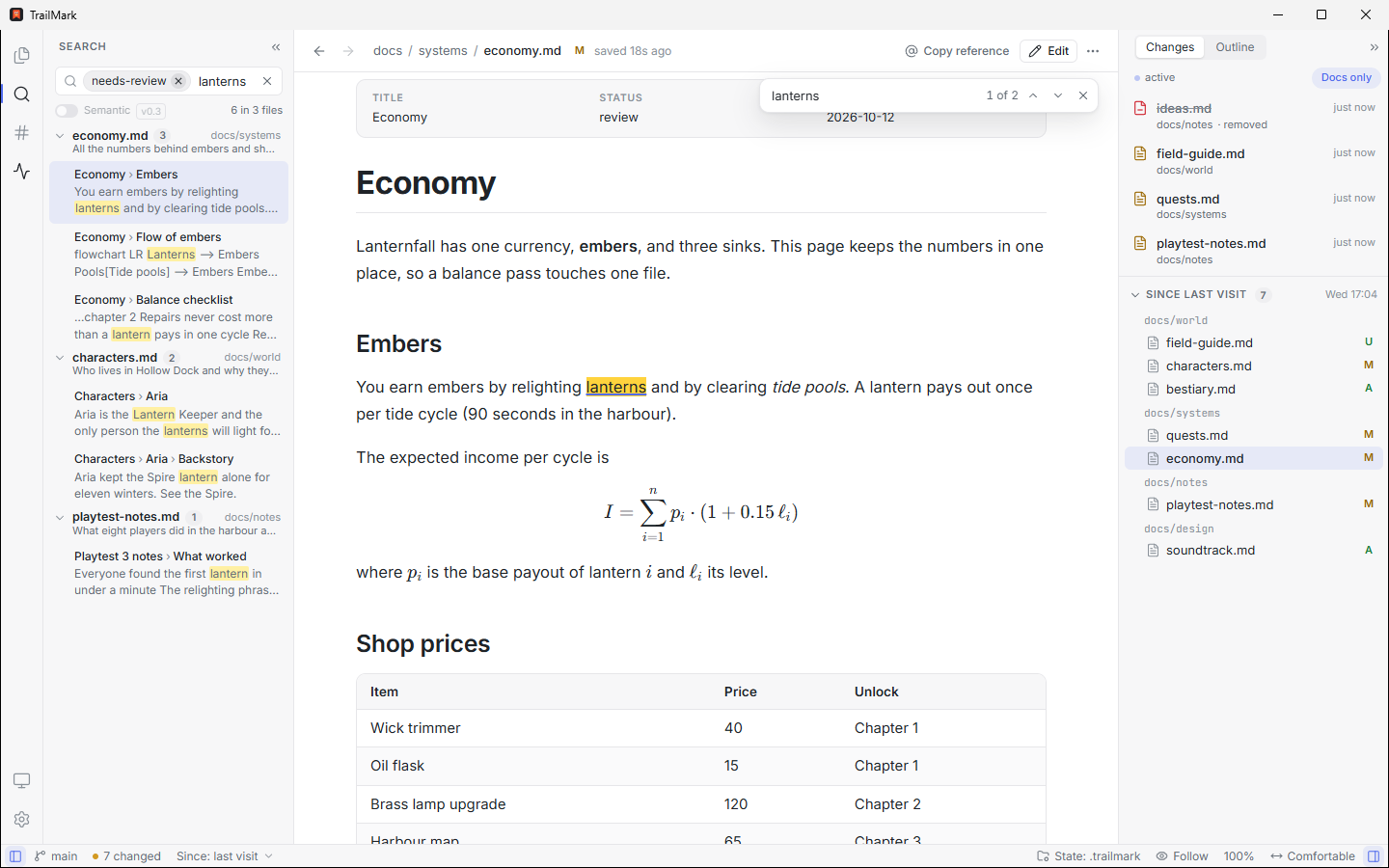
- Search everywhere (
Ctrl+T): files, sections, tags and commands in one box.Tabmoves between scopes,>jumps tocommands and#to sections;Ctrl+Shift+Popens the command list with every action of the app and its shortcut - Section-level full-text search (
Ctrl+Shift+F): results showfile › heading › snippetand jump to the exact spot - Accent- and case-insensitive, with light stemming, and incremental updates as files change
- Filter by tag right in the search box (
tag:needs-review retry policy) - Semantic search with a local multilingual model is planned for v0.6 (see the roadmap)
🏷️ Tags and descriptions
- Give any file a one-line description and tags ("needs-review", "character sheets"). Tags in a document's frontmatterare read automatically; the ones you add in the app never touch your files
- Added tags live in
.permark/meta.tomlonce the project is initialized (plain text you can commit, so teammates and agentscan read it), or in the app's own storage before that. Renaming or moving a file keeps its tags - A Tags view (
Ctrl+Shift+T) lists every tag with its number of files. Pick one, orCtrl+clickseveral to narrow the list - Descriptions and tags show up where you look for files: tree tooltips, quick open, search results
- Give a tag a color and an icon (right-click it in the Tags view) to see at a glance what kind of document you are in front of
- Your agent uses them too, to find the right documents in a large project without reading hundreds of search hits: it asks which tagsthere are (
list_tags), narrows a search to the documents that carry them, and reads only the few that fit
✏️ Edit without fear
- One switch in the header, Read | Visual | Source, goes to any mode in one click and keeps your place and your unsaved work. Visual is aWYSIWYG editor with a toolbar, a
/block menu, tables, task lists and code blocks (with a language picker that searches every languageand takes any text you type); Source is a Markdown editor with highlighting, also inside code fences, and line numbers.Ctrl+Etoggles Read and the editor you used last,Ctrl+Alt+Etoggles Visual and Source. Both editors are loaded onlywhen you start editing - Only the blocks you changed are rewritten. Every other byte of the file stays as its author (or agent) wrote it, including lineendings and a byte-order mark. A block you edited carries a bar in the margin until you save, and the status bar counts them
- Blocks the visual editor can't write back faithfully (front matter, raw HTML, math, diagrams, footnotes) stay as they are,with an Edit in Source button that opens the Markdown at that block
- Agents and you can share a file safely. If something changes the file while you edit, a clean buffer reloads in place, andone with your edits asks: Reload theirs or Keep mine. A save never overwrites a version you haven't seen
- Unsaved work is never lost quietly: a mark in the header and the tree, a
*in the window title, and a Save / Discard / Keep editingprompt before you leave - New file (
Ctrl+N): type a name in the tree, and it opens for editing with the caret after the title - Images pasted, dropped or picked are saved next to the document in an
assets/folder and linked with a relative path
🔗 File operations that keep your links working
- Rename (
F2), move (drag and drop, orCtrl+X/Ctrl+V), delete (Del, to the system trash, after asking) andNew folder, from the keyboard, the context menu or the[:]menu. Select several files withCtrl+clickorShift+click - Links are updated for you. Moving or renaming a file or folder rewrites the links and images that point to it, and therelative links inside the files that move. "Update 7 links in 4 files?" shows every change first: Apply, Move withoutupdating or Cancel. Only the destination changes; code is never touched
- Undo (
Ctrl+Zin the Explorer, or the toast's Undo button) puts back the files and every rewritten link. It is conservative:a document that changed since is not overwritten, and you're told what couldn't be restored - Tags follow the files, and the live feed shows the whole operation as one row
🌿 Git-aware
- Badges for modified, added and untracked files, with folder roll-up and a legend that says what each letter means
- Baseline "since your last visit" (default) or "since HEAD": useful when agents commit every few minutes
- Banner for rebase or merge in progress; clear messages when git can't read a repo
🔁 Close the loop with your AI
- Copy reference (
@docs/plan.md) and copy selection with reference: a quoted excerpt plus path and section,ready to paste into any AI chat or CLI - Configurable reference template
- Comments: select a passage, press
Cand write a comment; your agent can read the open ones and mark them done(see Use with an AI agent)
📝 Notes
Open PerMark, type, close: nothing to name, nothing to save, no folder to pick.
- A notes window of its own (
Ctrl+Shift+D, or the sticky-note icon in the activity bar, or Notes on the welcome screen).Ctrl+Shift+Nstarts a new note from any PerMark window, in the Visual editor with the caret ready. From the welcome screen the window itself turnsinto the Notes window, in the same place and size, so there is never a second window to close. A note is a plain Markdown file inDocuments/PerMark Notes(change it in Settings → Notes); PerMark makes the default folder by itself the first time. A note's nameis the date and time (2026-10-15 1432.md) and its title is its first line, until then "Untitled note" - A new note is there at once, and
+(orCtrl+Shift+N) always makes another, even when the note on screen is still empty. Empty notesstay in the list, also after a restart, until you delete them: nothing is removed for you - Saved as you type: 750 ms after you stop, and at least every 3 seconds. Switching notes, leaving the window or closing it saves too, and closingnever asks. Each note remembers its mode and where you were. PerMark writes nothing inside a note's text, and never overwrites a versionit has not seen: if something else changed the file, your text is kept next to it as a "(conflict ...)" copy
- Pinned notes first, then Today, Yesterday, This week, This month and Older. A note moves up when you leave it, not while you type.Pin a note and put it where you want it (drag, or
Alt+↑/Alt+↓);Ctrl+1…9jump to the pinned ones. The filter box andCtrl+P,Ctrl+TandCtrl+Shift+Fsearch the notes - Copy (
Ctrl+Shift+C) puts the exact Markdown of the note on the clipboard and marks it, with a Delete note button right in the toast,for the prompts and snippets you write only to paste. Delete copied notes clears the marked ones and keeps the pinned. In a project,Ctrl+Shift+Ccopies the whole open document - Deleting is gentle: the note goes to the system trash, the toast has Undo, and a pinned note asks first. Show earlier versions restoresan earlier text of the note (one is kept at the first save after you open a note and about every 10 minutes after, for 30 days)
- Files from anywhere join the list under Files: open a Markdown or text file with "Open with PerMark", with
Ctrl+Shift+O, or bydropping it on the Notes window (a file inside the project you have open still opens in that project). A file is never written on its own: itopens in Read,Eedits it, andCtrl+Ssaves it. What you type before you save is kept apart from the file and comes back after arestart, with an "unsaved" mark; closing the window asks nothing. If the file changes on disk while it is open, what you see stays until youchoose Reload (your typed text is kept as a note first) or Keep mine (the next save asks once more before it replaces the version ondisk). A file that is not found stays in the list, dimmed, with Locate... and Remove from list, and a rename in its folder is followed.Text files (.txt) are edited in Source. Removing a file from the list never touches the file - Move to project... (
Ctrl+Shift+S) is for a note that grew into a document: the Save dialog opens in the project you used last, with a name madefrom the title; the note is written there exactly as it is, goes to the system trash, and its row moves to Files. The toast hasOpen in project and Undo (which brings the note back, and takes the copy away unless you changed it since) - Share with agents marks a note that an AI agent connected to any of your projects may read (seeWhat an agent can do); a small mark shows it in the list and in the header. Notes you did not share stay private
- Rename (
F2) gives a note a real file name, and Open notes folder shows it in your file manager. Notes are ordinary files: edit themwith any tool, and PerMark picks the change up. Another PerMark process can't write to the same notes at once (the second one opens read-only) - A notes folder you chose that goes missing (an unplugged drive, a renamed folder) is reported, with Locate... and Create it: PerMarknever makes an empty one in its place by itself, which would split your notes in two
- On start (Settings → Notes) can open the Notes window instead of the welcome screen
🗂️ Zero footprint by default
PerMark keeps its state in your user profile. If you want settings and tags to travel with the project, runInitialize PerMark in this project to create a .permark/ folder (shared config.toml and meta.toml; caches are gitignored automatically).
🖱️ Open with PerMark
Windows: right-click a folder, the background of a folder or a Markdown file and choose Open with PerMark (under Show more options onWindows 11). You can also list PerMark in the Open with menu of .md files. Both are optional: pick them in the installer or later inSettings → File manager, which adds and removes them at once. PerMark never sets itself as your default app; Make default... takes you to theWindows page where you do. Nothing needs administrator rights, and uninstalling removes every entry.The Microsoft Store version has the same entry on folders and on the background of a folder, and on Windows 11 it is in the mainright-click menu, not under Show more options. The package provides it (and the Open with entry for Markdown files), sothere are no switches for it in Settings, and uninstalling the app removes it.
macOS: PerMark is listed in Finder's Open With for Markdown files, without becoming the default, and a folder dropped on itsDock icon opens as a project. Linux: the .deb and .rpm list PerMark under Open With for Markdown files.
🌍 Your language
PerMark speaks English, Português (Brasil), Español, Deutsch, 简体中文 and Italiano. It follows your system's language, and Settings → Languageswitches it at once, no restart. The Windows installer asks for a language too.
Install
Prebuilt installers for Windows, macOS and Linux are published on the Releases page.PerMark updates itself: when a new version is out, you'll be offered a one-click restart to update.
On Windows you can also get it from the Microsoft Store, which keeps it up to date.
Build from source (requires Rust, Node.js 20+ and theTauri prerequisites):
git clone https://github.com/EdelmarSchneider/permark.git
cd permark
npm install
npm run tauri build
Usage
permark                  # welcome screen with recent projects
permark .                # open the current folder in IDE mode
permark docs/plan.md     # open a single file in simple mode
You can also drag and drop a folder or a .md file onto the window.
Use with an AI agent
PerMark can tell an AI agent what you are looking at, the way a code editor tells it the open file. Say "rewrite thisparagraph" or "go through my comments" and the agent knows which document, which section and which words you mean. It talks toPerMark through the Model Context Protocol (MCP), so it works with any tool that supports MCP(Claude Code, Cursor, opencode, Codex, Gemini CLI, Claude Desktop and others), and without one of them nothing changes.
It is off by default, per project, and local. PerMark shares nothing until you turn it on in Settings → Agent connection (orAgent connection: turn on in the command palette), and it only talks to programs on your computer: it has no server and sendsnothing over the network. The agent you connect is another matter. It may send what it reads (your selection, your comments, searchresults) to its AI service, as it would anything else you show it. The switch is yours alone: it is kept in PerMark's own datafolder, so nothing inside a project, such as a cloned repository, can turn it on. While it is on, the status bar shows Agent, witha dot that fills while an agent is connected. Click it to see what is shared and what was asked lately, and to turn it off in one click.
Connect an agent
Turn the connection on, then add PerMark to your agent as an MCP server. Settings → Agent connection shows the lines below withthe right path filled in, and a Copy button for each.
Claude Code
claude mcp add permark -- "<path to PerMark>" mcpAny other MCP client (Cursor, Claude Desktop, ...): add this to its MCP servers configuration.
{
  "mcpServers": {
    "permark": { "command": "<path to PerMark>", "args": ["mcp"] }
  }
}
<path to PerMark> is the full path of the program, which Settings shows for the copy you are running: the program theinstaller put on your machine, the one inside PerMark.app on macOS, or the AppImage file. Use the full path: on Windows andmacOS permark is not on your PATH after an install, so the bare name only works where you put it there yourself. (The MicrosoftStore version on Windows is the exception: it puts permark on your PATH, so there Settings shows the short lines, such asclaude mcp add permark -- permark mcp.) Quote the path when it has spaces. The agent runs in your project's folder, and PerMark finds the project from it, so oneconfiguration serves every project you have opened in PerMark. Before it sends anything, permark mcp checks that what answersis PerMark running as you, and not another program that took the name.
What an agent can do
| Tool | What it answers or does |
|---|---|
get_context |
The open document, whether you are reading or editing, the section on screen, your selection (up to 4,000 characters) and whether there are unsaved edits |
list_unread |
The documents that changed since you last read them, newest first |
search |
"Where is X described?": ranked sections with path, headings, line and a snippet, from the same index as Search everywhere. Each hit carries its document's tags and description, and tags narrows the search to the documents that have all of them |
list_tags |
The tags in use, with how many documents have each and whether they come from the documents or from PerMark, plus how many documents have no tag; or, for one tag, the documents that have it with their descriptions |
list_comments |
Your comments: the open ones, each with the quoted passage, its section and line, and your text |
resolve_comment |
Marks a comment done, with an optional short reply that you read under the comment |
open |
Shows you a place (a document, a line or a heading) without taking the focus from the agent's terminal, and offers a way back |
list_notes |
The notes you chose to share with agents, each with its title, when it changed and its size |
read_note |
The text of one shared note, by the name list_notes gave |
The agent only reads, shows you a place, and checks off comments you wrote. It cannot create comments and it cannot edit a document throughPerMark. It sees the project you opened and nothing else: no other project, no file outside the project folder. Your notes are private:the agent sees only the notes you shared one by one (Share with agents in a note's menu, Stop sharing takes it back at once), throughlist_notes and read_note, in any project whose connection is on; it cannot list the notes folder, read a note you did not share, or changeone, and a notes folder that lies inside a project is not part of that project's search. When PerMark isclosed, list_unread, search, list_tags, list_comments, resolve_comment, list_notes and read_note still work from the files, get_context says thatPerMark is not open, and open starts it. With the connection off, every tool says so and explains how to turn it on.
Add what you are reading to every prompt
permark context prints where you are as one short line and exits, for tools that can run a command before each prompt:
Viewing docs/plan.md › Plan › Rollout (lines 40-62), selected (lines 44-46): 'ship it on Friday'.
In Claude Code, a UserPromptSubmit hook in .claude/settings.json (or your user settings) adds it to every prompt:
{
  "hooks": {
    "UserPromptSubmit": [
      { "hooks": [{ "type": "command", "command": "\"<path to PerMark>\" context" }] }
    ]
  }
}
Other tools can do the same from their own hooks. When there is nothing to say (the connection is off, or PerMark is not open), thecommand prints nothing, so a hook never adds noise to a prompt. A project that keeps its settings in .permark/ also has.permark/local/agent.json while the connection is on: the same answer as a file, for a script or a tool without MCP. It holdsthe open document, the section on screen and your selected text, and any program running as you can read it, as can a folder-sync toolthat watches the project. It stays out of git (local/ ignores itself) and is deleted when the connection is turned off.
Comments
Select a passage while you read and press C (or choose Comment in the selection toolbar), type a comment and press Enter. A thinbar marks the passage in the margin, and the Comments tab of the right panel lists the open comments by document, with the ones youfinished folded away. A click on a comment goes to its passage. Check a comment off yourself, or ask your agent to "go through my comments":it reads them with list_comments, and when it marks one done its reply appears under the comment.
Comments follow their passage when the document changes: they are found again by their words, then by their section, then by theirline. A comment whose passage was rewritten stays in the list marked Passage changed. Comments are yours, kept next to the other localstate (.permark/local/comments.json once you initialize PerMark in the project, otherwise in your user profile), never committed (the folder ignores itself),and they work without the agent connection.
Keyboard shortcuts
On macOS, use Cmd where this table says Ctrl.
Reading and navigating
| Action | Shortcut |
|---|---|
| Search everywhere (files, sections, tags, commands) | Ctrl+T |
| Quick open file | Ctrl+P |
| Commands | Ctrl+Shift+P |
| Search all docs (by section) | Ctrl+Shift+F |
| Find in page | Ctrl+F |
| Show the Explorer / the Tags view | Ctrl+Shift+X / Ctrl+Shift+T |
| Show the Outline (press again to go back) | Ctrl+Alt+O |
| Cycle the reading width | Ctrl+Alt+W |
| Toggle left / right panel | Ctrl+B / Ctrl+Alt+B |
| Next / previous change | F7 / Shift+F7 |
| Next unread document | Alt+U |
| Follow mode | Ctrl+Shift+L |
| Back / forward | Alt+← / Alt+→ |
| Copy reference (or selection with reference) | Ctrl+Alt+C |
| Edit tags and description | T |
| Leave a comment on the selected passage | C |
| Zoom in / out / reset (on a picture: zoom it, or fit it to the window) | Ctrl+= / Ctrl+- / Ctrl+0 |
Editing
| Action | Shortcut |
|---|---|
| Start editing, in the editor you used last | E or Ctrl+E |
| Done (back to reading) | Ctrl+E or Esc |
| Switch between Visual and Source (from reading: the editor you did not use last) | Ctrl+Alt+E |
| Save | Ctrl+S |
| New file | Ctrl+N |
| Bold / italic / strikethrough | Ctrl+B / Ctrl+I / Ctrl+Shift+X |
| Link / inline code | Ctrl+K / Ctrl+` |
| Headings 1 to 4 / paragraph (Visual) | Ctrl+Alt+1 … 4 / Ctrl+Alt+0 |
| Block menu (Visual) | / in an empty paragraph |
Notes
| Action | Shortcut |
|---|---|
| New note (from any PerMark window) | Ctrl+Shift+N |
| Show the Notes window | Ctrl+Shift+D |
| Copy the note's text (in a project: the open document) | Ctrl+Shift+C |
| Open a pinned note | Ctrl+1 … 9 |
| Open a file (listed under Files) | Ctrl+Shift+O |
| Save a file you opened (a note saves itself) | Ctrl+S |
| Move the note into a project | Ctrl+Shift+S |
| Next / previous note | Ctrl+Tab / Ctrl+Shift+Tab |
| Move the selected pinned note up / down | Alt+↑ / Alt+↓ |
| Rename the note / delete it | F2 / Del |
In the Explorer
| Action | Shortcut |
|---|---|
| Rename | F2 |
| Delete (asks first) | Del |
| Cut / paste to move | Ctrl+X / Ctrl+V |
| Select several files | Ctrl+click / Shift+click |
| Undo the last file operation | Ctrl+Z |
Roadmap
v0.2: the Markdown IDE (released)
- Tags and descriptions, the Explorer filter, reading widths, an Explorer that follows the open file, and the Outline
- A visual and a source editor with block-preserving saves, safe sharing of a file with agents, new files and images
- File operations (rename, move, delete) that update links and can be undone
v0.2.1: your language (released)
- Português (Brasil), Español and Deutsch, "Open with PerMark" in the Windows file manager, one Read | Visual | Source switch,a window that remembers its place, and an Explorer for workspaces of several repositories
v0.3 (released)
- Search everywhere (
Ctrl+T): files, sections, tags and commands in one box - Unread markers ("changed since I last read it") and clickable code references (
src/main.rs:42) - "Open with PerMark" in the macOS and Linux file managers (Windows has it already)
v0.4: your agent sees what you see (released)
- An optional, local connection (MCP, plus a plain file for tools without it) that lets any coding agent know which document andsection you are reading and what you selected, so "rewrite this paragraph" just works
- Comments: leave them on passages while you read, and your agent picks up the open ones
- Your agent can ask PerMark "where is X described?" and point you to a section, and it knows what you have not read yet.Off by default, per project, and read-only: an agent can show you a document, never edit through it
v0.5: Notes (released)
- Open PerMark, type, close: notes save themselves, with no name to choose and no folder to pick. Keep a sticky note formonths, draft a prompt and copy it to your agent, and open loose Markdown files from anywhere, with changes on disk detected
- v0.5.2: pictures, audio and video open in the pane, code blocks are highlighted for about 190 languages, and foldersshow up in Quick open
- v0.5.6: TrailMark is now PerMark: a new name, the same app, and nothing lost on the way
- v0.5.5: tags with colors and icons, tags as your agent's index (
list_tags, tag filter insearch), a folder switcher, the navigation trail, and Open in browser for web pages - v0.5.4: the interface in Italiano (Italian), soft light tones (Paper, Sage, Gray), and the Git letters explained in plain words
- v0.5.3: the interface in 简体中文 (Simplified Chinese), and search that finds Chinese and Japanese words inside sentences
v0.6
- Semantic search with a local, offline, multilingual model, so "retry policy" finds the section that describes it whatever words it uses.Your agent gets the same search
Later, no promises
- Spec-driven workflows
- A rendered diff against the last commit or your last read, rich JSON and XML views, backlinks, and installer extras(
permarkon thePATH)
Tech
PerMark is a Tauri 2 app. The core is written in Rust: rendering (comrak + ammonia), file watching(notify), git (libgit2), the search index and the block-preserving saves. The UI is Svelte 5 + TypeScript running in the systemwebview, with CodeMirror 6 (Source editor) and Milkdown (Visual editor). That keeps the installer small and memory uselow compared to Electron apps.
Contributing
Issues and pull requests are welcome. The project uses git-flow (develop for integration, feature/* branches) and a strictquality gate:
npm run check # rustfmt, clippy -D warnings, cargo test, svelte-check, vitest
Design notes are in docs/design/. See CONTRIBUTING.md before opening a pull request.
License
Copyright (c) 2026 Edelmar Schneider. Licensed under either of MIT or Apache-2.0, at your option.
"PerMark" and its logo are trademarks of Edelmar Schneider: forks are welcome under a different name. See TRADEMARKS.md.


