
dynu-mcp
MCP server for Dynu — a Dynamic DNS, domain registration, emailhosting, and cloud compute (VPS) provider. Exposes the full public DynuREST API v2 as MCP tools.
MSPbots Connector
The MCP Gateway built for MSPs: visible, controlled, and your data stays where it belongs.
MSPbots Connector gives your AI clients one MCP URL to reach your entire MSP stack (RMM, PSA, documentation, security, finance), and gives you control over who can call which tool and a record of everything that was called.
Hosted service: connect.mspbots.ai · Free to use.
Why Connector
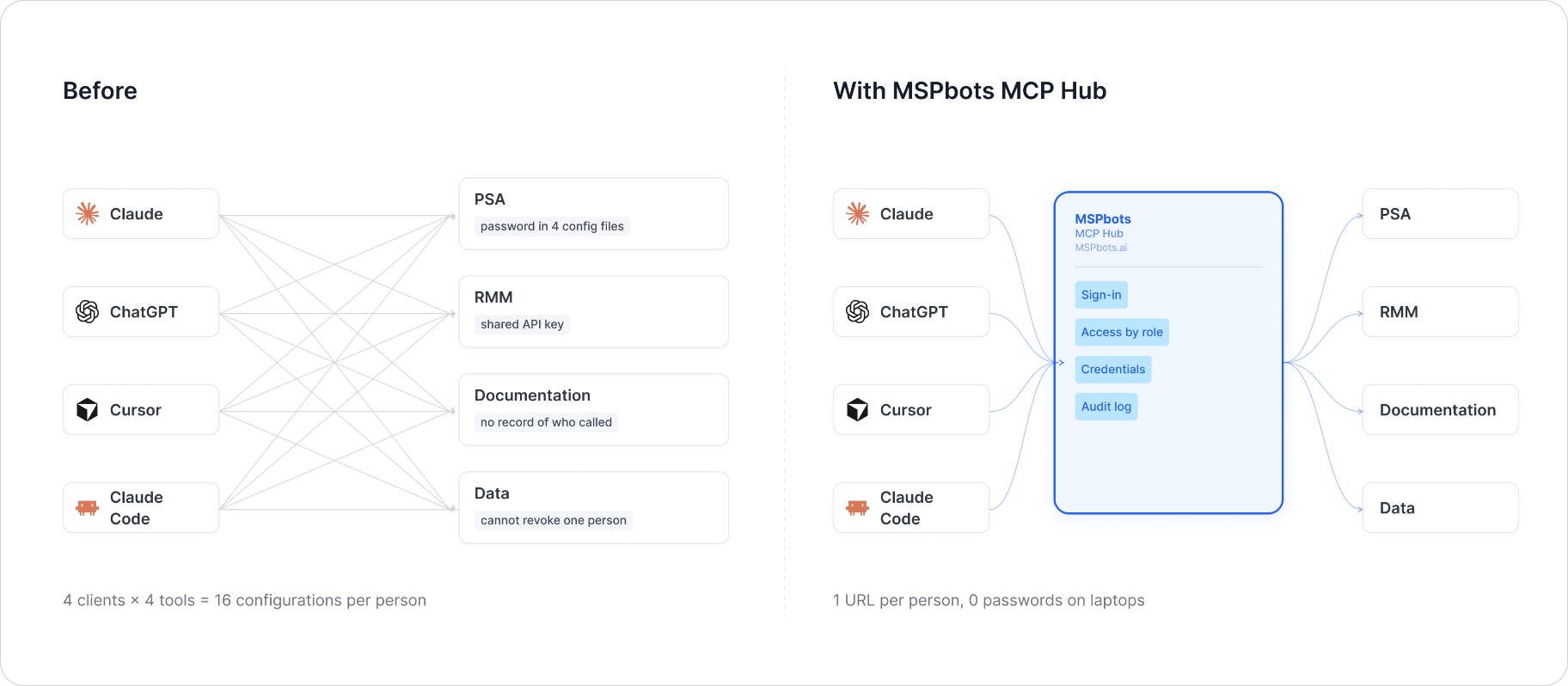
| Visible | Every tool call is logged: who, which vendor, when. Usage dashboard, CSV export, SIEM streaming. |
| Controlled | Role-based, per-tool allowlist. Deny by default. |
| Protected | Credentials encrypted per record. AI clients never see your vendor passwords or tokens. |
| MSP-native | Built for the MSP stack only: RMM, PSA, documentation, security, finance. |
Quick start
- Sign up at connect.mspbots.ai.
- Connect your vendors. Pick from 150+ connectors and authorize each one on the vendor's own page, or bring your own API keys. No extra vendor accounts needed.
- Set access. Create roles and decide which tools each role may call. Nothing is allowed until you allow it.
- Add your MCP URL to your AI client. Copy the URL from your Connector dashboard into Claude, ChatGPT, Cursor, VS Code, Gemini, Codex, or any MCP-capable client.
- Ask your AI to do real work, and watch every call appear in the audit log.
Features
Unified gateway
- One MCP URL for all your AI clients
- 150+ connectors across the MSP stack
- Custom MCP servers supported, free
- Authorization happens on each vendor's own page; the AI never sees passwords or tokens
- Bring your own credentials: use the vendor API keys you already have
- Multiple accounts per app; connect once, reuse across AI clients
- Tool search: finds the right action for the task
- One sign-in; vendor credentials are injected behind the scenes and OAuth tokens refresh automatically
Visibility
- Audit log for every tool call (who, which vendor, when)
- Usage dashboard: call volume, top vendors, error rate, per-user activity
- Export audit logs to CSV, or stream to Loki, Graylog, or LogScale (SIEM)
- Optional recording of tool arguments and result summaries (off by default, enabled per organization)
Control
- Per-role, per-tool allowlist, deny by default
- owner / admin / member roles
- SCIM provisioning with Entra ID, Okta, JumpCloud, and Google Workspace
Security
- Credentials encrypted one record at a time (AES-256-GCM, per-record key)
- AI clients authenticate with OAuth 2.1 + PKCE
- Vendor responses are scanned for prompt-injection patterns and returned as structured data. This is one layer of defense, not a guarantee against every attack.
- Static egress IP for customer firewall and API allowlisting
Pricing
Free.
Links: connect.mspbots.ai · mspbots.ai
Overview
- Stateless HTTP service. No credentials are ever persisted — each requestsupplies its own API key via a header, used only for the lifetime ofthat single request.
- Supports concurrent requests; per-request credential isolation is donevia Python
contextvars, not a global/shared client instance. - Entry points:
POST /mcp(MCP protocol) andGET /health(health check). - Default port:
8080(configurable viaMCP_HTTP_PORT).
Scope
30 tools, trimmed down from an initial 117-tool build covering Dynu'sfull OpenAPI 3.0 spec. The platform this MCP runs behind aggregates everyenabled vendor MCP's tools into a single Gemini/Vertex model call, whichcaps out at 512 total function declarations — with 50+ vendor MCPsregistered, each one needs to stay lean. Kept, across the same 6categories: dns (8 — MSPbots' real GET /dns endpoint plus corerecord/service CRUD), email (7 — service list/detail, accountcreate/read/update/delete), compute (4 — instance list/detail/start/stop),domain (2 — list/detail), monitor (7, full category), ping (2, fullcategory). Cut entirely: domain registration administration (gluerecords, name servers, auto-renewal, lock/unlock), email'sblacklist/whitelist/alias/distribution-list/DKIM management, and compute'sbackup/snapshot/VNC/reinstall operations — see Known Gaps. MSPbotsitself only calls 1 endpoint (GET /dns), which is kept.
Authentication
Dynu authenticates with a single static API key (found in the APICredentials area of the Dynu control panel). MSPbots' own integrationconvention sends this key as the raw value of the API-Key header, andthis server forwards it exactly that way.
HEADER Authorization Parameters
| Header | Type | Required | Default | Allowed values | Description | Example |
|---|---|---|---|---|---|---|
X-Dynu-Api-Key |
string | Yes | None | None | Static Dynu API Key, forwarded as-is as the upstream API-Key request header |
a1b2c3d4e5f6g7h8i9j0k1l2m3n4o5p6 |
Missing the header returns 401:
{
  "error": "Missing credentials",
  "message": "This server requires the X-Dynu-Api-Key header",
  "required_headers": ["X-Dynu-Api-Key"],
  "optional_headers": []
}
Environment Variables
| Variable | Type | Required | Default | Description |
|---|---|---|---|---|
MCP_HTTP_PORT |
int | No | 8080 |
HTTP listen port |
MCP_HTTP_HOST |
string | No | 0.0.0.0 |
HTTP listen address |
DYNU_BASE_URL |
string | No | https://api.dynu.com/v2 |
Dynu API base URL |
MCP Endpoint
POST /mcp— MCP protocol (streamable HTTP transport)GET /health— health check, returns{"status": "ok"}(pure local liveness probe, does not depend on the Dynu API)
Tool List
Tool names are derived from each operation's own summary in the vendor'sOpenAPI spec (e.g. "Get a list of domains for DNS service" →dynu_get_list_domains_dns_service); the one naming collision (bothGET /ping and POST /ping share an identical summary) is disambiguatedwith a _get/_post suffix. body parameters for POST operations areaccepted as a generic dict — see the vendor's OpenAPI spec's Modelssection (linked below) for the exact field names/types of each resource.
| Category | Tool | Description | Method + Path | Parameters |
|---|---|---|---|---|
| dns | dynu_add_new_dns_record_dns_service |
Add a new DNS record for DNS service. | POST /dns/{id}/record | id(required), body(required, dict) |
| dns | dynu_add_new_dns_service |
Add a new DNS service. | POST /dns | body(required, dict) |
| dns | dynu_get_details_dns_record_dns_service |
Get details of a DNS record for DNS service. | GET /dns/{id}/record/{dnsRecordId} | id(required), dns_record_id(required) |
| dns | dynu_get_details_domain_dns_service |
Get details of a domain for DNS service. | GET /dns/{id} | id(required) |
| dns | dynu_get_list_dns_records_dns_service |
Get a list of DNS records for DNS service. | GET /dns/{id}/record | id(required) |
| dns | dynu_get_list_domains_dns_service |
Get a list of domains for DNS service. | GET /dns | |
| dns | dynu_remove_dns_record_dns_service |
Remove a DNS record from DNS service. | DELETE /dns/{id}/record/{dnsRecordId} | id(required), dns_record_id(required) |
| dns | dynu_update_existing_dns_record_dns_service |
Update an existing DNS record for DNS service. | POST /dns/{id}/record/{dnsRecordId} | id(required), dns_record_id(required), body(required, dict) |
| domain | dynu_get_details_domain_registration_domain |
Get details of a domain registration domain. | GET /domain/{id} | id(required) |
| domain | dynu_get_list_domains_domain_registration_service |
Get a list of domains for domain registration service. | GET /domain | |
dynu_add_new_email_account_email_service |
Add a new email account for email service. | POST /email/{id}/account | id(required), body(required, dict) | |
dynu_get_details_email_account |
Get details of the email account. | GET /email/{id}/account/{accountId} | id(required), account_id(required) | |
dynu_get_details_email_service |
Get details of an email service. | GET /email/{id} | id(required) | |
dynu_get_list_email_accounts_email_service |
Get a list of email accounts for email service. | GET /email/{id}/account | id(required) | |
dynu_get_list_email_services |
Get a list of email services. | GET /email | ||
dynu_remove_email_account_email_service |
Remove an email account from email service. | DELETE /email/{id}/account/{accountId} | id(required), account_id(required) | |
dynu_update_existing_email_account_email_service |
Update an existing email account for email service. | POST /email/{id}/account/{accountId} | id(required), account_id(required), body(required, dict) | |
| compute | dynu_get_instance |
Get an instance. | GET /compute/instance/{id} | id(required) |
| compute | dynu_get_list_instances |
Get a list of instances. | GET /compute/instance | |
| compute | dynu_start_instance |
Start an instance. | GET /compute/instance/{id}/start | id(required) |
| compute | dynu_stop_suspend_instance |
Stop (suspend) an instance. | GET /compute/instance/{id}/stop | id(required) |
| monitor | dynu_add_new_monitor |
Add a new monitor. | POST /monitor | body(required, dict) |
| monitor | dynu_delete_monitor |
Delete a monitor. | DELETE /monitor/{id} | id(required) |
| monitor | dynu_get_details_monitor |
Get details of a monitor. | GET /monitor/{id} | id(required) |
| monitor | dynu_get_list_monitors |
Get a list of monitors. | GET /monitor | |
| monitor | dynu_limits_associated_monitoring |
Limits associated with monitoring. | GET /monitor/limit | |
| monitor | dynu_pause_monitor |
Pause a monitor. | GET /monitor/{id}/pause | id(required) |
| monitor | dynu_unpause_monitor |
Unpause a monitor. | GET /monitor/{id}/unpause | id(required) |
| ping | dynu_ping_api_server_obtain_pong_response_get |
Ping the API server to obtain the pong response. | GET /ping | message(required) |
| ping | dynu_ping_api_server_obtain_pong_response_post |
Ping the API server to obtain the pong response. | POST /ping | body(required, dict) |
Test Example
# Health check
curl -s http://localhost:8080/health

# Call a tool via the MCP protocol (streamable HTTP) — requires an
# initialize handshake first per the MCP spec; abbreviated example below
# shows the tool-call request body only:
curl -s -X POST http://localhost:8080/mcp   -H "X-Dynu-Api-Key: <your-dynu-api-key>"   -H "Content-Type: application/json"   -H "Accept: application/json, text/event-stream"   -H "mcp-session-id: <session-id-from-initialize>"   -d '{
    "jsonrpc": "2.0",
    "id": 1,
    "method": "tools/call",
    "params": {
      "name": "dynu_get_list_domains_dns_service",
      "arguments": {}
    }
  }'
Live-verified (2026-07-29): dynu_get_list_domains_dns_service (thesame endpoint MSPbots itself calls, zero parameters) was called end-to-endthrough this running server with a real API key and returned real DNSdomain records for the account.
API Reference
- Overview: https://www.dynu.com/Support/API
- Official OpenAPI 3.0 spec (Swagger): https://www.dynu.com/files/dynu.api/Dynu.API.OAS.zip
Known Gaps
- Trimmed from 117 to 30 tools, by explicit user decision: the platformthis MCP runs behind aggregates every enabled vendor MCP's tools into asingle Gemini/Vertex model call, which caps at 512 total functiondeclarations — with 50+ vendor MCPs registered, each needs to stay lean.Kept: MSPbots' real
GET /dnsendpoint, core DNS record/service CRUD (8),core email service/account CRUD (7), basic compute instancelist/detail/start/stop (4), domain list/detail (2), and Monitor/Ping infull (9). Cut entirely: domain registrar administration (glue records,nameservers, auto-renewal, lock/unlock/cancel), email'sblacklist/whitelist/alias/distribution-list/DKIM management, and compute'sbackup/snapshot/VNC/reinstall/password-change operations. Any of these canbe re-added on request if a real use case needs them. - Compute and domain write operations remain higher-stakes even aftertrimming —
dynu_start_instance/dynu_stop_suspend_instanceact on realVPS instances. Treat these as destructive/irreversible and confirmwith a human before invoking. bodyparameters are untyped (dict) rather than fully modeled —the OpenAPI spec's Models section defines the exact schema per resource(e.g.DNS.dnsRecordA), but reproducing all of them as typed Pythonparameters was out of scope. Callers should shape thebodydict per thelinked spec.- Only
dynu_get_list_domains_dns_service(MSPbots' own endpoint) waslive-verified with real account data. The remaining 29 tools arestructurally correct (schema validated, MCP-protocoltools/listconfirmed, tool count re-verified after trimming) but not individuallysmoke-tested — several are write/destructive operations that wouldcreate, modify, or delete real DNS records, email accounts, or VPSinstances, so they weren't exercised against the live test account.


