
webroot-mcp
MCP server for Webroot (OpenText endpoint security / SecureAnywhere,managed via the Global Site Manager "GSM" console). Exposes the WebrootUnity API's GSM console sites, endpoints, groups, policies, threathistory, real-time agent status, and DNS Protection (DNSP) methods as MCPtools.
MSPbots Connector
The MCP Gateway built for MSPs: visible, controlled, and your data stays where it belongs.
MSPbots Connector gives your AI clients one MCP URL to reach your entire MSP stack (RMM, PSA, documentation, security, finance), and gives you control over who can call which tool and a record of everything that was called.
Hosted service: connect.mspbots.ai · Free to use.
Why Connector
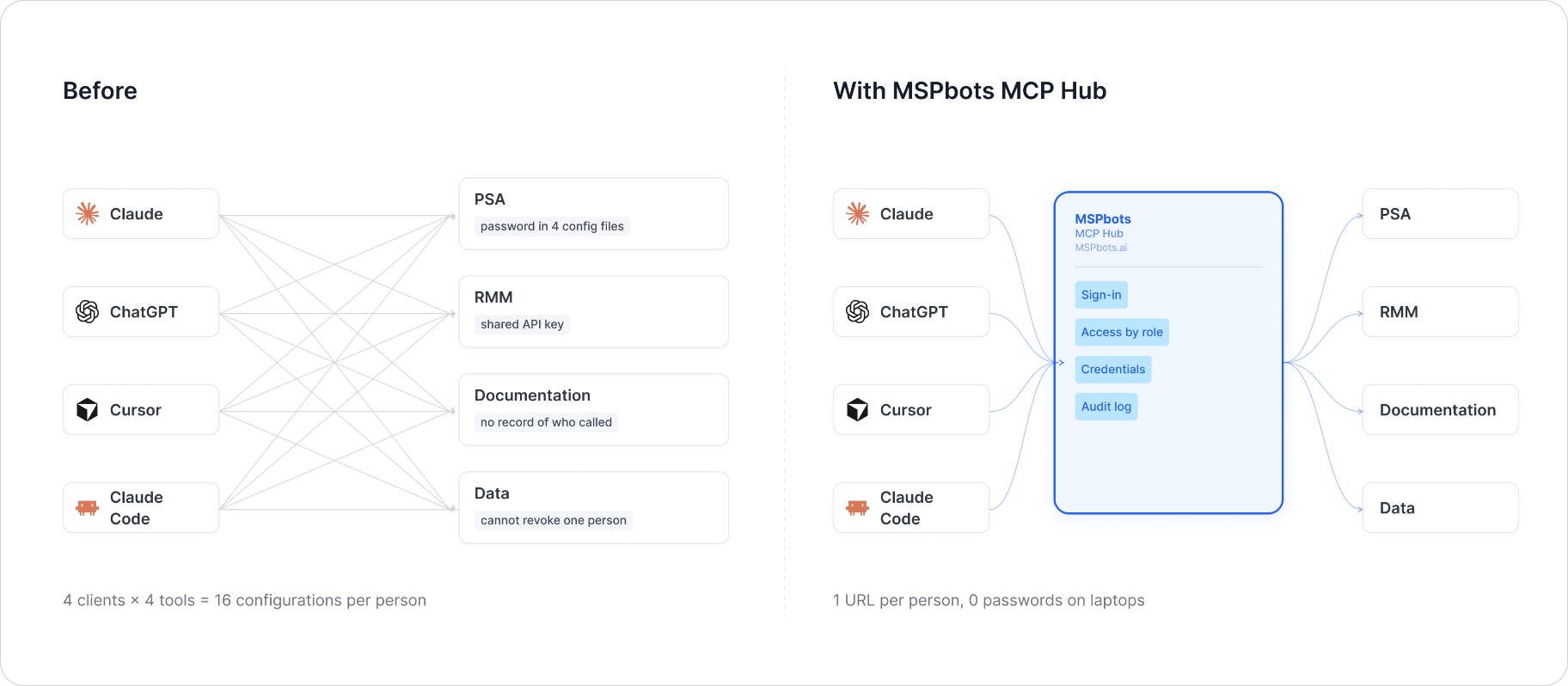
| Visible | Every tool call is logged: who, which vendor, when. Usage dashboard, CSV export, SIEM streaming. |
| Controlled | Role-based, per-tool allowlist. Deny by default. |
| Protected | Credentials encrypted per record. AI clients never see your vendor passwords or tokens. |
| MSP-native | Built for the MSP stack only: RMM, PSA, documentation, security, finance. |
Quick start
- Sign up at connect.mspbots.ai.
- Connect your vendors. Pick from 150+ connectors and authorize each one on the vendor's own page, or bring your own API keys. No extra vendor accounts needed.
- Set access. Create roles and decide which tools each role may call. Nothing is allowed until you allow it.
- Add your MCP URL to your AI client. Copy the URL from your Connector dashboard into Claude, ChatGPT, Cursor, VS Code, Gemini, Codex, or any MCP-capable client.
- Ask your AI to do real work, and watch every call appear in the audit log.
Features
Unified gateway
- One MCP URL for all your AI clients
- 150+ connectors across the MSP stack
- Custom MCP servers supported, free
- Authorization happens on each vendor's own page; the AI never sees passwords or tokens
- Bring your own credentials: use the vendor API keys you already have
- Multiple accounts per app; connect once, reuse across AI clients
- Tool search: finds the right action for the task
- One sign-in; vendor credentials are injected behind the scenes and OAuth tokens refresh automatically
Visibility
- Audit log for every tool call (who, which vendor, when)
- Usage dashboard: call volume, top vendors, error rate, per-user activity
- Export audit logs to CSV, or stream to Loki, Graylog, or LogScale (SIEM)
- Optional recording of tool arguments and result summaries (off by default, enabled per organization)
Control
- Per-role, per-tool allowlist, deny by default
- owner / admin / member roles
- SCIM provisioning with Entra ID, Okta, JumpCloud, and Google Workspace
Security
- Credentials encrypted one record at a time (AES-256-GCM, per-record key)
- AI clients authenticate with OAuth 2.1 + PKCE
- Vendor responses are scanned for prompt-injection patterns and returned as structured data. This is one layer of defense, not a guarantee against every attack.
- Static egress IP for customer firewall and API allowlisting
Pricing
Free.
Links: connect.mspbots.ai · mspbots.ai
Overview
- Stateless HTTP service. No credentials are ever persisted — each requestsupplies its own credentials via headers, used only for the lifetime ofthat single request.
- Supports concurrent requests; per-request credential isolation is done viaPython
contextvars, not a global/shared client instance. - Entry points:
POST /mcp(MCP protocol) andGET /health(health check). - Default port:
8080(configurable viaMCP_HTTP_PORT).
Authentication
The Webroot Unity API implements standard OAuth2, using the passwordgrant:
POST https://unityapi.webrootcloudav.com/auth/token
  grant_type=password&username=...&password=...&client_id=...&client_secret=...
  &scope=Console.GSM SkyStatus.GSM
-> {"access_token": "...", "expires_in": 299, "refresh_token": "...", ...}
The access token is valid only ~5 minutes, so this server re-authenticatesfresh on every single tool call rather than caching it across MCPrequests — nothing is cached or persisted. Every real API call then sendsAuthorization: Bearer <access_token>.
HEADER authentication parameters
| Header | Type | Required | Default | Allowed values | Description | Example |
|---|---|---|---|---|---|---|
X-Webroot-Username |
string | Yes | None | None | GSM console account email | [email protected] |
X-Webroot-Password |
string | Yes | None | None | Corresponding password | •••••••• |
X-Webroot-Client-Id |
string | Yes | None | None | Unity API Client ID (apply through Webroot) | [email protected] |
X-Webroot-Client-Secret |
string | Yes | None | None | Unity API Client Secret | a1B2c3D4%e5F6 |
X-Webroot-Parent-Keycode |
string | Yes | None | None | Parent Key Code of the GSM console | AB12-GSMT-3456-CD78-9EF0 |
Missing any header returns 401:
{
  "error": "Missing credentials",
  "message": "This server requires the X-Webroot-Username, X-Webroot-Password, X-Webroot-Client-Id, X-Webroot-Client-Secret, X-Webroot-Parent-Keycode headers",
  "required_headers": ["X-Webroot-Username", "X-Webroot-Password", "X-Webroot-Client-Id", "X-Webroot-Client-Secret", "X-Webroot-Parent-Keycode"],
  "optional_headers": []
}
An invalid credential surfaces as a structured tool-level error (see"Error Handling" below) during the internal login step, not an HTTP-levelerror from this server.
Environment Variables
| Variable | Type | Required | Default | Description |
|---|---|---|---|---|
MCP_HTTP_PORT |
int | No | 8080 |
HTTP listen port |
MCP_HTTP_HOST |
string | No | 0.0.0.0 |
HTTP listen address |
WEBROOT_BASE_URL |
string | No | https://unityapi.webrootcloudav.com |
Webroot Unity API base URL |
MCP Endpoint
POST /mcp— MCP protocol (streamable HTTP transport)GET /health— health check, returns{"status": "ok"}(pure local probe, does not depend on the Webroot API)
Tool List
All 10 tools are read-only (readOnlyHint=True); there are no write/delete tools in this service.
| Tool | Function | Parameters |
|---|---|---|
webroot_get_sites |
List all sites (customer accounts) under this GSM console | None |
webroot_get_endpoints |
List protected endpoint devices under the specified site | site_id (required), page_size (optional, default 50, hard limit 200) |
webroot_get_groups |
List endpoint groups under the specified site | site_id (required) |
webroot_get_policies |
List security policies under this GSM console | None |
webroot_get_threat_history |
Get the threat detection history of the specified site within a date range (the range cannot exceed 3 months) | site_id, start_date, end_date (all required), page_size (optional, hard limit 200), page_nr (optional) |
webroot_get_dnsp_blocked_traffic |
Get the DNS Protection blocked traffic records of the specified site (requires DNSP to be enabled on the console) | site_id, start_date, end_date (all required), page_size (optional, hard limit 200), page_nr (optional) |
webroot_get_dnsp_categories |
List DNS Protection content filtering categories (requires DNSP to be enabled on the console) | None |
webroot_get_dnsp_block_reasons |
List DNS Protection block reason codes (requires DNSP to be enabled on the console) | None |
webroot_get_dnsp_traffic_summary |
Get DNS Protection traffic summary statistics (requires DNSP to be enabled on the console) | start_date, end_date (both required) |
webroot_get_agent_status |
Get the real-time status/license information of endpoint Agents | batch_size (optional, default 50, hard limit 200) |
page_size/batch_size caps: the vendor's public API reference does notdocument a maximum for these parameters on any endpoint above, so thisserver applies its own default (50) and hard cap (200) rather than passthrough an unbounded value.
Responses are the vendor's JSON, serialized compactly (no pretty-printing,ensure_ascii=False) and capped at 20,000 characters — an oversized listfield is truncated with truncated/original_count markers rather thanever returning an unbounded blob.
Error Handling
Errors are returned as an in-band JSON envelope (a normal tool resultstring, not an MCP protocol error):
{"error": {"code": "not_found", "message": "...", "retryable": false}}
code is one of a fixed vocabulary: not_configured, unauthorized,not_found, invalid_argument, rate_limited, upstream_error.retryable tells the caller whether retrying the same call couldsucceed (true for rate_limited/upstream_error, false otherwise). Anempty result set (e.g. a site with no endpoints) is a normal successfulresult, not a not_found error.
Outbound calls to the Webroot API use a 5s connect / 30s read timeout,and retry 429/5xx responses up to 3 times with backoff (respectingRetry-After, capped at 20s), reusing a single pooled HTTP client for theprocess lifetime.
Test Example
# Health check
curl -s http://localhost:8080/health

# Call a tool via the MCP protocol (streamable HTTP) — requires an
# initialize handshake first per the MCP spec; abbreviated example below
# shows the tool-call request body only:
curl -s -X POST http://localhost:8080/mcp \
  -H "X-Webroot-Username: [email protected]" \
  -H "X-Webroot-Password: <your-password>" \
  -H "X-Webroot-Client-Id: <your-client-id>" \
  -H "X-Webroot-Client-Secret: <your-client-secret>" \
  -H "X-Webroot-Parent-Keycode: <your-parent-keycode>" \
  -H "Content-Type: application/json" \
  -H "Accept: application/json, text/event-stream" \
  -H "mcp-session-id: <session-id-from-initialize>" \
  -d '{
    "jsonrpc": "2.0",
    "id": 1,
    "method": "tools/call",
    "params": {
      "name": "webroot_get_sites",
      "arguments": {}
    }
  }'
Live-verified (2026-07-30) against a real GSM console, all 10 toolscalled end-to-end through this running server with real credentials:webroot_get_sites returned 92 real sites (e.g. "Pinnacle Technologies","Hohimer Wealth Management"); webroot_get_policies returned 11 realpolicies; webroot_get_agent_status returned real per-device statusdata; webroot_get_endpoints and webroot_get_groups (using a real siteID) both returned real data (6 endpoints, 1 group with 46 devices);webroot_get_threat_history returned a valid (empty) result for a real2-month range. The 4 DNS Protection tools(webroot_get_dnsp_categories/_block_reasons/_traffic_summary/_blocked_traffic) all correctly reached the API and returned thevendor's own dnsp_not_enabled error — proving the request/auth pipelineis correct; DNS Protection is simply not enabled for this particular testaccount's GSM console (see Known Gaps).
API Reference
- Public, no login required: https://unityapi.webrootcloudav.com/Docs/en/APIDoc(Guide covers OAuth2 authentication in full; API Reference covers everymethod's parameters and response shape)
Known Gaps
- Scope is exactly MSPbots' 10 configured endpoints, not the vendor'sfull API surface — the Unity API also covers ECom (licenseorder/management), Notifications, agent command issuance, sitecreation/editing, and the OpenText Secure Cloud platform API; those areout of scope here.
- The 4 DNS Protection (DNSP) tools could not be verified with realdata — DNS Protection is an add-on product that is not enabled forthe test account's GSM console (
dnsp_not_enablederror, confirmedlive). The other 6 tools succeeded with real data using the exact sameaccess token, confirming this is an account feature gap, not animplementation bug. webroot_get_endpoints/webroot_get_groups/webroot_get_threat_historyrequire asite_idthe authenticated GSM user actually has accessto — Webroot GSM access is per-site; attempting these calls against asite the user isn't granted access to returns a clean"User does not have access to this console"error (observed live forone of the 92 sites during testing), not a bug in this server.webroot_get_threat_historyrejects date ranges over 3 months(Invalid data entered - Date Range Over 3 Months, confirmed live) —this server does not enforce or auto-split the range; it passesstart_date/end_datethrough as-is.


