
paperpress
An API that detects a company's brand from its live URL — logo, primary color, font — and renders markdown into a PDF styled in that brand, in one HTTP call. Ships as a plain REST API and as an MCP server.
POST /v1/documents
{ "markdown": "# Q4 report\n...", "brandFromUrl": "stripe.com" }
→ ~1s → signed URL to a PDF in Stripe's brand
About this project
This was built and briefly run as a real deployed service before I looked closely at the market it would need to compete in: Claude ships native PDF/PPTX/DOCX generation now, and Brandfetch already sells a Brand Context API built specifically for grounding AI agents, with real paying customers. Both halves of what this does — detect a brand, render a document — are now commodity-adjacent or already owned by a funded competitor. I'm not pursuing this as a product.
It's public as a portfolio piece / reference implementation: a working Playwright-based brand detector (CSS custom properties, CTA color sampling, scored logo-candidate extraction, WCAG contrast guard), a sync Fastify render pipeline, an SSRF-hardened URL fetcher, and an MCP server wrapping it. Read the code, fork it, run it — it's MIT licensed. It is not maintained as a product: no payment processing is wired up and the MCP package (mcp/) is not published to npm.
How it works
A single Fastify process does three things:
- Detect (
src/render/detect.ts) — navigates the target URL with a pooled Playwright/Chromium instance, readstheme-color, brand CSS custom properties, CTA button colors, header<img>candidates scored by position/size/format, and computed font stacks. Filters near-white/near-black/near-gray noise, applies a WCAG luminance guard so a too-light brand color doesn't blow out text contrast. - Render (
src/render/) — turns markdown into HTML viaunified/remark/rehype(withallowDangerousHtml: false), applies one of five themes plus the detected/supplied brand kit, and prints to PDF with Playwright. - Serve — PDFs go to local disk (or a mounted volume) behind HMAC-signed, time-limited URLs.
No queue, no worker process, no Redis. Renders are sync and typically 100–400ms once Chromium is warm; detection is cached 24h per host.
What's here
.
├── src/                       Fastify API (single process)
│   ├── index.ts               Bootstrap, route registration
│   ├── env.ts                 Env validation (zod)
│   ├── lib/                   prisma, auth, billing, storage, email, url-fetch (SSRF guard), inline-image
│   ├── render/                markdown → HTML → PDF (themes/, detect.ts)
│   └── routes/                auth, documents, demo, account, pdf, brand-kits, admin
├── prisma/schema.prisma       5 models: User, ApiKey, Document, CreditTransaction, BrandKit
├── mcp/                       MCP server (unpublished — see mcp/README.md)
├── samples/                   Example output (see Examples below) + input markdown used to generate it
├── scripts/                   preview.ts / detect.ts — regenerate the samples/ output locally
├── Dockerfile                 Single-image deploy (Playwright base)
└── railway.json               Railway config (healthcheck only — start cmd is in Dockerfile)
API surface (v1)
Auth
| Method | Path | Auth | What it does |
|---|---|---|---|
| POST | /auth/register |
- | Request a key by email. Always 202; key is sent to the inbox. First time = new user + free credits. Subsequent calls = rotate (old keys valid 24h, then revoked). |
Render
| Method | Path | Auth | What it does |
|---|---|---|---|
| POST | /v1/documents |
Bearer key | Markdown → PDF. Accepts theme, brandKit (saved name or inline), brandFromUrl (detect-and-apply shortcut), css, format, landscape, title. Returns signed URL. 413 if rendered pages > MAX_PAGES_PER_RENDER (default 200). |
| GET | /pdf/:id?exp=&sig= |
signed URL | Stream the PDF |
Brand kits
| Method | Path | Auth | What it does |
|---|---|---|---|
| POST | /v1/brand-kits |
Bearer key | Create/update a saved kit by name (one per user per name) |
| GET | /v1/brand-kits |
Bearer key | List your kits |
| GET | /v1/brand-kits/:id |
Bearer key | Read one kit |
| DELETE | /v1/brand-kits/:id |
Bearer key | Delete a kit |
| POST | /v1/brand-kits/detect |
Bearer key | Pass a URL, get back primaryColor, logoUrl, favicon, fontFamily, fontStyle. 24h-cached. Pass { refresh: true } to bypass. |
| POST | /v1/brand-kits/detect-batch |
Bearer key | Up to 20 URLs in parallel through the existing Playwright pool. Per-item errors return inline. |
Account / health
| Method | Path | Auth | What it does |
|---|---|---|---|
| GET | /account |
Bearer key | Email, credits, list of active API keys (plaintext, so users can recover) |
| GET | /health |
- | { status: 'ok' } |
Demo (anonymous, gated)
No auth, no credits charged. Strict per-IP rate limit (30/hour) on top of the global 60/min.
| Method | Path | What it does |
|---|---|---|
| POST | /v1/demo |
{ url } → detect brand (cached) + render the bundled samples/demo-q4-review.md as PDF. Returns kit + signed URL. |
Admin (read-only)
Gated by X-Admin-Token header. When ADMIN_TOKEN is unset, every /admin/* route returns 404 — no surface, no discovery.
| Method | Path | What it does |
|---|---|---|
| GET | /admin/stats |
Totals: users, active keys, docs, pages, bytes, credits, doc counts for last 24h / 7d |
| GET | /admin/users |
Paginated list with per-user doc and key counts |
| GET | /admin/documents |
Paginated list with user email joined. Filter by userId, status. |
| GET | /admin/documents/:id/pdf |
Stream any PDF without a signed URL |
Security posture
- API keys: 192-bit random, stored as plaintext (so
/accountcan show them); revocation uses arevokedAttimestamp with a grace window. - Signed URLs: HMAC-SHA256,
exp+sigquery params, 7-day default TTL. - SSRF guard:
assertPublicUrlresolves DNS and rejects RFC1918, loopback, link-local, IPv6 ULA on the URL a caller submits. Applied tobrandKit.logoUrland/v1/brand-kits/detect. The submitted host being public doesn't guarantee every hop is — a public host can redirect to a private address — so both the Playwright navigation path (src/render/detect.ts) and the image-inlining fetch (src/lib/inline-image.ts) re-validate the address on every redirect hop before following it and again after final navigation. This narrows the window but doesn't fully eliminate it: the initial connection to a redirect target happens before the re-check can reject it, so a determined attacker can still cause a blind outbound request (no response data is returned to them) even though no page content is ever extracted or rendered from a rejected target. Full closure would need IP-pinning at the network layer. - CSS injection guard: the
cssfield rejects<style>,</style>,<script>,</script>— otherwise the raw embed inside<style>${css}</style>would let an attacker break out and run JS in the Chromium pool. - Markdown sanitization:
remark-rehyperuns withallowDangerousHtml: false, so<script>in markdown bodies is stripped. - Limits: markdown ≤ 500KB, css ≤ 50KB, body ≤ 2MB, render ≤ 30s, rendered pages ≤
MAX_PAGES_PER_RENDER(default 200), rate ≤ 60 req/min/key. - Admin endpoint: constant-time token compare; routes return 404 (not 401) when token wrong or unset.
Known limitations
Not a product, so these are disclosed rather than tracked as a backlog:
- No automated test suite. Everything above was verified by hand against a running instance; there's no regression net.
- No committed Prisma migrations. The container start command runs
prisma db push --skip-generate --accept-data-loss. - In-memory rate limiting and detect-cache. Fine single-instance; wouldn't survive multiple replicas without moving both to something shared.
- No payment processing wired up. The credit system exists in the schema and API; nothing charges a card.
- The MCP package (
mcp/) is not published to npm and isn't going to be — see mcp/README.md.
Local dev
# 1. Postgres running locally on 5432
# 2. Env
cp .env.example .env
# (set SIGNING_SECRET to `openssl rand -base64 32`)

# 3. Install + migrate
npm install
npx prisma migrate dev

# 4. Run
npm run dev
Smoke test:
# Request a key. Response is { "sent": true } - the key arrives by email.
# In dev (RESEND_API_KEY unset) the server logs the email to stdout; grab the
# key from there.
curl -X POST http://localhost:3000/auth/register \
  -H "Content-Type: application/json" \
  -d '{"email":"[email protected]"}'

export PP_KEY="pp_live_..."

# Render
curl -X POST http://localhost:3000/v1/documents \
  -H "Authorization: Bearer $PP_KEY" \
  -H "Content-Type: application/json" \
  -d '{"markdown":"# Hello\n\nWorld.","title":"Test"}'
MCP
See mcp/README.md. A thin MCP client over the REST API. Not published to npm — included as reference code, not as an installable tool.
Deploy (Railway example)
The exact steps used for the real deployment this was run under — kept here as documentation, not as an invitation to run this in production.
# 1. Create project with a Postgres database
railway init --name paperpress
railway add --database postgres

# 2. Create the app service. DATABASE_URL is wired via service reference.
railway add --service paperpress \
  --variables "DATABASE_URL=\${{Postgres.DATABASE_URL}}" \
  --variables "SIGNING_SECRET=$(openssl rand -base64 32)" \
  --variables "PUBLIC_BASE_URL=https://your-app.up.railway.app" \
  --variables "STORAGE_DIR=/data/storage" \
  --variables "NODE_ENV=production" \
  --variables "FREE_TIER_CREDITS=100" \
  --variables "PLAYWRIGHT_MAX_CONTEXTS=2" \
  --variables "RENDER_TIMEOUT_MS=30000" \
  --variables "KEY_GRACE_PERIOD_HOURS=24" \
  --variables "MAX_PAGES_PER_RENDER=200" \
  --variables "ADMIN_TOKEN=$(openssl rand -base64 36 | tr -d '\n')"

# 3. Attach a volume so PDFs survive container restarts
railway service paperpress
railway volume add --mount-path /data/storage

# 4. Domain (auto-detects the container port)
railway domain --port 3000

# 5. Ship
railway up --detach -c
Notes:
- The Dockerfile uses
mcr.microsoft.com/playwright:vX.Y-jammyas the base. Keep that version in lockstep with theplaywrightnpm package — a mismatch means the browser binary won't exist and renders fail. - The
startCommandinrailway.jsonis intentionally absent: Railway parses it as argv (not shell), so chained&&commands fail. TheCMDinDockerfilewraps insh -cand runs the full start sequence. - Emails: until
RESEND_API_KEYis set, registration keys are logged to stdout. Grep for[email:console].
Examples
All of these are checked into samples/ — generated by scripts/preview.ts and scripts/detect.ts, regenerate them yourself with npx tsx scripts/preview.ts / npx tsx scripts/detect.ts <url>.
Same markdown, five themes (clean shown below — full PDF):
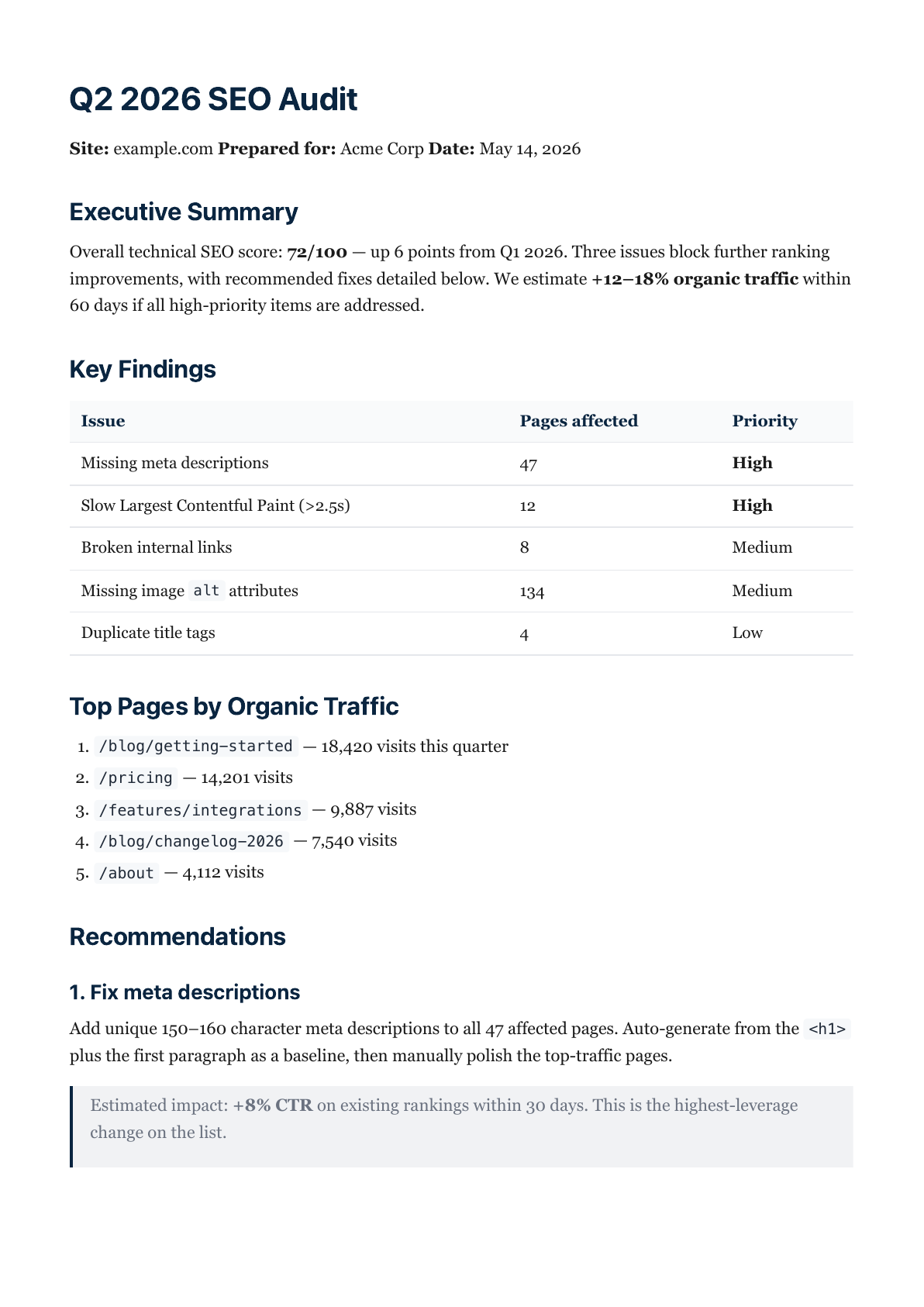
| Theme | |
|---|---|
academic |
preview-academic.pdf |
executive |
preview-executive.pdf |
marketing |
preview-marketing.pdf |
technical |
preview-technical.pdf |
Brand auto-detected from a live URL (brandFromUrl: "stripe.com" — full PDF):
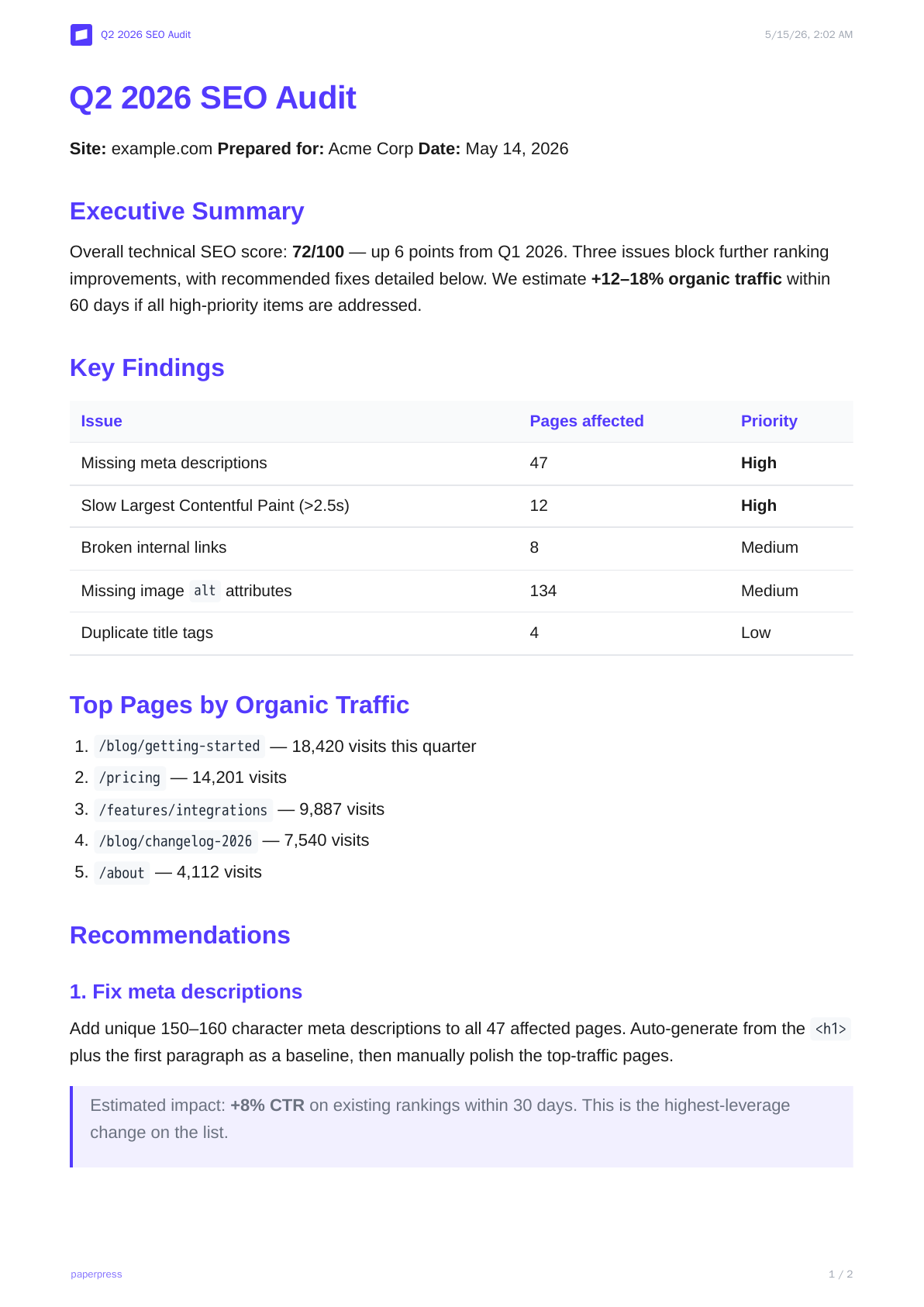
| Source URL | Detected + rendered |
|---|---|
| github.com | detect-github-com.pdf |
| railway.com | detect-railway-com.pdf |
| vercel.com | detect-vercel-com.pdf |
Inline brand kits (no URL, fields passed directly in the request) — forest, mono-coral, stripe-colors.
Input markdown used above: sample.md, demo-q4-review.md (the one used by /v1/demo).
Status
Built: markdown → PDF across 5 themes, brand-kit auto-detect from a URL (real font-family stack, not just a serif|sans|mono bucket), 24h detect cache, brandFromUrl one-call shortcut, batch detect (20 URLs in parallel), WCAG luminance guard, email-based key issuance with rotation grace, an MCP server, a read-only admin surface, signed share URLs, pre-rendered docs.
Not built, on purpose: payment processing, npm publish of the MCP package, automated tests, real Prisma migrations. This isn't a live backlog — it's finished as a portfolio piece, not being developed toward a 1.0.
License
MIT — see LICENSE.


