
Quarterdeck
Quarterdeck turns Claude Code into a captain's mate with standing orders: a personal assistant that keeps looking after the things you hand it, asks before it does anything you haven't allowed, and remembers what you decided.
You give it goals, things you want kept true: "unsubscribe me from mailing lists I never read", "find me the three best new job ads each week", "keep my GitHub profile up to date", "clear old installers out of Downloads". Each goal runs on its own schedule in the background of your Claude Code session, on your Claude plan. When it wants to act, it proposes, and you approve or reject from the Goals pane beside your chat, or from your phone.
The idea behind it: persistent intent may matter more than persistent memory.
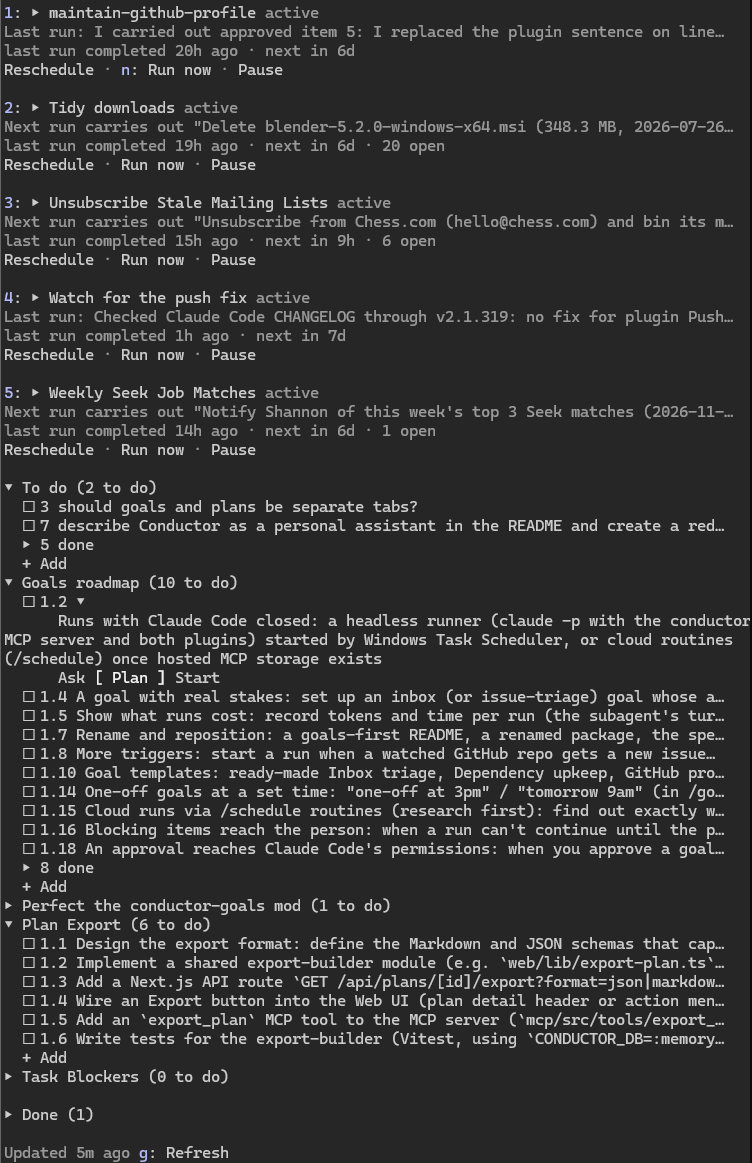
What it's like
- It asks first. "Unsubscribe from Chess.com (13 messages in 60 days, none opened) and bin its mail?" waits under Needs you until you approve. Rejected with "too formal"? That feedback becomes memory, and later runs follow it.
- It reaches you when you're away. With Remote Control connected, a new proposal or question pushes to the Claude app on your phone. Reply "approve" and it's done.
- It asks when it's stuck. When a run needs something only you can give (which job sites, signing in to
gh), it asks under Needs you instead of guessing, and carries on with your answer. - It earns trust one kind of action at a time. Each kind of action (send mail, delete a file, archive) is off, propose or auto. After 10 approvals in a row, the pane offers to switch that kind to auto.
- It remembers. Each goal keeps its own memory, its open items (never handling the same email twice) and its run history, outside any one conversation.
- You see what it costs. Each run shows its tokens and time, e.g.
· 48k tokens · 2m.
Start with /goal-new: pick a ready-made goal (unsubscribe from mailing lists, a weekly job scan with your CV, tidy Downloads, inbox triage, keep your GitHub profile current) or type your own. Schedules can be plain words: "30d", "weekdays at 9", "the first of every month".
How it differs
- From Claude Code's scheduled tasks (
/schedule): scheduled tasks run in Anthropic's cloud, so they keep going with your laptop closed. They suit clear-cut work, like reviewing every PR. A Quarterdeck goal is for ongoing jobs where you want a say: it proposes and waits for you, keeps memory and items between runs, and asks when it's unsure. Its guard holds a run to what you've allowed, outside the model, rather than only asking in the prompt. - From OpenClaw: OpenClaw is a self-hosted, always-on assistant you message from WhatsApp, Telegram and other chat apps, with broad system access and a large community skills marketplace. Quarterdeck is much smaller: no gateway or server to run, and no marketplace of its own. A goal's run is a Claude Code subagent, so it can use the skills, plugins, MCP servers and connectors you've chosen to install in Claude Code (a job-search goal can use your job-search skill, an inbox goal your Gmail connector), on your Claude plan. It works through goals you can see and change, item by item.
Limits
- It runs while Claude Code is open on your computer. Runs don't happen with your laptop closed (yet).
- Phone alerts need Remote Control connected and mobile push on in
/config; a short Claude turn sends each one. - It's early. It's built and used daily by one person, on Windows; expect rough edges.
It's an MCP server (the tools agents use) and two Claude Code plugins: quarterdeck-goals runs goals and shows the Goals pane, and quarterdeck-guard keeps each run within its goal. An optional web app adds goal pages in a browser and webhook triggers. Everything lives in one local SQLite database. Setup: Quickstart.
Persistent goals
A goal is an objective that never finishes. Type /goal-new alone to start from a ready-made goal (unsubscribe from mailing lists, a weekly job scan, tidy your Downloads, inbox triage, keep your GitHub profile current), each with its rules and schedule set. Or create your own with /goal-new <name>: <objective> (it works in the session's directory, and asks how often it should run, suggesting a schedule from the objective), or from the web app's home page (+ New goal) with standing instructions too. A goal can also be a one-off: it runs once and, when nothing is left open, moves to the pane's Done section.
The pane also keeps your to-do list for the project (/todo <text>, or ask Claude to add something): a backlog for working with Claude on a codebase. The ideas and decisions you put off along the way stay beside the chat, outside the conversation, where a /clear or a context compaction can't lose them. Any to-do can be brought back into the conversation with Ask… (a question, nothing changed), Plan (plan mode, for you to review) or Start. A list can hold anything, not only code work.
- Runs. Each run is a fresh background subagent in your Claude Code session, with its own context: it doesn't interrupt your conversation, and its report goes to the Goals pane, not your chat. It calls
get_goal_brief— objective, instructions, memory, your decisions since the last run, open items, recent run summaries, latest health — handles what's new, and ends withend_runand a summary for the next run. - Triggers. Every N minutes (with optional active hours), a cron expression, Run now, a webhook with a per-goal secret, or a failing health check.
- Work items. Each thing the agent handles is an item, deduplicated by an external ID (e.g. an email's ID) so it's never handled twice. Resolved items are hidden after 7 days.
- Autonomy per action category (e.g.
email.archive,email.send): off, propose (the agent asks first — the default), or auto. Proposals wait under Needs you; approve and the next run carries the action out; reject with feedback and the feedback becomes memory later runs follow. After 10 approvals in a row, the page suggests switching that category to auto. - Enforcement. With tool rules (
mcp__gmail__send*→email.send), the quarterdeck-guard plugin blocks a run's tool call that the goal's autonomy doesn't allow, e.g. sending mail without an approved proposal. A run also can't approve its own proposals or change the goal's settings. - Health. A command that exits 0 while the goal is being met; the last number it prints is charted (e.g. unread mail older than a day). A failure can start a run.
- Memory. Rules, facts and preferences — written by you, learned by the agent, or taken from your feedback. Pin what must always be included.
Goals run while Claude Code is open with both plugins installed. With several sessions open, one at a time runs them, so after updating the plugins, reload them in every open session. npm run doctor tells you when they can't run. Design: specs/persistent-goals.md.
Under the hood: plans
A goal's work items are tasks in a plan, the task tree Quarterdeck started with, and your to-do lists are plans too. Each item has a status (pending → active → completed | abandoned), a result, structured state and notes, and can carry checks that must pass before it's completed: acceptance criteria (the agent gives evidence for each), a verify command that must exit 0, and human approval. Every check result is kept.
The tools for building plans by hand (create_plan, provision_tasks, next_task, ...) are hidden from Claude by default, so they cost nothing in your sessions. Set QUARTERDECK_TOOLS=all on the MCP server to list them, e.g. to track a long multi-session project as a task tree.
MCP tools
Goals
| Tool | Description |
|---|---|
list_goals |
Persistent goals with open items and items waiting for review |
get_goal_brief |
Start of a run: everything a fresh agent needs, in one call |
add_item |
Add a work item (deduplicated by external_ref); actions are proposed, recorded or refused per the goal's autonomy |
remember / forget |
Add a fact, rule or preference to the goal's memory; deactivate one an agent added |
end_run |
Finish a run with a summary for the next one |
run_goal |
Queue a run now |
The plugins also use goals_overview, goals_tick (one scheduler pass), decide_item, cancel_run, set_goal_status, create_goal, delete_memory, attach_agent, fail_run and guard_check. The guard plugin refuses the person's actions among them (approving, cancelling, pausing...) to agents and to Claude.
Goal items
| Tool | Description |
|---|---|
update_task |
Record progress on an item: result, structured state patch, notes |
set_status |
active, completed (runs its checks) or abandoned (with a reason) |
The plan tools are listed only with QUARTERDECK_TOOLS=all: list_plans, create_plan, open_plan, archive_plan, create_task, provision_tasks, get_context, next_task, synthesize, verify_task and get_history. Hidden tools still answer calls.
Web app (optional)
The Next.js app shares the database and shows each goal as a page: items waiting for you (approve or reject), open items, runs, memory, the health chart, the guard's decisions, and settings (instructions, autonomy, tool rules, schedule, limits). It also takes webhooks (/api/goals/:id/trigger). Goals don't need it: they run from the Claude Code plugins.
Quickstart
Install (Claude Code)
You need Claude Code and Node.js 22.13 or newer. From a terminal:
claude plugin marketplace add shannonbay/Quarterdeck#release
claude plugin install quarterdeck-goals@quarterdeck --scope user
That's the whole setup. quarterdeck-guard comes with it as a dependency, and the plugin brings the quarterdeck MCP server with it, so there is nothing to clone, build or claude mcp add. Start Claude Code (or /reload-plugins) and type /goals to open the Goals pane. Due runs start on their own while Claude Code is open. The web app is optional.
See plugins/quarterdeck-goals for the pane, commands, settings and how runs work, and plugins/quarterdeck-guard for what a run may do.
Turn on updates
Claude Code updates Anthropic's marketplaces on its own but leaves others to you. Turn it on once: in Claude Code, /plugin → Marketplaces → quarterdeck → Enable auto-update. New versions then arrive in the background, and Claude Code says Plugin updated · Run /reload-plugins to apply. The plugins and the MCP server update together. Or update by hand at any time:
claude plugin update quarterdeck-goals@quarterdeck
With several sessions open, /reload-plugins in each. Until you do, a session that's still on the old version stops starting goal runs and its Goals pane says so: the updated session runs them.
Upgrading from a manual install
If you set Quarterdeck up from a clone before (claude mcp add ... quarterdeck), remove the hand-added server so two copies don't run, then install as above:
claude mcp remove quarterdeck --scope user
claude plugin marketplace remove quarterdeck
Your goals stay where they are, in ~/.quarterdeck/tasks.db. The plugin's server names its tools mcp__plugin_quarterdeck-goals_quarterdeck__* (Claude Code's naming for a plugin's server), not mcp__quarterdeck__*. Goals' tool rules work with either name. Permission rules in your settings that name the old tools need the new prefix, and npm run doctor points them out.
Developing Quarterdeck
git clone https://github.com/shannonbay/Quarterdeck
cd Quarterdeck
npm install
npm run build
claude plugin marketplace add .
claude plugin install quarterdeck-goals@quarterdeck --scope user
A local-folder marketplace is read straight from your checkout. After changing code, run npm run build (it bundles the server into plugins/quarterdeck-goals/server/, which is gitignored on main), then /reload-plugins. Releases: npm run release -- <version> tests everything, sets the version in both plugin.json files, and commits the built marketplace to the release branch with tags (add --push to publish).
Web app (optional)
The web app runs from a clone (see Developing Quarterdeck for npm install):
cd web && npm run dev
Open http://localhost:3000 for goal pages and webhooks. It uses the same database (~/.quarterdeck/tasks.db) and doesn't start goal runs: queued runs (Run now, a webhook, a failing health check) are started by the quarterdeck-goals plugin within 30 seconds.
Your first goal
- Give your Claude Code session the tools the goal needs (e.g. a mail MCP server for an inbox goal). Runs are subagents of that session, so they get the same tools.
- In the goal's directory, type
/goal-newand pick a ready-made goal, or run/goal-new Inbox: keep my inbox under 20 unreadand pick how often it runs (it suggests one: hourly, for an inbox). The first run starts within a minute. Change it later with/goal-schedule inbox every 6h. In the web app you can also give it standing instructions. - Set each action category to off, propose or auto (in the web app's goal Settings). Keep anything irreversible at propose or off to start. Unlisted categories are propose.
- Optional: add tool rules (tool name → category) so the guard plugin blocks actions the goal doesn't allow, and a health check command to chart how the goal is doing.
- Approve or reject what the Goals pane shows under Needs you (
/goals). Your rejections become memory, so the agent improves run by run.
Checking your setup
npm run doctor
Rebuilds core/ and mcp/, then checks Node.js, the database and its schema version, the server bundle, where the quarterdeck server comes from (the plugin, and no second hand-added copy), leftover hooks from older versions, both goal plugins, whether updates are automatic, old permission rules, the optional web app, and whether your active goals can run. Anything wrong comes with the command to fix it. Without a clone, run the same checks with the copy inside the plugin: node ~/.claude/plugins/cache/quarterdeck/quarterdeck-goals/<version>/server/quarterdeck-cli.mjs doctor.
Database
Both the MCP server and web app write to ~/.quarterdeck/tasks.db (SQLite through Node's built-in node:sqlite, WAL mode). Override the path with the QUARTERDECK_DB environment variable — set it to :memory: in tests for an isolated in-memory database. The schema lives in one place, core/src/migrate.ts, and every change made by Claude or by you is recorded in the events table.
Project structure
Quarterdeck/
  core/              Shared schema, migrations and queries (@quarterdeck/core)
  mcp/               MCP server (stdio transport, no HTTP)
    src/
      index.ts       Entry point — registers tools and dispatches calls
      cli.ts         `quarterdeck doctor` setup checker
      schema.ts      Zod schemas for all tool inputs
      db.ts          Binds @quarterdeck/core queries to one connection
      history.ts     Records MCP changes in the events log
      session.ts     In-memory open-plan tracking
      context.ts     Builds the context view returned by every tool
      tools/         One file per tool handler
  web/               Next.js goal pages and webhooks (optional)
    app/             App Router pages and API routes
    components/      React UI components
    lib/             DB layer, request guard, WebSocket broadcaster
    __tests__/       Vitest test suites
    server.ts        Custom HTTP + WebSocket server
  plugins/
    quarterdeck-goals/        Claude Code plugin: goal runner (subagents), Goals pane, /goal* commands, and the MCP server (.mcp.json, server/ built by `npm run build`)
    quarterdeck-guard/  Claude Code plugin: what a goal run may do
  .claude-plugin/    marketplace.json: makes the repo a plugin marketplace ("quarterdeck")
  scripts/release.mjs  `npm run release`: builds and publishes to the release branch
  specs/             Original design specs
Running tests
npm test             # all packages, from the repo root

cd core && npm test  # schema and migrations
cd mcp && npm test   # MCP tools and doctor
cd web && npm test   # goal API, poller, request guard

claude plugin test plugins/quarterdeck-goals        # the plugins (Claude Code's test kit)
claude plugin test plugins/quarterdeck-guard
The packages use Vitest with QUARTERDECK_DB=:memory: so tests are isolated and leave no files behind.
Configuration
| Env var | Default | Description |
|---|---|---|
QUARTERDECK_DB |
~/.quarterdeck/tasks.db |
Path to SQLite database; use :memory: for tests |
QUARTERDECK_TOOLS |
goals | MCP server: all also lists the plan tools (hidden by default) |
QUARTERDECK_REQUIRE_DECOMPOSE |
off | MCP server, plan tools: 1 blocks activating a task with no sub-tasks unless state.atomic is true |
QUARTERDECK_STRICT_COMPLETE |
off | MCP server, plan tools: 1 blocks completing a task while any child is unresolved (otherwise a warning) |
QUARTERDECK_ALLOWED_HOSTS |
— | Web server: extra host:port values to accept besides localhost (comma-separated) |
The MCP server gets Claude Code's environment, so set its variables where Claude Code starts, or under env in ~/.claude/settings.json.
Renamed from Conductor. Quarterdeck used to be called Conductor. The old CONDUCTOR_* env vars and the x-conductor-secret webhook header still work, and a database left in ~/.conductor is used until you move it. npm run doctor lists anything still set up under the old name (the data folder, a conductor MCP server entry, the old conductor-goals plugins) and how to switch it over.
License
Apache License 2.0. See LICENSE.


