
satori
A self-learning loop for Claude Code — the model learns skills from its own sessions, behind a human gate.


English · Русский
⚠️ Beta disclaimer
This is beta software I build for myself and share with the community as-is. It parses your session transcripts, stores lesson data locally and drafts skills that — once you approve them — will instruct your future Claude sessions. Read
server.pyand the drafts instaging/before approving anything. It works on my setup; I can't guarantee yours and take no responsibility for what your agent learns. Nothing self-activates and everything is reversible — but the judgment is yours.
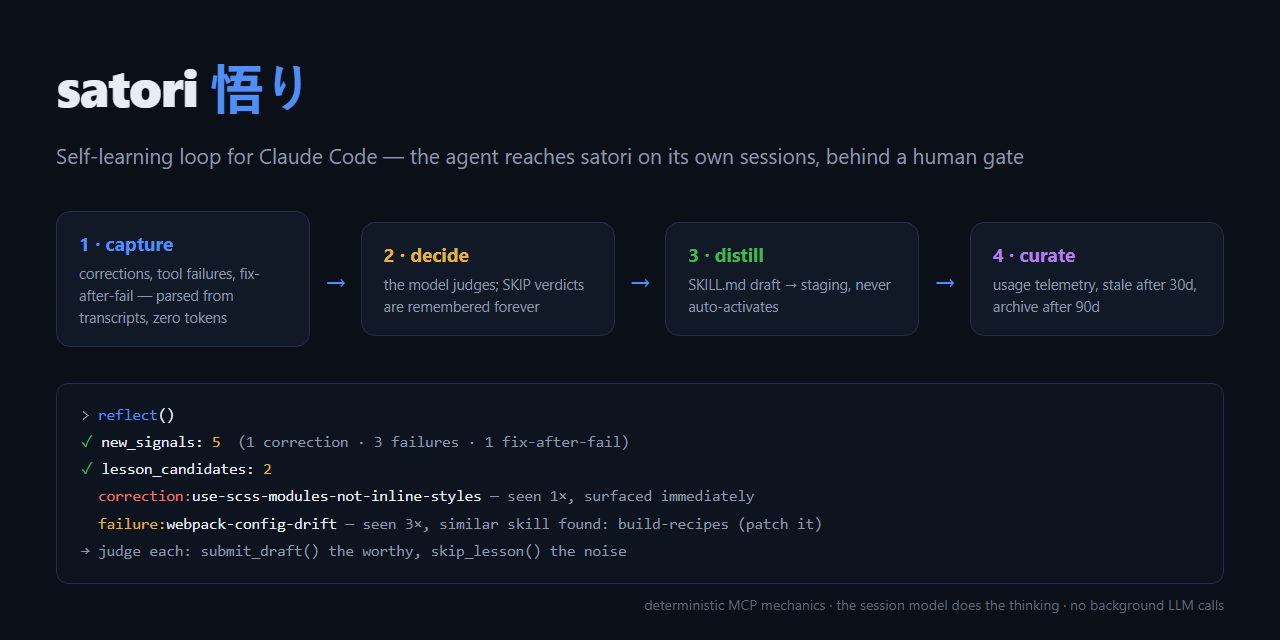
satori is an MCP server + hooks that give Claude Code a closed self-learning loop: user corrections and tool failures become lesson candidates, lessons become skill drafts, drafts become active skills — but only through a gate. Windows-native, works in Claude Desktop, zero bash wrappers.
Two principles you won't find together elsewhere: the server does only deterministic mechanics (parsing, counters, storage, validation) — the thinking is done by the calling model right in the session, no background LLM calls, no extra bills; and nothing self-activates — drafts sit in staging until explicitly approved.
Features
- 4-stage loop — capture → decide → distill → curate;
reflect()is called several times per session - User correction = signal #1 — surfaces as a candidate after a single occurrence (Devin's mechanic); tool failures wait for recurrence
- Patch-not-append — a recurring signal bumps
seen_countinstead of piling up rows - SKIP gate, forever — "not skill-worthy" verdicts are remembered; rejected noise never comes back
- Staging instead of auto-write — a draft activates only via
approve_draft(by you, or by the wake skill) - The trigger is sacred —
description: Use when ...is mandatory: recall works when a note says when to recall it, not what it does - pinned_project — a lesson is global or pinned to one project; approve routes it to the right skills folder
- Draft validation — frontmatter, size, secrets (also redacted at rest), prompt-injection markers (EN+RU)
- FTS5 search over past sessions — "when did I fix exactly this error" finds the actual transcript
- Curator — usage telemetry; unused drafts go stale in 30 days, archived in 90
- Smart nudge hooks — silent by default; they speak only on a correction (instantly) or accumulated work; a declined nudge stays declined
- Visible audit trail — every loop event surfaces in chat as a ⛩ marker line: what fired, why, what was staged or skipped
- dream/wake integration — the dream-skill consolidation pass harvests satori's staging and promotes/retires drafts through its validator gate
Quick Start
Easiest — let Claude install it. Paste this message into Claude Code:
Install the satori self-learning loop from https://github.com/timoncool/satori:
1) clone the repo to a permanent location (not a temp dir — the MCP runs from it);
2) create a venv inside it and install the single dependency: fastmcp;
3) register the MCP in my .mcp.json (project or global) as "satori" with
   command = absolute path to the venv python and args = [absolute path to server.py];
4) recommended: add the three nudge hooks (UserPromptSubmit / Stop / SessionEnd,
   all calling hooks/nudge.py with the venv python — exact JSON is in the README
   "Quick Start" step 3) into ~/.claude/settings.json, PRESERVING my existing hooks;
5) smoke-test: import server in the venv and show me what got configured;
then remind me to restart Claude Code / Desktop so the MCP and hooks load.
That's it — Claude clones, wires configs, verifies and reports. Manual way:
Clone & install the one dependency
git clone https://github.com/timoncool/satori.git
cd satori && python -m venv .venv && .venv\Scripts\pip install fastmcp
Register the MCP — in your project's
.mcp.json(or global config):"satori": { "command": "<path>\\satori\\.venv\\Scripts\\python.exe", "args": ["<path>\\satori\\server.py"] }(Optional) nudge hooks — three hooks onto one script in
~/.claude/settings.json:"UserPromptSubmit": [{"matcher": "", "hooks": [{"type": "command", "command": "<venv-python> <path>/hooks/nudge.py prompt-submit", "timeout": 10}]}], "Stop": [{"matcher": "", "hooks": [{"type": "command", "command": "<venv-python> <path>/hooks/nudge.py stop", "timeout": 10}]}], "SessionEnd": [{"matcher": "", "hooks": [{"type": "command", "command": "<venv-python> <path>/hooks/nudge.py session-end", "timeout": 60}]}]Restart Claude Code / Desktop.
How it works
session transcript
      │  (hook/tool call — parsing costs 0 tokens)
      ▼
① capture   reflect() reads what's new since the stored offset: corrections,
            failures, fix-after-fail, complex segments (≥12 calls + ≥2 edits)
      ▼
② decide    the model judges candidates (corrections after 1×, the rest after 2×):
            noise → skip_lesson (forever), worthy → a draft
      ▼
③ distill   submit_draft → staging/, validated, backed up, provenance-stamped.
            Does NOT activate. approve_draft → ~/.claude/skills/ or the project
      ▼
④ curate    usage telemetry, stale at 30d, archive at 90d
Hooks (all optional, all silent by default): UserPromptSubmit — on a correction injects one line "fix it, then reflect" (series-deduplicated); on ≥25 accumulated tool calls — same, and repeats only after the next full threshold; Stop — same threshold at turn end; SessionEnd — silent capture directly in Python, no model involved at all. When a nudge does fire, the model opens its reply with a visible ⛩ satori: ... marker and reports what was recorded — you always see the loop working.
Anti-pollution by construction: the loop never writes into Claude's memory (only its own SQLite + staging); context injections are one line and only when warranted; an ignored nudge doesn't nag.
Tools
| Tool | What it does |
|---|---|
reflect(transcript_path?) |
stages 1+2+4: signals since offset, aggregation, candidates + similar existing skills, curator tick |
skip_lesson(key, reason) |
permanent SKIP |
submit_draft(name, markdown, lesson_key?, patches?, pinned_project?) |
draft into staging with full validation |
approve_draft(name, dest_dir?) |
the gate: staging → active skills (routed by pinned_project) |
session_search(query, limit?) |
FTS5 over all past transcripts |
loop_status() |
loop telemetry |
Configuration (env)
| Variable | Default | Meaning |
|---|---|---|
SN_PROMOTE_AT |
2 | recurrences before a candidate (except corrections) |
SN_CORRECTION_PROMOTE_AT |
1 | user corrections surface immediately |
SN_SEGMENT_TOOL_CALLS / SN_SEGMENT_FILE_EDITS |
12 / 2 | "complex segment" threshold |
SN_STALE_DAYS / SN_ARCHIVE_DAYS |
30 / 90 | draft aging |
SN_NUDGE_MIN_CALLS |
25 | accumulated work before a nudge |
SN_NUDGE_COOLDOWN_MIN / SN_CORR_COOLDOWN_MIN |
10 / 3 | nudge cooldowns |
SN_STOP_NUDGE |
1 | Stop-hook nudge (0 = off) |
Works best with dream-skill
dream-skill is this project's sibling — memory consolidation for Claude Code (dream = read-only pass, wake = gated apply, full rollback). satori handles procedural memory (skills), dream/wake handles factual memory (notes, rules, index) — and they meet in the middle:
- dream's Skill harvest phase reads satori's
staging/+ usage telemetry and proposespromote_skill/retire_skillalongside its memory proposals - the same gate applies: your checkboxes, or an independent validator agent in auto mode (with a mandatory draft checklist:
Use whentrigger, no injection markers, no duplicates) - wake activates or retires drafts, logs every promotion, and its
rollbackrestores skills too
Each works standalone; together the cycle is complete: сон → пробуждение → прозрение (dream → wake → satori).
Standing on shoulders
An honest list of sources: Hermes Agent (Nous) — the 4-stage cycle, FTS5, periodic self-reflection; claude-self-improving-skills — complexity thresholds, patch-over-create, curator, telemetry, "declined stays declined"; claude-evolve — objective signals, patch-not-append; claude-harness-hermes — permanent SKIP, redaction at rest; Devin (Cognition) — corrections at threshold 1, the trigger as a sacred field, pinned scoping, injection scanning; dream-skill (ours) — the staging gate.
Other Projects by @timoncool
| Project | Description |
|---|---|
| dream-skill | Memory consolidation for Claude Code — dream/wake with a gate |
| trail-spec | TRAIL — cross-MCP content tracking protocol |
| telegram-api-mcp | Full Telegram Bot API as MCP server |
| civitai-mcp-ultimate | Civitai API as MCP server |
| GitLife | Your life in weeks — interactive calendar |
Authors
- Nerual Dreming — Telegram | neuro-cartel.com | ArtGeneration.me
Support the Author
I build open-source software and do AI research. Most of what I create is free and available to everyone. Your donations help me keep creating without worrying about where the next meal comes from =)
All donation methods | dalink.to/nerual_dreming | boosty.to/neuro_art
- BTC:
1E7dHL22RpyhJGVpcvKdbyZgksSYkYeEBC - ETH (ERC20):
0xb5db65adf478983186d4897ba92fe2c25c594a0c - USDT (TRC20):
TQST9Lp2TjK6FiVkn4fwfGUee7NmkxEE7C
Star History
License
MIT


