
x402-agent-data
Paid on-chain data for AI agents (and humans). Pay per call in USDC on Base over HTTP 402 (x402) —no signup, no API key, no account. The money goes straight to the wallet advertised in the 402response; nothing is held by the service.
- Landing / discovery: https://x402-agent.majighufron.workers.dev
- MCP server (remote, streamable HTTP):
https://x402-agent.majighufron.workers.dev/mcp - Machine-readable catalogue:
https://x402-agent.majighufron.workers.dev/api - Agent instructions:
https://x402-agent.majighufron.workers.dev/llms.txt
Services
| Service | Price | What you get |
|---|---|---|
token_report · GET /api/token-report |
$0.01 | ERC-20 metadata, supply, recent transfer activity, optional pool balance. Chains: Base, Base Sepolia, Robinhood Chain |
pool_risk · GET /api/pool-risk |
$0.02 | Pool reserves, implied price, constant-product slippage for a given notional |
wallet_profile · GET /api/wallet-profile |
$0.03 | Transfers in/out, distinct counterparties, first and last block seen |
contract_dd · GET /api/contract-dd |
$0.05 | Due-diligence signals: risky selectors present in bytecode, owner + renounced status, activity, largest-transfer share |
Free endpoints: / discovery · /api catalogue · /llms.txt agent text · /api/sample truncatedreport so you can check the data shape before paying · /mcp MCP server (the service_catalogtool is free).
Use it from an MCP client
Add the remote server to any MCP client (Claude Desktop, Cursor, or your own agent):
{
  "mcpServers": {
    "x402-agent-data": {
      "type": "streamable-http",
      "url": "https://x402-agent.majighufron.workers.dev/mcp"
    }
  }
}
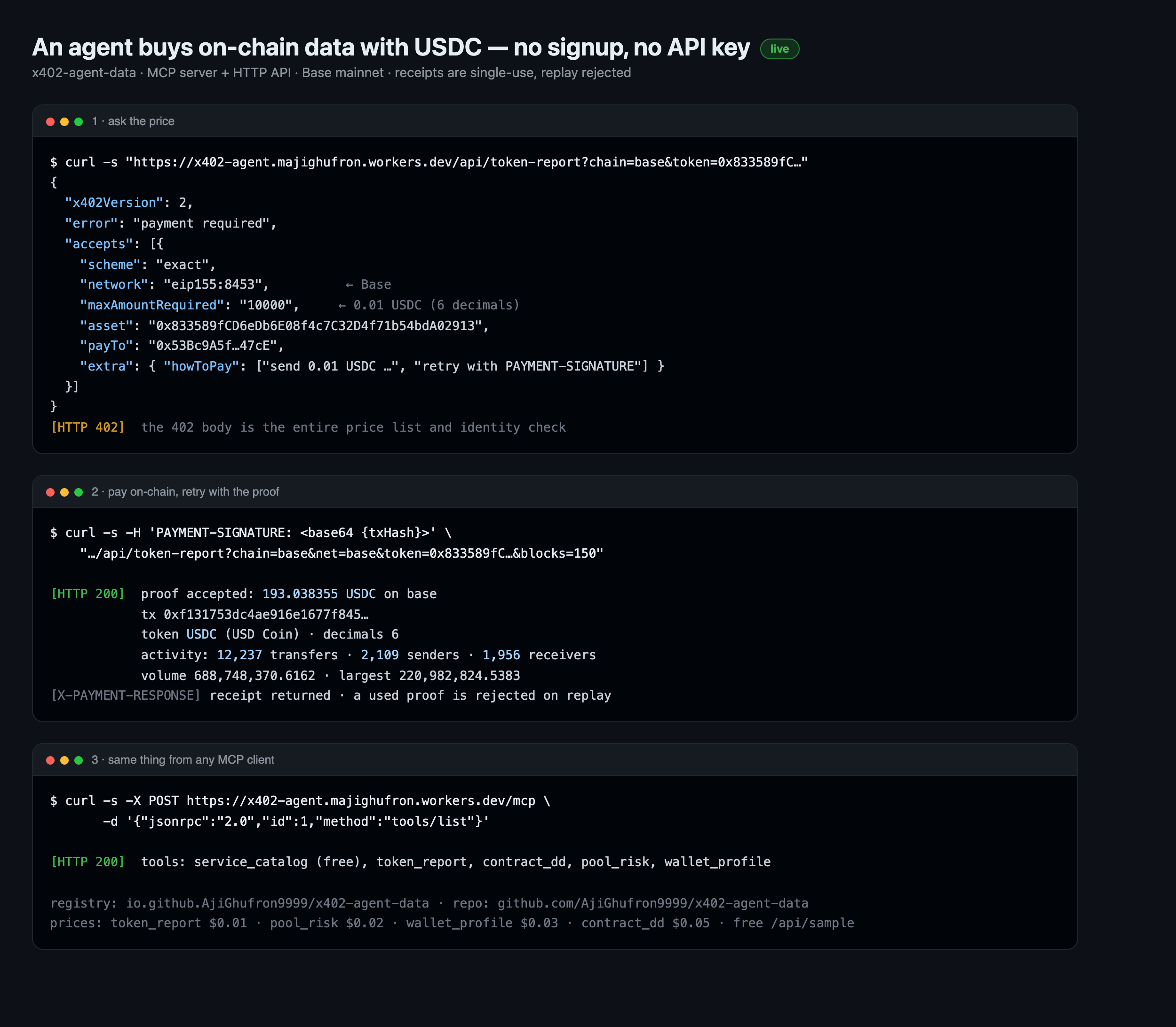
Tools: service_catalog (free), token_report, pool_risk, wallet_profile, contract_dd.Call a paid tool once without payment_signature and it returns the payment requirements; pay,then call again with payment_signature = base64 of {"txHash":"0x…"}.
Use it over plain HTTP
# 1. Ask without paying -> HTTP 402 + payment requirements
curl -s "https://x402-agent.majighufron.workers.dev/api/token-report?chain=base&token=0x833589fCD6eDb6E08f4c7C32D4f71b54bdA02913"

# 2. Send the quoted USDC amount to the payTo address on Base (USDC, 6 decimals)

# 3. Retry with the proof
TX=0x…   # your transfer hash
PROOF=$(printf '{"txHash":"%s"}' "$TX" | base64)
curl -s -H "PAYMENT-SIGNATURE: $PROOF" \
  "https://x402-agent.majighufron.workers.dev/api/token-report?chain=base&token=0x833589fCD6eDb6E08f4c7C32D4f71b54bdA02913"
A proof is single-use and must be from the last 15 minutes. If the service itself fails (upstreamRPC throttling), it answers 503 retryable: true and releases your proof, so you can call againwithout paying twice.
See examples/pay_and_fetch.py for a runnable walkthrough.
Why it exists
On-chain data is usually sold as a monthly subscription behind an API key. Agent software cannotfill in signup forms, so this exposes the same data per call: the HTTP 402 response is the pricelist, and the wallet is the identity.
Honest limits
- Upstream public RPCs throttle shared egress IPs, so a call can occasionally answer
503;proofs are released so retries are free. contract_ddreports signals, not verdicts: selector presence says what is in the bytecode,not how it behaves. Proxies and dead code both hide intent.- Payment uses a plain USDC transfer plus a proof header (self-verified). It is not the EIP-3009facilitator flow yet.
License
MIT


