
mcp-context-card


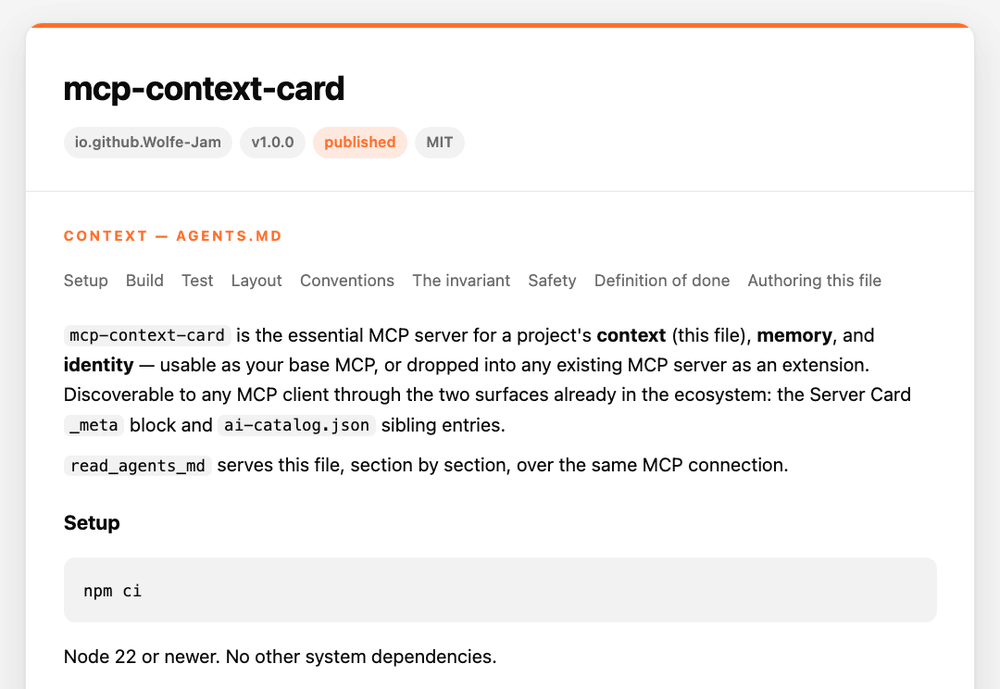
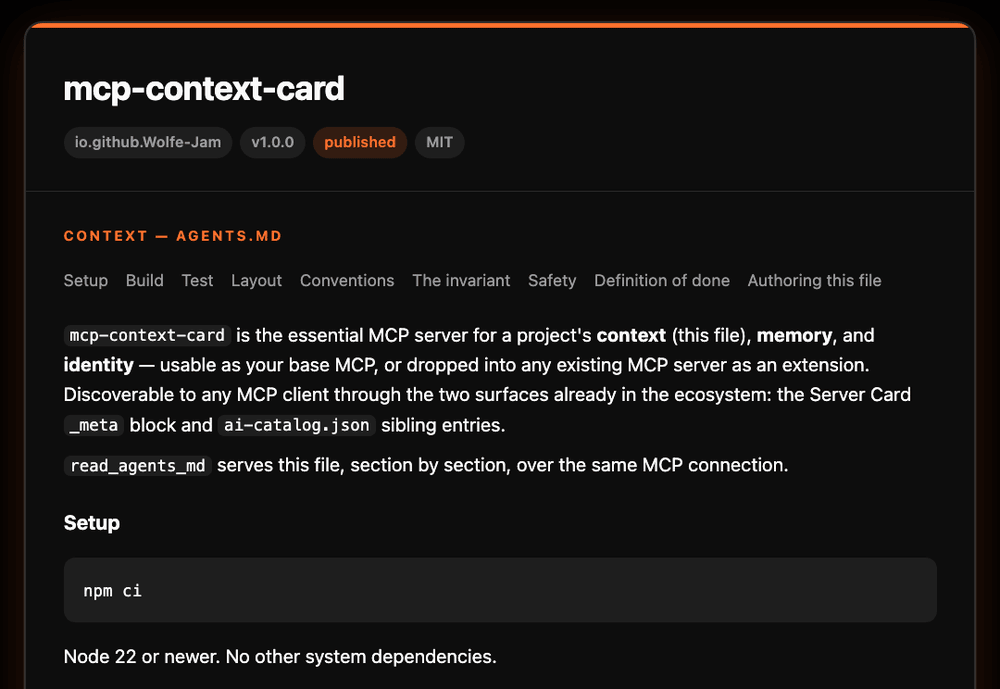
Get one. Or add it to yours. The essential MCP server for a project'scontext, memory, and identity — discoverable to any MCP client, andrendered as one card you can read.
| Light | Dark |
|---|---|
 |
 |
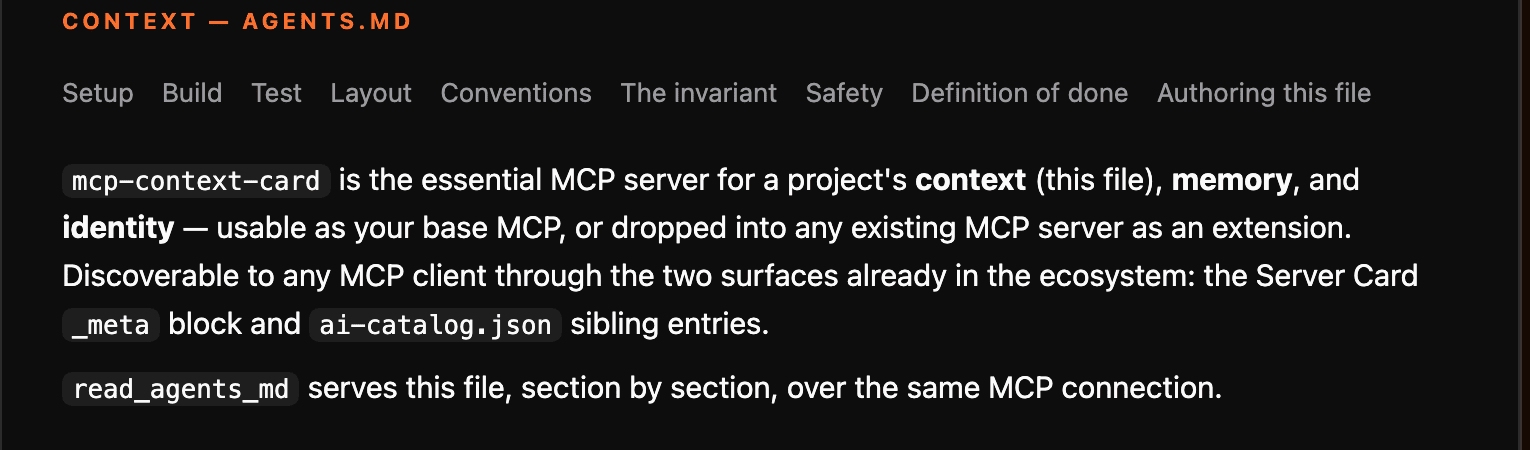
context — the project's AGENTS.md, served whole or one section at a time.
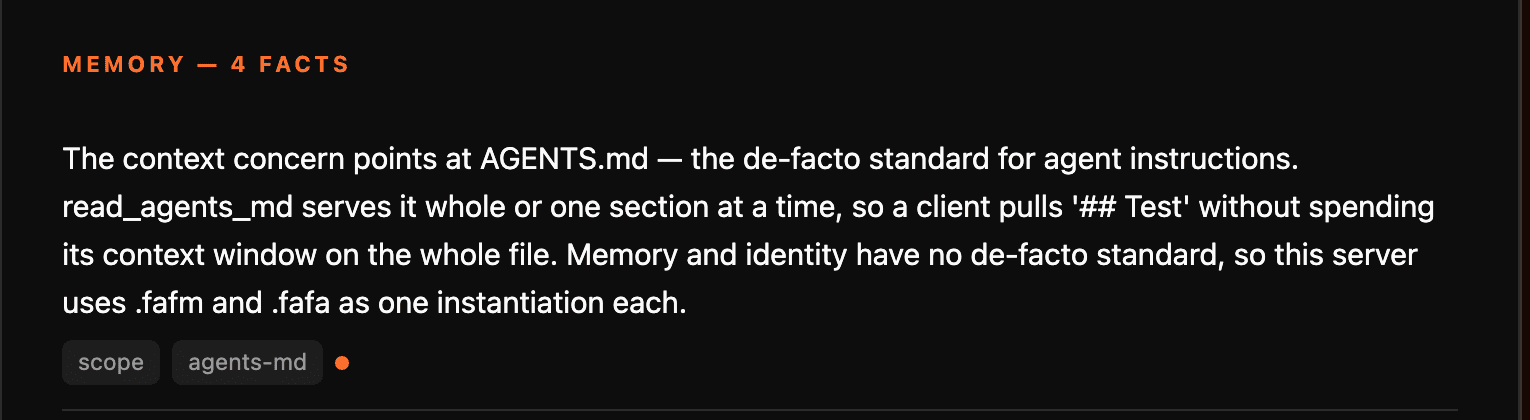
memory — facts that persist across sessions, in a file.
identity — what this server is, from its own Server Card.

Discovery goes through two surfaces already in the ecosystem: the Server Card_meta block and ai-catalog.json sibling entries.
Pick one
| You want to… | |
|---|---|
Add an AGENTS.md — you don't have one |
author_agents_md drafts one from your repo's real facts |
Improve an AGENTS.md — you have one, make it the best it can be |
the same tool, automatically — drop in a project.faf and it upgrades to BEST: goal, who it's for, why |
| Get a new MCP server base — context, memory, identity, wired | stand this up as-is; a host has all three before you write a tool of your own |
| Improve your MCP with context, memory, ID — you already run one | run it alongside your existing server; nothing to migrate, it composes |
A base MCP — or an extension for any other
Context, memory, and identity are essential — every MCP host needs an agentthat knows a project's instructions, remembers facts across sessions, and cansay what it is. mcp-context-card is those three, done once:
- Stand it up as your base MCP. Point a host at it and an agent alreadyhas
AGENTS.mdserved section‑by‑section,remember/recall/forgetmemory that survives a restart, and awhoamiidentity — before a singletool of your own is written. - Or extend any existing MCP with it. Run it alongside a server youalready have — filesystem, git, a database, your own — and that agentgains context, memory, and identity discovery it didn't have. Nothing tomigrate; it composes.
Nine tools, two discovery surfaces already in the ecosystem (Server Card_meta, ai-catalog.json), and a rendered card. MIT, on npm.
It composes:
- serve · discover · render — this server
- author BETTER, keep true —
agents-md-facts(author_agents_mdwraps it for the facts layer; adds a BEST layer of its own fromproject.fafwhen one exists) - files · shell · git —
server-filesystem,server-git/ github‑mcp‑server, your test runner's MCP
Vendor-free — context is plain Markdown (AGENTS.md); the memory andidentity formats are swappable examples. It reads and writes only its ownthree files (AGENTS.md, project.fafm, .well-known/fafa) — no generalfile access, no shell, no search.
The card
The screenshot at the top of this page is exactly this — the same threesources rendered as one self‑contained HTML page: identity, AGENTS.md,memory, and how a machine fetches it. The view for people: read it, screenshotit, drop it in a PR, put it on a status page.
AGENTS.md sections are collapsed by default, so the card scans in one screen;a sticky index jumps to any section, Expand all opens everything. Sectionstoggle natively — the one small inline script only adds the bulk button and theprint handler. --expanded / ?expand=all renders it fully open, script-free,for a screenshot.
npx mcp-context-card card            # at a terminal: writes context-card.html and opens it
npx mcp-context-card card --expanded # every section open
npx mcp-context-card card > x.html   # piped/redirected: raw HTML to stdout
GET /card                            # live, on the HTTP transport
GET /card?expand=all&theme=light&accent=%230066cc
Light, dark, or auto; the accent defaults to the AAIF palette and takes any hex.This repo's own card, live: auto ·light ·dark(all in the AAIF accent shown here — pass any hex to change it).
Add it to your setup
No AGENTS.md yet?
The author_agents_md tool authors one — BETTER from your repo's realfacts (build/test commands, entry points, toolchain conventions, viaagents-md-facts), orBEST when a project.faf exists: the same facts, plus its structuredgoal, who it's for, and why, as a section ahead of them. Nothing toconfigure — the tier follows what's actually there.(The ladder this follows.)
To author or keep the facts layer true outside a session:
npx agents-md-facts          # author / refresh AGENTS.md
npx agents-md-facts --check  # fail if missing or stale (CI, pre-commit)
See the card
One command, no host, no config — from your project directory:
npx mcp-context-card card
At a terminal it writes context-card.html and opens it in your browser. Pipedor redirected (> card.html, a script, CI) it writes raw HTML to stdout instead;--stdout forces that from a terminal too. --expanded opens every section.
Wire it into a host
Claude Desktop, Cursor, or any stdio host:
{
  "mcpServers": {
    "context-card": {
      "command": "npx",
      "args": ["-y", "mcp-context-card"],
      "env": { "MCP_CONTEXT_CARD_ROOT": "/abs/path/to/your/project" }
    }
  }
}
MCP_CONTEXT_CARD_ROOT points at the directory with your AGENTS.md. Thememory tools work with or without it; identity is optional. Over HTTP instead:PORT=8080 npx mcp-context-card. Requires Node ≥20.
If command: "npx" fails to spawn (spawn npx ENOENT — seen on Cursor, whosehost process doesn't inherit a shell PATH), point command at node andthe installed dist/bin.js instead — seedocs/WIRING.md. Transport choice isin docs/TRANSPORT.md.
Extending an MCP you already run: most hosts accept more than onemcpServers entry — add context-card alongside server-filesystem,server-git, or your own, and every agent in that host gains context,memory, and identity discovery without anything else changing.
Why
AGENTS.md is the de-facto standard for telling a coding agent how to work in arepo. But a client has to know the file exists and read the whole thing intocontext. There is no standard way for a server to say "here is my AGENTS.md,here is what I remember, here is who I am" — so every server that wants thisgrows its own shape.
mcp-context-card answers all three through mechanisms that already exist:
- Server Card
_meta(SEP‑2127) —one reverse‑DNS‑namespaced key per concern, readable in‑band as an MCPresource and atGET /.well-known/mcp/server-card. ai-catalog.json— sibling entries keyed by media type, atGET /.well-known/ai-catalog.json.
The context concern points at AGENTS.md (text/markdown). Memory and identityhave no de‑facto standard yet, so the examples here use.fafm and.fafa — one instantiation each,swap in your own.
The wire‑level detail is in docs/MECHANISMS.md.
Tools
| Tool | What it's for |
|---|---|
author_agents_md |
draft an AGENTS.md — BETTER from the repo's facts (via agents-md-facts), BEST when a project.faf exists — ready to drop in |
read_agents_md |
return the project's AGENTS.md — whole, or one section by heading |
list_agents_md_sections |
the headings, so a client pulls one section instead of the whole file |
remember |
write a fact that will still be there next session |
recall |
read a fact stored in a previous session |
forget |
drop or correct a stale fact |
whoami |
this server's name, vendor, version, status, license |
list_context_sources |
what this project publishes, in what media types, via which surface |
render_context_card |
the whole card as one self‑contained HTML page (also GET /card) |
The demo
npm run demo runs every tool over both transports:
- Context — list the
AGENTS.mdsections, then pull just## Test. - Memory —
remember()a fact, stop the server process, start a new one,recall()the same fact. Only the file carries it across. - Identity —
whoami(), and the Server Card_metablock read back from alive client. - Discovery —
list_context_sources(), then the same server over statelessHTTP with its.well-knownroutes andGET /card.
104 tests on Linux, macOS, and Windows, coverage‑gated in CI. Two spawn a realchild process and check a remembered fact survives the restart — one againstan existing project.fafm, one starting from a project that has never hadone; another checks the stdio and HTTP tool surfaces match.
Layout
| Path | What |
|---|---|
src/server.ts |
the nine tools + the Server Card resource |
src/agents-md.ts |
reads and section‑splits AGENTS.md |
src/author.ts |
author_agents_md — BETTER via agents-md-facts, BEST when project.faf exists |
src/md.ts |
a minimal dependency‑free Markdown → HTML renderer |
src/render-card.ts |
the card — identity + AGENTS.md + memory + discovery, as one HTML page |
src/memory.ts |
file‑backed remember / recall / forget |
src/identity.ts |
whoami (.fafa → package.json fallback) + the _meta block |
src/catalog-gen.ts |
writes ai-catalog.json from the same three sources |
src/transport/http.ts |
the stateless Streamable HTTP app (Hono) |
src/bin.ts |
the entry point — stdio · --http · card · --help · --version |
Related
- Server Card SEP‑2127 · ai-catalog · AGENTS.md
mcp-project-context— an earlier take on the context concern alonetext/markdown(AGENTS.md) ·application/vnd.fafm+yaml·application/vnd.fafa+yaml
License
MIT.
This repo dogfoods what it serves — its AGENTS.md is a real, current file, andit ships a project.faf as the structured source behind it.


