
cliptunnel-mcp
Operate a locked-down remote machine through its clipboard.
What it does
cliptunnel-mcp turns a shared clipboard into a reliable control channel between two machines. When the remote machine sits behind a Citrix session, a locked-down VDI, or any environment that blocks SSH, file transfer, and networking but still exposes a clipboard, ClipTunnel tunnels commands through that single slot and exposes them as Model Context Protocol tools.
The package ships three layers:
- Protocol — a wire format (
CT1) with base64 payloads, sequence numbers, and typed messages (command, response, error, ack). - Endpoints —
Controller(operator side) andAgent(remote side), connected by an injectedTransport. Both run background threads with ARQ retransmission, sequence-bound deduplication, and generation-safe lifecycle. - MCP server — a FastMCP application that exposes the Controller's helpers as
remote_shell,remote_fs_*,remote_upload,remote_download, andremote_sysinfotools over stdio.
The core package has zero dependencies. The MCP server requires the optional [server] extra (mcp>=1.2,<2).
Architecture
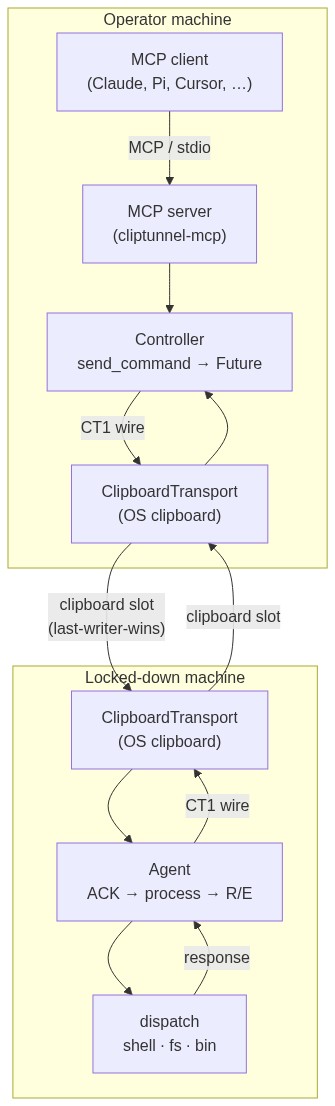
Both endpoints share a single last-writer-wins clipboard slot. The protocol uses stop-and-wait ARQ: the Controller writes one command, the Agent ACKs immediately, processes the command in a worker pool, then writes one typed response (R or E) and retransmits it until the Controller's matching ACK arrives. The Controller sends one command at a time and resolves futures as responses come back.
Wire format
CT1|<from>|<to>|<seq>|<type>|<payload>
| Field | Value |
|---|---|
CT1 |
Protocol signature + version |
from |
C (Controller) or A (Agent) |
to |
C or A |
seq |
Positive integer, monotonic per Controller session |
type |
C (command), R (response), E (error), A (ack) |
payload |
Base64-encoded UTF-8 |
Installation
pip install cliptunnel-mcp          # core + cliptunnel-agent binary
pip install cliptunnel-mcp[server]  # adds cliptunnel-mcp server binary (mcp>=1.2,<2)
Both modes install console entry points:
| Binary | Extra needed | Purpose |
|---|---|---|
cliptunnel-agent |
(none) | Runs the Agent on the local OS clipboard. |
cliptunnel-mcp |
[server] |
Runs the MCP server over stdio. |
Quick start
Agent (remote machine)
The simplest way to run the Agent is the installed binary:
cliptunnel-agent
Antivirus / EDR workaround (Windows): unsigned
.exeentry points may be quarantined. Usepython -minstead — it runs through the already-trusted Python interpreter with no generated binary:python -m cliptunnel_mcp.agent # instead of cliptunnel-agent python -m cliptunnel_mcp.server # instead of cliptunnel-mcp
This builds a ClipboardTransport backed by the system clipboard (pbcopy/pbpaste on macOS, user32 on Windows, wl-copy/wl-paste on Wayland, xclip/xsel on X11) and wires operations.dispatch as the command handler. The Agent watches the clipboard slot, ACKs commands, processes them in a worker pool, and writes responses back. Press Ctrl+C to stop.
Controller + MCP server (operator machine)
On the operator side, configure your MCP client (Claude Desktop, Cursor, Pi, etc.) to launch the server binary:
{
  "mcpServers": {
    "cliptunnel": {
      "command": "cliptunnel-mcp",
      "args": []
    }
  }
}
If the cliptunnel-mcp binary is blocked by antivirus, use python -m:
{
  "mcpServers": {
    "cliptunnel": {
      "command": "python",
      "args": ["-m", "cliptunnel_mcp.server"]
    }
  }
}
The server binary injects a Controller backed by a ClipboardTransport and runs the FastMCP application over stdio. All remote_* tools are available immediately.
Note: the MCP server requires
pip install cliptunnel-mcp[server].
Controller only (no MCP)
For programmatic use without an MCP client:
from cliptunnel_mcp.clipboard_transport import ClipboardTransport
from cliptunnel_mcp import Controller
import json

controller = Controller(transport=ClipboardTransport())

# Async — returns a Future
future = controller.send_command(json.dumps({"op": "shell", "cmd": "whoami"}))
result = future.result(timeout=30)

# Sync — blocks until response or timeout
output = controller.send_command_sync(json.dumps({"op": "fs.read", "path": "/etc/hostname"}))
Programmatic Agent
If you need a custom handler or transport:
from cliptunnel_mcp.clipboard_transport import ClipboardTransport
from cliptunnel_mcp import Agent
from cliptunnel_mcp.operations import dispatch

agent = Agent(transport=ClipboardTransport(), handler=dispatch)
# Blocks until agent.close() — run in a thread or manage lifecycle yourself.
API surface
Controller
The operator-side endpoint. Sends commands asynchronously, dispatches one at a time, and resolves futures as responses arrive.
| Method | Description |
|---|---|
send_command(command: str) -> Future |
Queue a command; returns a Future that resolves with the response payload or None on failure. |
send_command_sync(command: str) -> str | None |
Send and block until response or timeout seconds. |
close() |
Stop background threads. Idempotent. |
Constructor parameters: transport (required), timeout, retries, poll_interval, ack_timeout, initial_seq, persist_seq, seq_store.
Agent
The remote-side endpoint. Watches the slot, ACKs commands immediately, processes them in a worker pool, and writes one typed response at a time with retransmission.
| Method | Description |
|---|---|
close() |
Stop this agent generation. Idempotent; never strands a thread. |
Constructor parameters: transport (required), handler (required), poll_interval, max_workers, response_ack_timeout.
dispatch
The default Agent handler. Parses JSON payloads and routes to the matching operation.
from cliptunnel_mcp.operations import dispatch

output, is_error = dispatch('{"op": "shell", "cmd": "echo hello"}')
Protocol primitives
| Symbol | Description |
|---|---|
pack(msg) -> str |
Serialize a Message into wire format. |
unpack(raw) -> Message | None |
Parse a wire string; None on malformed input. |
validate(raw, my_role) -> bool |
True if raw is well-formed and addressed to my_role. |
Message |
Dataclass: frm, to, seq, mtype, payload. |
MsgType |
Enum: COMMAND, RESPONSE, ERROR, ACK. |
Role |
Enum: CONTROLLER, AGENT. |
SeqTracker |
Per-seq dedupe state: new → processing → done. |
Transport protocol
class Transport(Protocol):
    def read(self) -> str: ...
    def write(self, value: str) -> None: ...

class RevisionMonitor(Protocol):
    @property
    def revision(self) -> int: ...
    def wait_for_change(self, after: int, timeout: float = 1.0) -> int: ...
A transport must implement read/write (last-writer-wins). Implementing RevisionMonitor (or exposing wait_for_revision / wait_for_change) enables change-aware waits instead of polling.
Operations
The dispatch handler supports these operations:
| Operation | Parameters | Returns |
|---|---|---|
shell |
cmd |
JSON: {stdout, stderr, returncode} |
fs.read |
path |
JSON: {content, lines} |
fs.write |
path, content |
wrote N bytes to PATH |
fs.list |
path |
JSON: [{name, size, is_dir}] |
fs.delete |
path |
deleted PATH |
fs.replace |
path, old, new |
replaced 1 occurrence in PATH (exact-once match) |
fs.search |
path, pattern |
JSON: [{line, content}] (regex) |
fs.find |
path, pattern |
JSON: [PATH, ...] (glob, ** recurses) |
fs.bin_read |
path |
JSON: {path, size, b64} |
fs.bin_write |
path, b64 |
wrote N bytes to PATH |
MCP tools
The server exposes 13 tools over stdio:
| Tool | Description |
|---|---|
remote_shell |
Execute a shell command; auto-sync (10 s) then async with job_id polling. |
remote_shell_result |
Poll for the result of an async shell command. |
remote_fs_read |
Read a file. |
remote_fs_write |
Create or overwrite a file (creates parent dirs). |
remote_fs_list |
List directory entries. |
remote_fs_delete |
Delete a file. |
remote_fs_replace |
Search-and-replace in a file (exact-once match). |
remote_fs_search |
Regex search in a file. |
remote_fs_find |
Glob-find files under a directory. |
remote_fs_bin_read |
Read a binary file as base64. |
remote_fs_bin_write |
Write base64 content to a binary file. |
remote_upload |
Upload a local file to the remote machine. |
remote_download |
Download a remote file to the local machine. |
remote_sysinfo |
Return system info (OS, Python, CPU, memory, disk) from the remote machine. |
Lifecycle and coalescing semantics
- One command at a time: the Controller dispatches commands serially. The pending command's seq is published atomically with the slot write so the reader never observes the command before the dispatcher.
- Immediate ACK: the Agent ACKs every command before processing, freeing the slot for the Controller.
- One response at a time: the Agent holds exactly one pending response envelope. A new command never implicitly ACKs a pending response — only the Controller's matching
A(seq)releases it. - Retransmission: both sides retransmit on ACK timeout. The Controller retries up to
retriestimes (default 3). The Agent retransmits the response everyresponse_ack_timeoutseconds (default 1.0). - Deduplication: the Agent's
SeqTrackertracks per-seq state (new → processing → done). Duplicate commands are ACKed; done ones replay the cached typed response; in-flight ones are already being processed. - Stale message guard: the Controller skips any R/E with
seq <= min_seq— stale slot content from a previous session. - Generation-safe: all stop state and queues are local to each instance. Closing and starting a new Agent or Controller never strands threads.
- Paced writes: the Controller enforces a bounded inter-write gap (2× poll interval) so the Agent can read each message before it is overwritten.
Backend selection
ClipTunnel ships ClipboardTransport, a transport backed by the OS clipboard. On Wayland it uses wl-paste --watch for event-driven change detection (zero polling, zero CPU when idle). On macOS, Windows, and X11 it polls every 100 ms with hash-based change detection. It implements both Transport and RevisionMonitor, so both endpoints get change-aware waits. The binaries cliptunnel-agent and cliptunnel-mcp use it automatically.
For custom setups — a Citrix clipboard redirection, a shared Gist, a network pipe — implement the Transport protocol (read() -> str, write(str) -> None) and optionally RevisionMonitor (revision + wait_for_change). Inject it into Controller or Agent directly.
Platform support
| Platform | Status | Clipboard backend | Change detection |
|---|---|---|---|
| macOS | Tested | pbcopy/pbpaste (built-in) |
Polling (100 ms) |
| Windows | Tested | ctypes + user32 (no extra deps) |
Polling (100 ms) |
| Linux / Wayland | Tested | wl-copy/wl-paste (wl-clipboard package) |
Event-driven |
| Linux / X11 | Core works | xclip (fallback: xsel) |
Polling (100 ms) |
Development
# Create a virtual environment
uv venv && source .venv/bin/activate

# Install in development mode
uv pip install -e . pytest

# Run the test suite (161 tests)
python -m pytest -q
# or
python -m unittest discover -s tests -t .

# Bare mode — no install, just PYTHONPATH
PYTHONPATH=src:. python -m pytest -q
The test suite uses a deterministic ClipboardSlot test double that models the last-writer-wins channel with revisions and bounded waits. No clipboard hardware is needed.
Limitations
- Text-only clipboard: the protocol carries UTF-8 strings. Binary files are base64-encoded, which roughly doubles their size over the wire.
- Single slot: the clipboard holds one value at a time. The ARQ protocol serializes all traffic through it, so throughput is bounded by the clipboard round-trip latency.
- No encryption: the wire format is plain base64. If the clipboard is observable, use an encryption layer in your transport or handler.
License
MIT — see LICENSE.


