
ctxprune
Shrink what your LLM reads, locally. ctxprune has two parts:
| you want to... | use | drops content? | what you get |
|---|---|---|---|
| shrink tool outputs inside a coding agent (Claude Code, Hermes, Pi, OpenCode, dsh, Codex) | ctxprune install --all |
no: every value stays | ~9% fewer tool-output tokens on MCP-heavy work (12% on Claude Opus), 0.3–4% on coding |
| shrink prompts, retrieved documents or logs you control (Python, LangChain, LlamaIndex, shell) | ctxprune.prune(text, keep=0.5) |
yes: deletes low-value words | you pick the size; at 50% kept, +15 points of QA accuracy over LLMLingua-2-large |
Both run on your machine with no API key, and nothing leaves it.
What it's good for
- MCP-heavy agents (Linear, Notion, GitHub, databases, Playwright): JSON record lists become rows andPlaywright snapshots lose their YAML noise. This is where the agent hooks save the most: 8.7% of tool-outputtokens on an MCP-heavy mix, 12.0% on Claude Opus.
- Claude Code on Windows: PowerShell output loses its colour codes, saving 4.1% of tool-output tokens (6.5% onOpus) in real sessions.
- Long Claude Opus sessions: cross-turn dedup turns a repeat of an output that is still in context into areference. Opus reads those references as well as the originals (−0.2 points [−1.8, +1.3]). Open models don't,so dedup is on for Opus only.
- Agents that must not lose a detail: unlike lossy compactors, the
safepreset never drops content, leaves fileviews and code the agent may edit alone, and caused no re-fetches in next-action replay. - RAG and prompt pipelines:
CtxpruneDocumentCompressor(LangChain) andCtxpruneNodePostprocessor(LlamaIndex) cut retrieved documents to a set share of tokens and keep IDs, paths and numbers unsplit. - Logs and CI output before you paste them into a chat:
some_command | ctxprune --keep 0.33 --protect.
Not for: shrinking source files you'll edit (left alone by design), or coding sessions that are mostly file reads(Claude Code's Read is 58% of tool tokens in the sessions measured, and the hooks don't touch it, which is why thecoding number is small).
What the agent hook does to one MCP result (a Linear list_issues reply, 521 → 285 o200k tokens; produced byctxprune compress):
[cp:rows #1 TSV id, title, state, assignee(json), labels(json), updated_at; compact]
PRJ-140	Checkout times out on slow 3G	open	{"login":"mila"}	[{"name":"bug"}]	2026-11-10T09:00:00Z
PRJ-141	Add Dutch translations for invoices	open	{"login":"joost"}	[{"name":"i18n"}]	2026-11-11T09:07:00Z
...
Every key and value is still there: decoding gives JSON equal to the original (only the pretty-print whitespaceisn't restored). Rules that are byte-exact are checked against the original on every output and skipped if thecheck fails. What is exact and what isn't has the details per rule.
Numbers at a glance
| result | source | |
|---|---|---|
tool-output tokens saved, safe, MCP-heavy mix |
8.7% [8.2, 9.3]; 12.0% on Opus | 2,225 public agent trajectories, o200k |
| ... coder plus MCP mix | 3.7% [3.0, 4.6]; 7.6% on Opus | same |
| ... real Claude Code sessions, Linux/macOS | 0.3% [0.0, 0.6]; 1.8% on Opus | 37 sessions |
| ... real Claude Code sessions, Windows | 4.1% [2.0, 6.9]; 6.5% on Opus | 18 sessions |
| exactness checks on changed outputs | 0 failures: 1,205 byte-exact, 5,463 JSON-equal | same traces |
| next-action replay (does the agent do something different?) | safe: 0 re-fetches (it changed 7 of 400 items); other compactors at their defaults: +13 to +45 points of changed next actions |
400 items, Qwen3.6 + Qwen3.8 (BENCHMARKS §8) |
| reading accuracy, Claude Opus 5.5 | jsonrows, a11y and 4 opt-in rules: −3 to +1 points vs the raw output; dedup −0.2 [−1.8, +1.3] |
100 questions per rule, 450 for dedup |
| hook latency (Claude Code, fresh process per call) | p50 39 ms, p95 47 ms (runtime 106bcea) | 300 replayed events |
| token pruning, QA at 50% kept (uncompressed 91.8%) | 68.8% vs LLMLingua-2-large 53.4%, -base 41.0% | 378 held-out questions, DeepSeek V4 Flash reader |
Brackets are 95% CIs. The agent-hook numbers trace back to scripts and result files indocs/BENCHMARKS.md, and the token-pruning ones to themodel card.The savings are small on purpose: lossy tools save more (LLMLingua-2 and headroom remove 18–58% at their defaults)but change what the agent does next. ctxprune stats shows what it saves on your own machine.
The hooks and plugins use only the Python standard library, with no model, no network and no server. Their output isbyte-identical across operating systems and Python versions, and they never re-render history that a model hasalready cached.
Install
uv tool install ctxprune        # or: pipx install ctxprune
ctxprune install --all          # every supported agent found on this machine
ctxprune doctor                 # checks versions and runs a test call through each integration
To install for one agent only: ctxprune install claude-code (or hermes, pi, opencode, dsh, codex).ctxprune uninstall --all removes everything it added. The first time install changes one of your config files,it keeps a backup of the original. PACKAGE.md lists every file it touches, the paths it uses, and notesfor Windows and for the Codex proxy.
Don't run install through uvx. It writes the interpreter path into your agent configs, and uvx deletes thatenvironment later. ctxprune install refuses to run from one.
Claude Code plugin, without pip. A self-contained plugin bundles the same stdlib runtime, so it needs onlyPython 3.9+ on the machine:
/plugin marketplace add riceharvest/ctxprune
/plugin install ctxprune-safe@ctxprune
Use either the plugin or ctxprune install claude-code, not both. ctxprune doctor warns if both are on.
MCP server (Claude Desktop, Cursor, Cline and other MCP clients)
For clients without tool-output hooks, ctxprune mcp is a local stdio MCP server with two read tools:
read_compact(path, start_line?, end_line?): the losslesssafepipeline, for big logs, JSON/MCP dumps, CSV andtest output. Nothing is dropped.read_pruned(path, keep=0.5, protect=true): token pruning with the model below (lossy). Identifiers, numbers andpaths are kept unlessprotect=false.
{ "mcpServers": { "ctxprune": { "command": "uvx", "args": ["ctxprune", "mcp"] } } }
It reads only the files the client asks for, makes no network calls (read_pruned downloads the model once on firstuse), and needs no MCP SDK.
Token pruning: the 0.2 API (Python, LangChain, LlamaIndex)
This is lossy compression for prompts, retrieved documents and logs: a 140M-parameter token classifier(darioooooo0o/ctxprune-small, Apache-2.0) deletes the words thatmatter least and keeps identifiers, paths and numbers unsplit. It runs on CPU (int8 ONNX, ~0.1 s per 500 tokens;the model downloads once, 143 MB). It works exactly as in 0.2.1, with the same outputs byte for byte. The agent hooksabove never use it.
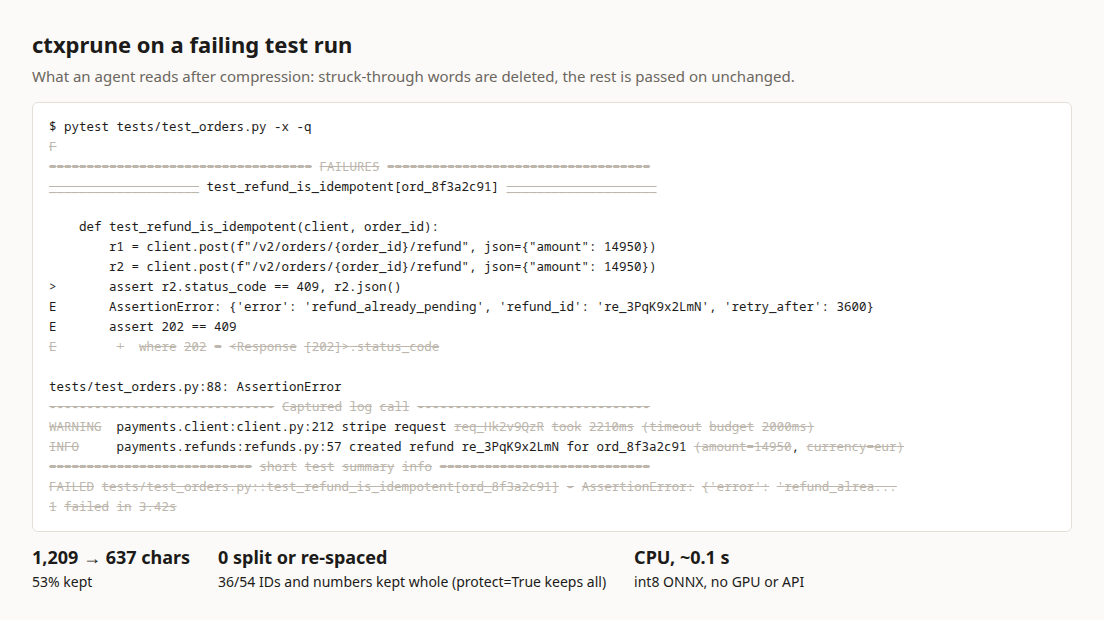
pip install ctxprune # library + CLI; the model downloads on first use
import ctxprune
short = ctxprune.prune(text, keep=0.5)                # keep ~50% of the tokens
short = ctxprune.prune(text, keep=0.33, protect=True)  # never drop identifiers, numbers or paths

from ctxprune import Compressor                        # batching, fp32, torch backend, keep_structure
Compressor().compress(text, rate=0.5)["text"]
from ctxprune.integrations import CtxpruneDocumentCompressor   # LangChain (pip install "ctxprune[langchain]")
retriever = ContextualCompressionRetriever(base_compressor=CtxpruneDocumentCompressor(rate=0.5),
                                           base_retriever=base)

from ctxprune.integrations import CtxpruneNodePostprocessor    # LlamaIndex (pip install "ctxprune[llamaindex]")
engine = index.as_query_engine(node_postprocessors=[CtxpruneNodePostprocessor(rate=0.5)])
ctxprune build.log --keep 0.5                  # or: some_command | ctxprune --keep 0.33 --protect --stats
ctxprune serve                                 # HTTP on 127.0.0.1:8719: POST /compress {"text": ..., "rate": 0.5}
With LLMLingua: PromptCompressor(model_name="darioooooo0o/ctxprune-small", use_llmlingua2=True) needsLLMLingua#261.
How good it is: at 50% of tokens kept, a reader LLM (DeepSeek V4 Flash) answered 68.8% of 378 held-out questions onagent text exactly, vs 53.4% for LLMLingua-2-large and 41.0% for LLMLingua-2-base (uncompressed: 91.8%). It is weakerthan LLMLingua-2-large on non-English web prose, and the question set comes from our own training sources. Per-sourcetables and caveats are on the model card.
Use protect=True on tool output, logs and anything with identifiers. ctxprune never splits or re-spaces anidentifier, but without protect it may delete one. On 30 held-out agent tool outputs at 50% kept, the share of IDs,paths, versions, URLs and numbers that survived verbatim was 99.6% with protect=True (55.9% of tokens kept),45.8% without it, 72.9% for LLMLingua-2-base and 94.6% for LLMLingua-2-large. Every type and rate:docs/bench/llmlingua_facts.md. The training andevaluation code for this model is at tag v0.2.1(scripts/, ctxprune/).
What is exact and what isn't
"Lossless" means different things for different rules, so here is the precise version.
Byte-exact. The decoder (lossless.decode) returns the original bytes. Each rule is checked against the originalon every output, and it is dropped for that output if the check fails.On by default:
table: an aligned table (ps,docker ps,kubectl get) is single-spaced. The columns are restored on decode.diffhdr:---/+++lines that repeat thediff --gitline are dropped.jsonrows: a JSON array of 3 or more records with nested objects or arrays in them (typical MCP results) iswritten as tab-separated rows under one header. The rewrite is used only if the exact original bytes (key order,numbers, spacing) come back. Off for local / self-hosted endpoints (see "Presets").json_ascii: JSON where non-ASCII text is\uXXXX-escaped is shown with the characters themselves, under oneheader line. The decoder restores the exact escapes, including hex case.- Windows text: a leading BOM is set aside and put back. CRLF line endings are kept exact line by line.
a11y: Playwright MCP accessibility snapshots drop the YAML-dash, and[cursor=pointer]becomes↗.Element refs stay byte-exact.- Marker escaping (see docs/SAFETY.md).
Opt-in (off by default). With the output placed inside a 16k–56k-token agent transcript, a reader did worse on these,even though short 1–6k-token probes showed no loss (see "Which models it was tested on"). Each saved under 1% oftokens:
CTXPRUNE_HITS=1: grep-stylepath:line:textruns become apathheader plusline:textlines. At long contextthe reader filed hits under the wrong file header.CTXPRUNE_PATHS=1(orCTXPRUNE_PATHS_MODELS=<hosted model ids>): runs of bare/paths in one directory aregrouped under that directory; Hermessearch_filesfile lists become one path per line (sffiles). Files ended upunder the wrong directory header. Windows\path lists stay raw even when it is on.CTXPRUNE_NUMBERED=1: a padded line-number gutter (cat -n,nl) is unpadded. The reader re-ran the view moreoften instead of answering.CTXPRUNE_JSONROWS_FLAT=1:jsonrowsalso on flat records (search hits, a git log as JSON). The reader re-ran thesearch instead of answering (re-fetch +7 points).
Exact content, but no decoder. Three or more identical consecutive lines become one line plus [× N]. The countis exact, but lossless.decode doesn't expand it, so I don't count it as byte-exact.
Render-preserving, not byte-exact.
- ANSI: colour and title codes (SGR/OSC) are removed. Cursor moves and erases are kept. This never runs on fileviews.
- CR: progress-bar redraws that use
\rare collapsed to the final state the terminal would show.
Value-preserving, not byte-exact. These need a JSON parser to see that nothing changed.
json_compact: removes the whitespace between JSON tokens of pretty-printed JSON. Every key and value parsesidentically.json_unescape: a JSON wrapper around a text field (e.g.{"output": "...", "exit_code": 0}) becomes one headerline with the other keys, followed by the text unescaped. The text is exact.
Never touched. File views (Read, cat, sed -n, git show/diff/blame and the like) get no rule bydefault (only the opt-in numbered), so code lines that an agent copies into an edit stay byte-identical. Edit/Write results are not changed.
On the public traces below, the per-output checks found 0 failures:
- 1,205 changed outputs were decoded byte-exact;
- 5,463 were checked for identical JSON values;
- with dedup on, 2,960 outputs were checked byte-exact, the deduped ones through
dedup.expand.
1,254 outputs carry a combination the check script doesn't verify end to end, mostly json_compact followed byjsonrows. 194 had ANSI codes removed.
How much it saves
These figures are % of the tool-output tokens the model sees, measured with o200k on 2,225 public agenttrajectories (28,174 tool outputs). They use the safe preset at the 0.3.0 runtime, run through each integration'sreal reach: in Claude Code that is Bash, PowerShell, Grep and MCP tools, not Read. Brackets are 95% trajectorybootstrap CIs.
The two columns differ only in cross-turn dedup:
- On Claude Opus (
claude-opus-*served by Anthropic), dedup is on: a repeat of something still in contextbecomes a reference to it. - Every other model has dedup off.
| who | any other model | on Claude Opus (dedup on) |
|---|---|---|
| Claude Code coder, sessions with no PowerShell call (37: 28 Terminal-Bench trials, 9 trace-commons) | 0.29% [0.04, 0.62] | 1.76% [0.66, 3.38] |
| Claude Code coder, Windows sessions (18 with PowerShell calls, all trace-commons) | 4.08% [1.98, 6.88] | 6.53% [4.23, 9.86] |
| Mix 1, coder with few MCP servers (coding 0.8, GitHub MCP 0.1, web search 0.1) | 2.64% [1.47, 4.08] | 4.58% [3.02, 6.13] |
| Mix 2, coder plus MCP (coding 0.5, browser 0.2, GitHub 0.15, DB 0.05, web 0.1) | 3.69% [2.95, 4.59] | 7.55% [6.56, 8.58] |
| Mix 3, MCP-heavy assistant (multi-server MCP 0.3, Notion 0.15, browser 0.2, web 0.15, API tools 0.2) | 8.73% [8.16, 9.28] | 12.04% [11.42, 12.60] |
How to read this:
- The traces don't say which model wrote them. The Opus column is what dedup removes from these same sessions. Imeasured how well Opus reads the references separately (below).
- The weights in mixes 1–3 are my assumptions, not measured user mixes. "Coding" in the mixes means the 55 realClaude Code sessions, Windows and non-Windows pooled. The Windows sessions hold 68% of those tokens, so mixes 1 and 2mostly reflect Windows. On Linux or macOS, the first row is the closer guide.
- Most of the Windows gain is removing ANSI colour codes from PowerShell output. That is a render-preserving rule,not a byte-exact one.
- Claude Code's biggest tool is Read (58% of tool tokens in these 55 sessions). ctxprune leaves Read alone bydesign, which is why the coding number is small.
- MCP JSON is where the structural rules pay off, mostly through
jsonrowsandjson_compact. - Grep grouping,
paths,numberedand flat-recordjsonrowsare opt-in since the long-context probe; on LinuxClaude Code sessions they were most of what the default saved without dedup (0.98% before, 0.29% now). - Other tokenizers: with Qwen3.6, the mixes are 2.38 / 3.36 / 9.05% (dedup off) and 4.11 / 7.14 / 12.43% (dedupon), with no CIs. I didn't count with Claude's tokenizer; o200k and Qwen3.6 stand in for it.
Big outputs Claude Code saves to a file (Bash over 30k chars, MCP over 50k chars or over its token cap) are not inthe table above, because the model only sees a preview of them. For these, ctxprune rewrites the file itselflosslessly ("spill files", on by default). If the agent later reads a quarter of such a file, this adds+0.05 / +0.58 / +0.67 points to mixes 1 / 2 / 3. How much of the file gets read back is an assumption; I couldn'tmeasure it.
Every number, the exact commands and the scripts are in docs/BENCHMARKS.md. ctxprune statsshows what it saved on your own machine (a counts-only log; see "Privacy").
Which models it was tested on
I checked that models still read the rewritten output correctly. Each rule got 100–150 questions, asked once on theraw output and once on the rewritten one, and accuracy was compared with a paired bootstrap.
Claude Opus 5.5 (through claude -p, n = 100 per rule, short outputs only) passed every rule it was given:
hits,paths,numbered, flatjsonrowsand Playwrighta11yall scored 0.0 to +1.0 points.jsonrowson MCP results scored −2.0 [−5.0, 0.0], and −3.0 [−7.0, 0.0] with the marker note. The CIs touch 0,and graded on the answer's last line it was 100 → 100.
Opus also passed cross-turn dedup in the shipped format: −0.2 [−1.8, +1.3] over 450 multi-turn items.
Open models: Qwen3.8-27B, Qwen3.6-35B-A3B and Gemma 4 31B (with thinking on and off, n = 100–150 per rule):
- The same default rules: within ±2 points.
json_ascii: it improved accuracy by +11 to +20 points on both Qwen readers in every mode. Raw\uXXXXescapes were read correctly only 54–60% of the time.- Cross-turn dedup: they failed it. Qwen3.8 lost 7.3 points on whole-output references, 18 on line runs and 21 onreferences to tool inputs. That's why dedup is on for Opus only.
Long context (Qwen3.6-35B-A3B, the shipped bytes). Short probes put one output in a 1–6k-token prompt. Realsessions are 50k+ tokens, so each output was also placed at 10/50/90% depth of a 16k/32k/56k-token agent transcript(every other output encoded too, tool schemas sent; 24 items × 9 cells per rule). A reply that re-runs a tool insteadof answering was counted as a re-fetch (an extra turn), not as wrong. Without thinking:
json_ascii+27.3 [+11.1, +44.0] points, nested-recordjsonrows+1.4, Playwrighta11y+4.6: kept on.- grep grouping −3.7 [−9.7, +3.2] (hits filed under the wrong file),
paths−8.3 [−20.9, −0.5] (an earlier run),flatjsonrowsre-fetch +7.4 [+3.7, +12.0],numberedre-fetch +5.1 [+0.9, +10.2]: made opt-in. - With thinking:
json_ascii+26.4, flatjsonrowsre-fetch +12.0 [+5.6, +18.1]; grep grouping helped(+8.3, fewer re-greps), but it had to pass in both modes, so it is opt-in. - Claude has no long-context data; the rules above are off for it too.
Not probed:
- other Claude models (Sonnet, Haiku) and other hosted models: they get dedup off;
table,diffhdrandsffileson Claude (on the open readers they scored 0 to +2 points,sffiles−1 in two modes);- the
[× N]repeat counts, and the JSON compaction and unescape steps; json_asciion Claude and Gemma.
Presets
safe(the default). The rules above, with nothing dropped and no model.- Cross-turn dedup is decided by model, once per session. It is on for
claude-opus-*served by Anthropic andoff for everything else (ctxprune_core.DEDUP_MODELS).CTXPRUNE_DEDUP=0|1overrides that in every integration. - In Claude Code the hook reads the model from the session. If
ANTHROPIC_BASE_URLpoints anywhere other thanAnthropic, dedup stays off. - Grep grouping,
paths(withsffiles),numberedand flat-recordjsonrowsare opt-in for every model(the long-context results above). No model has long-context data for them yet, Claude included, and a ClaudeCode session is past 16k tokens before its first tool output. On public Linux Claude Code sessions they were mostof the default's saving without dedup (0.98% of tool tokens before, 0.29% now); on assistant / multi-MCP workloads0.6–0.8%. - On a local or self-hosted endpoint
jsonrowsis off. On nested MCP records, local thinking models spent +139to +407 extra thinking tokens per lookup to save ~176 prompt tokens, a latency loss on your own GPU. - To opt in to
paths:CTXPRUNE_PATHS_MODELS=claude-(a comma list of hosted model ids; entries ending in-areprefixes; local and self-hosted endpoints stay off), orCTXPRUNE_PATHS=1(every target).CTXPRUNE_PATHS=0forces it off.
- Cross-turn dedup is decided by model, once per session. It is on for
balancedandaggressive(opt-in, experimental). These also drop low-value lines with a small line-scoringmodel, keep a recovery file for every dropped range, and leave file views whole.- They need
pip install "ctxprune[model]"andctxprune serve --model-dir DIR. - The 0.3.0 model weights are not published yet, so for now these presets are for experiments.
- In my session runs, the cost results were mixed (see "Presets" in docs/BENCHMARKS.md).
- They need
- Harnesses that opt out of lossy. On Codex, dsh, OpenCode and Pi,
balancedruns assafeunless you setCTXPRUNE_FORCE_LOSSY=1.- Codex cost +36.8% (90% CI +15.8 to +60.6) with the model on: holes in file views made it re-read ranges inloops.
- dsh used 14% more prompt tokens and 1.9 more turns per episode.
- Pi and OpenCode didn't lower cost reliably.
aggressiveapplies everywhere, because choosing it is an explicit opt-in.
Pick a preset with ctxprune install --all --preset balanced, or set CTXPRUNE_PRESET.
Opt-in rules
These rules are off by default. In the comprehension probes on open models each one cost accuracy or extrathinking, so you should only turn one on if you've checked it with your model. Only the first four were probed onClaude (short outputs, where they passed); the long-context results that turned them off are from Qwen3.6.
| flag | what it does | why it's off |
|---|---|---|
CTXPRUNE_HITS=1 |
Grep-style path:line:text runs become a path header plus line:text lines. |
Without thinking at 16k–56k context: −3.7 [−9.7, +3.2] points, hits filed under the wrong file (with thinking +8.3). On real Claude Code sessions it was the biggest default saver: about 0.7–0.8 of the 1.4% of hook-reachable tokens on the author's sessions. |
CTXPRUNE_PATHS=1 |
Runs of bare / paths are grouped under their directory; Hermes search_files lists become one path per line. CTXPRUNE_PATHS_MODELS=<ids> limits it to listed hosted models. |
At 16k–56k context: −8.3 [−20.9, −0.5] points, −11 at 56k (wrong directory). Saves 0.1–0.6% (0.13 of 1.4% reachable on the author's Claude Code sessions). |
CTXPRUNE_JSONROWS_FLAT=1 |
jsonrows also on flat records (search hits, a git log as JSON). |
At 16k–56k context the reader re-ran the search instead of answering: +7.4 [+3.7, +12.0] points of re-fetches. Saves up to 0.75%. |
CTXPRUNE_NUMBERED=1 |
A padded line-number gutter (cat -n, nl) is unpadded. |
At 16k–56k context, without thinking: +5.1 [+0.9, +10.2] points of re-fetches. Saves 0.27 of 1.4% reachable on the author's Claude Code sessions. |
CTXPRUNE_BLOCKREF=1 |
A repeated run of lines inside one output becomes [cp:= same as lines A–B]. |
It lost 27–85 points overall (3 on Qwen3.8 with the marker note) and 73–100 on "how many times" questions. |
CTXPRUNE_PREFIX=1 |
Lines that share a prefix (e.g. web-1 | in docker compose logs) are written once. |
Without thinking it cost 2.7–6.7 points. With thinking it used ~2.9× the thinking tokens. |
CTXPRUNE_JSONROWS_EXT=1 |
jsonrows also flattens sub-objects into key.sub columns and allows quoted keys. |
Qwen3.6 with thinking: −7.3 points on those items. |
CTXPRUNE_READ_TRIM=1 |
Claude Code Read: an already-shown, unchanged prefix or suffix of the file is dropped, and the line numbers stay exact. |
It saved 1.14% [0.33, 2.34] of tool tokens on real sessions, but in 1.85% of Edits it would have hidden the latest copy of the text being edited. The A/B on Edit failures hasn't run yet. The installer's hook matcher doesn't include Read, so you also have to add Read to ctxprune's matcher in ~/.claude/settings.json yourself, and again after every ctxprune install or upgrade, which rewrite that entry. |
CTXPRUNE_SPILL=0 turns off the spill-file rewrite.
Turning it off
- Kill switch: set
CTXPRUNE_OFF=1in the agent's environment, or put it inside one command(CTXPRUNE_OFF=1 cat big.log). The output then passes through untouched. - The Codex proxy also checks per request for the file
~/.cache/ctxprune/OFF, so you don't need to restart it.The native hooks read only the environment variable. - Uninstall:
ctxprune uninstall --allremoves everything thatinstalladded.
Every native integration fails open. If ctxprune crashes, hangs past its timeout, or can't import, the agent getsthe original output:
- the Claude Code hook has a 30 s timeout;
- the Pi, OpenCode and dsh plugins have a 60 s timeout;
- the in-process Hermes plugin gives up after
CTXPRUNE_BUDGETseconds (2 by default).
The exception is the Codex proxy. It sits in the request path, so if the proxy process dies, Codex requests fail.
For the proxy and the plugins' request-time dedup, OFF is soft. New results go out raw, and results already sent keeptheir bytes, so turning it on or off costs no prompt-cache miss.
Details are in docs/SAFETY.md.
Same bytes everywhere, and no re-rendered history
A prompt cache only helps if the bytes don't change, so ctxprune is built to keep them stable.
Deterministic. The same tool output gives the same bytes on every OS, Python version and locale.
- CI compared Windows, macOS and Ubuntu on Python 3.9–3.13: all 15 cells were identical.
- A local audit covered 9,935 output hashes across Python 3.9–3.14, hash seeds and non-UTF-8 locales, with 0differences.
History stays put.
- Hooks and per-output plugins only ever touch new tool results.
- The proxy and the plugins' request-time dedup pin the exact text they first sent for each result. An upgrade, or apreset, dedup or paths change, therefore reaches only new outputs, never history that's already cached.
- Request-time dedup only rewrites results that arrive after the last assistant turn it has seen, so turning it onmid-conversation leaves the earlier history alone.
CTXPRUNE_RERENDERis ignored: a re-render is a history edit. - The remaining one-time cache miss is a hard OFF (
echo hard > ~/.cache/ctxprune/OFF).
Details are in docs/SAFETY.md.
See what it saves: stats and audit
ctxprune stats reads the counts-only log that every integration writes and prints tokens saved, one row peragent plus a total. Where the agent keeps its own usage records locally, it also prints ctxprune's share ofinput: of the input that would have entered the context in that period (fresh input plus cache writes, not cachereads), the part ctxprune removed. Content re-read from the prompt cache on later turns shrinks by about the sameshare. The records it reads, read-only and numbers only (--no-transcripts skips them):
| agent | records | counted as |
|---|---|---|
| Claude Code | ~/.claude/projects/**/*.jsonl |
usage per API response: input + cache writes |
| Codex | ~/.codex/sessions/**/rollout-*.jsonl |
token_count events: input minus cached input |
| Pi | ~/.pi/agent/sessions/**/*.jsonl |
assistant usage: input (without cache) + cache writes |
| OpenCode | ~/.local/share/opencode/opencode.db (read-only) |
assistant tokens: input + cache writes |
| Hermes | ~/.hermes/sessions/session_*.json only |
these files hold no token counts: characters of the system prompt, tool schemas and messages |
| dsh | none | no verified local format; the counts log only |
ctxprune audit looks at the rest of the bill, which ctxprune doesn't touch, for every agent it finds.
- Claude Code: it reads your transcripts (
~/.claude/projects) and settings, rebuilds each request's context,and prints where the bill goes: system prompt and tool schemas, MCP listings per server, skills and plugins,CLAUDE.md, hook injections, thinking and tool calls re-read on later turns, and tool results. Then it listsconcrete things to remove, with what each costs: MCP servers you never call, plugins whose skills never ran,oversized CLAUDE.md files. - Codex, Pi, OpenCode, Hermes, dsh: the static-overhead checks that apply to each: the prefix every sessionstarts with (measured from the agent's records), instruction files (AGENTS.md, CLAUDE.md, HERMES.md, SOUL.md) andtheir size, configured MCP servers and how often their tools were called, skills and plugins, the measuredprompt-cache share, and what each provider documents about caching (OpenAI, for example, caches prefixesautomatically from 1,024 tokens, so a stable prefix matters).
- Every finding is marked [verified] (measured from your records, or checked by ctxprune on a stub API) or[unverified] (from the agent's or provider's documentation). Only verified savings go into totals.
- It is local and advice-only. It prints numbers and names (server, plugin and file names), never text from aprompt, an output or a file, disables network access for the run, and never changes a config file.
Subscription or API.
- On the API, both commands' dollar figures are what the tokens cost.
statsuses--price(your model'sinput price per million tokens).auditprices every request at Claude Opus 5.5 list prices, by cache position. - On a subscription (Pro or Max) nothing is billed per token, so the dollar figures are only a yardstick. Ashare of input tokens saved shows up as usage-limit headroom on the input side instead. Usage limits also countoutput, and they aren't published as token numbers, so it is an estimate of headroom, not a promise of moremessages.
- Expect a small number either way. On my own Claude Code sessions tool results were about a fifth to a third ofthe bill, and the
safepreset removed under 1% of the whole bill. The static context the audit points at (MCPlistings, skills, CLAUDE.md, hook injections) was several times larger than that.
ctxprune install claude-code --weekly-summary (off by default) adds a SessionStart hook that shows you one linewith the last week's savings, at most once a week. Claude Code shows it in the terminal as a system message; it isnot sent to the model, so it adds no tokens. --no-weekly-summary removes it.
Privacy
Nothing leaves your machine. ctxprune makes no network calls in the safe preset. What it stores locally:
| what | where (Linux/macOS) | contents | kept |
|---|---|---|---|
| stats log | ~/.local/state/ctxprune/stats.jsonl |
counts only: time, agent, tool name, chars before/after. No tool output, no commands. CTXPRUNE_STATS=off disables it. |
until you delete it |
| "already sent" registry | ~/.cache/ctxprune/emitted/ |
one empty file per sha256 of a rewritten output. No text. | 14 days |
dedup state (Claude Code sessions with dedup on: Opus by default, CTXPRUNE_DEDUP=1, or Read trim) |
~/.cache/ctxprune/dedup/ |
the last ~100 rendered outputs per session | 30 days (CTXPRUNE_DEDUP_KEEP_DAYS) |
| first-render pins (Codex proxy; Hermes/Pi/OpenCode request-time dedup) | ~/.cache/ctxprune/proxy-cache-<preset>.sqlite, ~/.cache/ctxprune/context-store.sqlite |
the exact text sent for each tool result, so history keeps its bytes | dropped after 30 days unseen; capped at 512 MB (never an entry seen in the last 3 days) |
weekly-summary marker (only with --weekly-summary) |
~/.cache/ctxprune/weekly-summary.ts |
the time the last summary was shown | until you delete it |
recovery files (only balanced/aggressive) |
~/.cache/ctxprune/out/ |
the full output, so the agent can read dropped ranges | 7 days |
- State directories are created 0700 and files 0600.
- Spill files are Claude Code's own
tool-results/files. ctxprune rewrites them in place, losslessly. It doesn'tcreate new copies. - On Windows the same files live under
%LOCALAPPDATA%\ctxprune.
Limitations
- Tested platforms.
- CI on Windows, macOS and Ubuntu (Python 3.9–3.13) passed the install/uninstall end-to-end test and thesame-bytes check. That was GitHub Actions run 39076169557, at runtime a4bd87e, one day before this release'sruntime.
- Live runs with real agents (Claude Code, Hermes, Pi, OpenCode) were only on Linux. Claude Code on Windows runshooks through Git Bash, which I haven't tried.
- Codex needs the proxy.
- Codex hooks can't replace shell output, so ctxprune sits in front of the API as a local proxy (127.0.0.1:8787).
- I've checked the proxy's request rewriting, but I haven't run Codex itself through it yet. ChatGPT-login accountsare not expected to work.
- The proxy is in the request path: if it dies, Codex fails until it restarts. The systemd/launchd units restart itwithin ~1 s; the Windows scheduled task doesn't.
- dsh gets the per-output rules only. It has no request-level hook, so dedup can't run there, even on Opus. Usethe proxy if you need it.
- Pi, OpenCode and dsh start a Python process per tool output (about 50–70 ms), and the call blocks the harnesswhile it runs.
- Comprehension is probed on Claude Opus 5.5 and three open models only (see above).
License
0BSD (see LICENSE). ctxprune 0.2.1 and earlier were Apache-2.0. The token-pruning model used by the 0.2API, darioooooo0o/ctxprune-small, is downloaded from HuggingFace on first use and stays Apache-2.0.
The optional line-scoring model weights for balanced/aggressive are not part of this package and are not 0BSD.They are a fine-tune of mmBERT-small (MIT), trained on data that includes CC-BY-4.0 sets (SWE-rebench-openhands,Nemotron-SWE). The weights are not published yet; their license and attributions will be on the Hugging Facemodel card when they are. SeeTHIRD_PARTY_NOTICES.
Changes from 0.2.1: CHANGELOG.md.
Credits
Made by @imdariotoo. I post my releases on X, so follow there for the next ones.
The GPU work behind this release ran on RTX 5090s from CloudRift, provided through theirAI Builder Grant: the comprehension and long-context probes on open models, the next-action replay against othercompactors, and the agent-session runs behind the presets. Thanks to CloudRift for the compute. The savings numbersand the latency were measured locally on CPU, and the 0.2 token-pruning model was trained on a local GPU.


