
memi
Design-system memory for coding agents. Give Claude Code, Cursor, and Codex memory of your tokens, components, and Figma — so they edit your app without breaking the design.
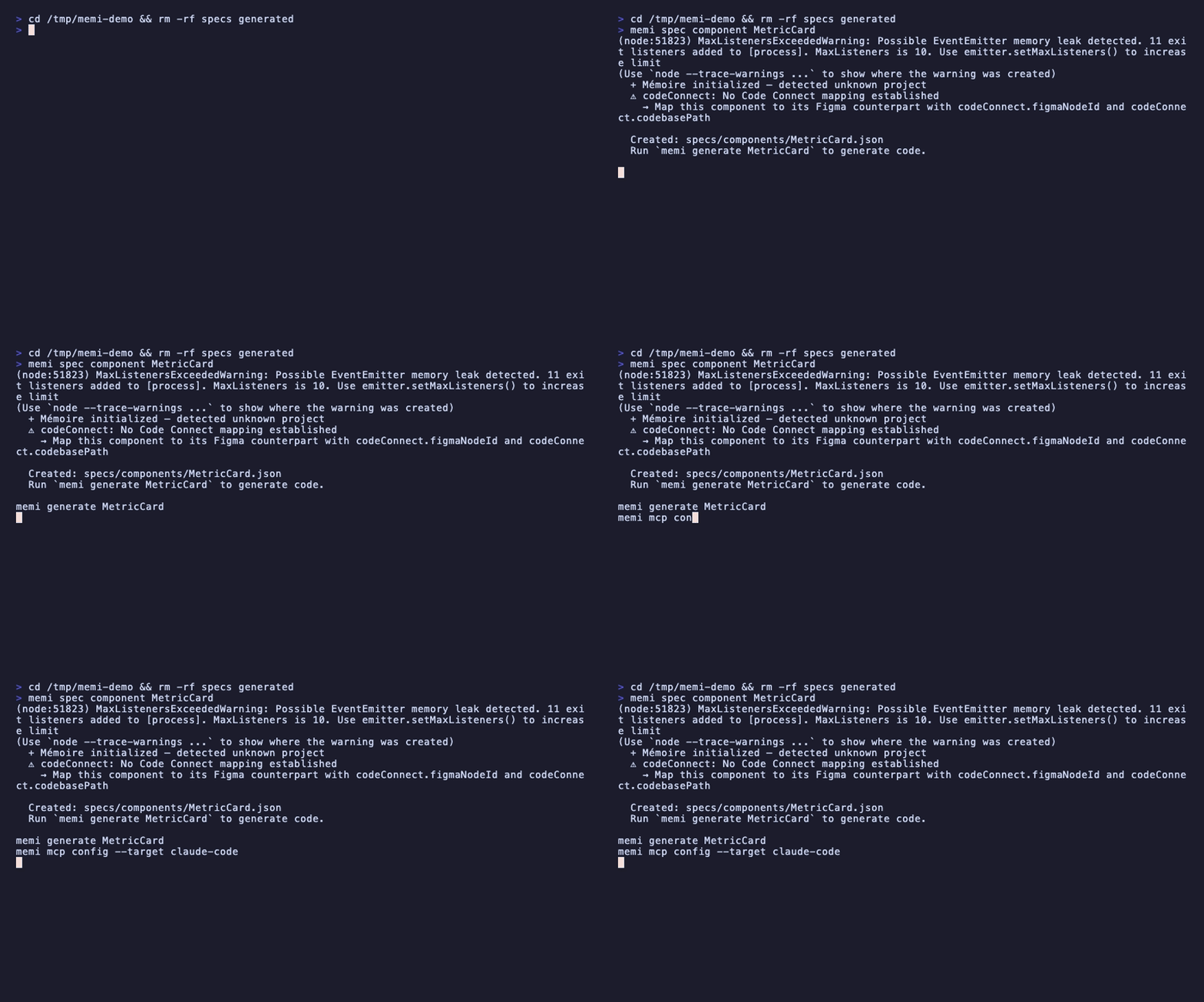
Install
npm i -g @memi-design/cli
30-second example
memi diagnose                       # audit your current Tailwind app
memi tokens --from ./src --report   # extract design tokens
memi shadcn export --out public/r   # publish a shadcn-native registry
Looking for the macOS app? memi Studio (Tauri shell, signed DMG) lives at github.com/sarveshsea/memi-studio. Homepage: memoire.cv.
Full quickstart → · llms.txt · Compatibility: shadcn registry · v0 design systems
Install Mémoire into your AI agent
0.16.3 ships native agent kits and the first native-runtime trust patch inside the npm package. Install Memoire once, initialize the workspace suite manifest, warm the shared daemon, then give Hermes agents, OpenClaw bots, Claude Code, Cursor, Codex, and OpenCode the same design-system memory, Figma bridge context, Atomic Design rules, shadcn/ui codegen, Tailwind diagnostics, and research-backed UI audit flow.
npm i -g @sarveshsea/memoire

memi suite init --project .
memi daemon start --project . --port auto
memi daemon status --json
memi simulate plan --hypothesis "New onboarding lowers activation risk" --json

memi agent install hermes
memi agent install openclaw --project .
memi agent install claude-code --project .
memi agent install cursor --project .
memi agent install codex
memi agent install codex-plugin
memi agent install opencode --project .

# install every supported kit, or inspect first
memi agent install --project .
memi agent install --dry-run --json
Hermes and OpenClaw receive memoire-design-tooling SKILL.md packages. Claude Code and Cursor receive MCP config for memi mcp start --no-figma. Codex can receive either the skill-only kit with memi agent install codex or the full Codex plugin with memi agent install codex-plugin, which installs a home-local plugin and marketplace entry. OpenCode receives a workspace skill-style context pack. Agent kit installs also plan or write memoire.agent.yaml, the YAML suite manifest agents use for memory sources, harnesses, skills, and recipes. Mirror-ready community skill files live in agent-kits/mirror for sarveshsea/memoire-agent-skills. MCP registries and crawlers can inspect the Figma-independent server with memi mcp start --no-figma.
| Agent | Native install target | What it unlocks |
|---|---|---|
| Hermes | ~/.hermes/skills/memoire/memoire-design-tooling/SKILL.md |
Hermes loads Memoire as a design-system skill for UI, Figma, specs, and research runs. |
| OpenClaw | <workspace>/skills/memoire/memoire-design-tooling/SKILL.md |
OpenClaw picks up a workspace skill with memi install metadata for ClawHub-style agent use. |
| Claude Code | .mcp.json |
Project MCP config for memi mcp start --no-figma; Claude Code asks to approve project MCP servers from .mcp.json. |
| Cursor | .cursor/mcp.json |
Cursor MCP config for Memoire design-system tools. |
| Codex skill | ~/.codex/skills/memoire/memoire-design-tooling/SKILL.md |
Skill-only instructions for design audits, Figma context, specs, and Tailwind/shadcn workflows. |
| Codex plugin | ~/plugins/memoire + ~/.agents/plugins/marketplace.json |
Full Codex plugin with the Memoire skill and MCP server wiring. |
| OpenCode | workspace skill pack | Agent-native instructions for design audits, Figma context, specs, and Tailwind/shadcn workflows. |
Public Codex plugin marketplace
Memoire also ships as a Git-backed Codex marketplace so users can install it from /plugins without waiting for the official Codex Plugin Directory:
codex plugin marketplace add sarveshsea/m-moire --ref main --sparse .agents/plugins --sparse plugins/memoire
Then open /plugins in Codex and install Memoire from the marketplace list. The same plugin is available through npm for users who already have memi:
npm i -g @sarveshsea/memoire
memi agent install codex-plugin
See docs/CODEX_PLUGIN.md and the public plugin page at https://www.memoire.cv/codex-plugin.
Mémoire Studio for macOS
0.16.3 includes Mémoire Studio: a macOS agent workbench and local web shell for Claude Code, Codex, Hermes, OpenCode, Ollama, Gemini, Mémoire Native, project memory, the Figma bridge, and an in-app Marketplace for Mémoire Notes. The desktop app includes a native Agent Kits panel so you can dry-run, install, and force-refresh Hermes/OpenClaw/Claude/Cursor/Codex/OpenCode kits without leaving Studio. Studio and the CLI share the same daemon-aware install path, suite manifest, project memory, harness metadata, and MCP startup guidance.
# web/TUI workflows from npm
memi studio web --port 1422
memi studio tui
memi studio logs --follow
memi studio run --harness codex --action design-doc --prompt "Audit this UI and generate a design spec"

# local macOS app build
npm run studio:build
open "apps/studio/src-tauri/target/release/bundle/dmg/Mémoire Studio_0.16.3_aarch64.dmg"

# signed and notarized direct DMG release
npm run studio:release:macos

memi video create "Launch story" --adapter remotion --prompt "Product motion system"
Tagged GitHub Releases attach signed and notarized DMGs when Apple release secrets are configured. See docs/STUDIO_MACOS_RELEASE.md.
Product Scenario Lab
Memoire includes a clean-room product simulation layer for research-backed spec work. memi simulate maps research/store.v2.json into personas, variables, graph edges, model-swarm transcripts, interviews, reports, and spec-impact artifacts. Studio exposes the same flow through the simulate action and Scenario Lab so Codex, Claude Code, Hermes, OpenCode, Ollama, OpenAI-compatible providers, and deterministic fallback can operate from the macOS workbench.
memi research synthesize
memi simulate models --json
memi simulate generate-agents --adapter model-swarm --count 24 --json
memi simulate plan --hypothesis "Evidence-linked acceptance criteria reduce launch risk" --json
memi simulate run <scenario-id> --adapter local --json
memi simulate run <scenario-id> --adapter model-swarm --max-agents 24 --rounds 3 --json
memi simulate run-matrix --adapter model-swarm --hypothesis "Faster setup reduces churn" --hypothesis "Evidence links reduce churn" --json
memi simulate transcript <run-id> --json
memi simulate costs <run-id> --json
memi simulate compare <run-a> <run-b> --json
memi simulate interview <run-id> --agent <agent-id> --prompt "What should change in the spec?" --json
memi simulate report <run-id> --json
memi simulate export-spec <run-id> --json
Live model calls are opt-in; model-swarm falls back deterministically when Codex, Claude Code, Ollama, or provider credentials are unavailable. Studio and MCP expose: simulation.models, simulation.generate_agents, simulation.plan, simulation.run, simulation.run_matrix, simulation.stream, simulation.transcript, simulation.compare, simulation.costs, simulation.interview, simulation.report, and simulation.export_spec.
The npm package does not vendor MiroFish source. The optional --adapter mirofish --url <server> path talks to a separately licensed fork bridge over /api/memoire/capabilities, /api/memoire/import, /api/memoire/runs/:id/events, /api/memoire/runs/:id/interview, and /api/memoire/runs/:id/export.
Research Vibe Design + FigJam Export
Product agents can now turn research/store.v2.json and optional Scenario Lab reports into full Atomic Design specs plus Mermaid Jam-ready FigJam source. The first delivery path is source + open: Memoire writes Mermaid/markdown artifacts under .memoire/mermaid-jam/<package-id>/ and opens Mermaid Jam when requested; it does not automate clipboard or direct paste.
memi research synthesize
memi research design --intent "Design an evidence-backed planning board" --hypothesis "Evidence links improve product confidence" --json
memi research design --write-specs --mermaid-jam --json
memi research design --run-id <simulation-run-id> --write-specs --mermaid-jam --open --json
memi mermaid-jam export --from research --json
memi mermaid-jam export --from <simulation-run-id> --open --json
Studio exposes the same flow through research.design_package, research.generate_specs, and mermaid_jam.export. Scenario Lab includes an Export to FigJam action that generates the research design package, writes Mermaid Jam source, and opens the local manifest when ready or the Figma Community route otherwise.
Install the output anywhere
# shadcn-compatible registry item
npx shadcn@latest add https://your-site.com/r/button.json

# v0 / AI-editor context
memi shadcn serve --port 4014

# Mémoire install path with aliases, npm packages, URLs, GitHub, or local paths
memi registry install Button --from @you/ds
memi add Button --from ./public/r
No Figma required
Most developer teams do not start in Figma. Memoire reads the codebase directly: Tailwind classes, shadcn usage, CSS variables, routes, markup, repeated literals, dark-mode coverage, token aliases, component targets, and registry shape.
# Diagnose an existing app from code
memi diagnose

# Diagnose a running local route / public URL
memi diagnose http://localhost:3000

# Extract the token system from the app and write audit reports
memi tokens --from ./src --output generated/tokens --report

# Export shadcn-compatible registry.json and /r/*.json items
memi shadcn export --out public/r

# Save extracted tokens into .memoire/design-system.json for publish/codegen flows
memi tokens --from ./src --save
Reports are written to .memoire/app-quality/diagnosis.{json,md} and token extraction emits CSS, Tailwind, JSON, Style Dictionary, semantic coverage, scale-health notes, alias graph validation, duplicate-value groups, recommendations, and inferred token candidates. Shadcn export emits registry.json plus installable item JSON files under /r.
Trust defaults
The public npm package does not run install-time lifecycle scripts. Figma plugin installation is explicit with memi setup plugin, and repairs are explicit with memi doctor --repair-plugin. The default packaged Figma plugin disables raw JavaScript execution; agents should use typed Memoire Figma tools, MCP tools, suite recipes, and local commands that the user can inspect.
Registry workflow
After diagnosis, the registry loop is simple: publish the improved design system, mirror shadcn-native registry files, install real components anywhere, then keep the registry updated as the source changes.
Existing app/CSS -> tokens -> shadcn registry
npm i -g @sarveshsea/memoire

memi tokens --from ./src --report
memi shadcn doctor
memi shadcn export --out public/r
memi publish --name @you/ds
memi add Button --from @you/ds
Point Memoire at src/, app/globals.css, a built CSS file, http://localhost:3000, or a public URL.
Published registry -> shadcn/v0/AI editors
# Install through shadcn directly
npx shadcn@latest add https://cdn.example.com/r/button.json

# Use the same registry as AI design-system context
memi shadcn serve --from @you/ds

# Install through Memoire when you want alias/package/URL/GitHub resolution
memi registry install Button --from @you/ds
Figma -> npm -> shadcn app
npm i -g @sarveshsea/memoire

# Publish your Figma file to npm
npx @sarveshsea/memoire publish --name @you/ds --figma https://figma.com/design/xxx --push

# From any project, drop working code in
npx @sarveshsea/memoire add Button --from @you/ds
# → src/components/memoire/Button.tsx (real working code, not a spec)
tweakcn -> npm -> shadcn app
npm i -g @sarveshsea/memoire

memi theme import ./tweakcn-export.css --name "Acme Theme"
memi theme publish "Acme Theme" --package @you/theme
memi add Button --from @you/theme
A registry bundles tokens (W3C DTCG JSON + Tailwind v4 @theme CSS), component specs, and real generated code for React / Vue / Svelte. Publishable to npm, GitHub, or any static host.
Featured registries
@memoire-examples/starter-saas— neutral SaaS starter. Install withmemi add Button --from @memoire-examples/starter-saas. Source:examples/presets/starter-saas@memoire-examples/docs-blog— editorial docs/blog kit. Install withmemi add Button --from @memoire-examples/docs-blog. Source:examples/presets/docs-blog@memoire-examples/dashboard— high-contrast analytics dashboard. Install withmemi add Button --from @memoire-examples/dashboard. Source:examples/presets/dashboard
More examples and the featured fallback catalog live in examples/.
Designed in tweakcn? Publish with Memoire.
tweakcn is the visual theme editor for shadcn/ui. Memoire now treats tweakcn as a full workflow, not just a publish flag:
# Import from a tweakcn CSS export or share URL
memi theme import ./tweakcn-export.css --name "Acme Theme"
memi theme import https://tweakcn.com/r/themes/xxx --name "Acme Theme"

# Validate, preview, diff, and generate packaged variants
memi theme validate "Acme Theme"
memi theme preview "Acme Theme"
memi theme variants "Acme Theme"

# Apply it into the current workspace or publish it to npm
memi theme apply "Acme Theme"
memi theme publish "Acme Theme" --package @you/theme
Theme import handles both Tailwind v3 (:root { --primary: ... }) and v4 (@theme { --color-primary: ... }) exports, including :root + .dark multi-mode themes. If you want the one-shot path, memi publish --theme <path-or-url> still works.
Demo scripts for recording and reuse live in docs/DEMOS.md.No-Figma proof examples live in docs/PROOF.md.
Why teams keep Memoire in the stack
Claude Design, Figma Make, Lovable, Bolt, Replit Agent, and v0 are useful for fast first passes. Memoire is for the part after that first pass, when the output has to survive beyond a single prompt or canvas session.
- App builders: strong for creating the first version. Memoire diagnoses the design debt that shows up once the app is real.
- Claude Design and Figma Make: strong for visual exploration. Memoire keeps the reusable system portable across code, registries, and AI tools.
- v0: strong for generating screens and using registries. Memoire helps infer, improve, and publish the registry from the app you already have.
If your team needs better visual quality, versioned tokens, installable components, tweakcn theme packaging, and cross-tool design system context, that is the Memoire wedge.
Studio interface references and adapted components
Memoire Studio is a desktop-first agent workbench for design runs. Its interface uses Hermes WebUI and Hermes Agent as MIT-licensed references for the transcript-first console, three-pane workbench, event normalization, and supervised local sessions.
Studio runs Claude Code, Codex, Hermes, Ollama, OpenCode, Gemini, and Memoire Native through a shared harness manifest. External coding agents receive a Memoire design/research envelope before execution, so their runs start from project memory, specs, references, Figma state, accessibility, and Atomic Design rather than a generic coding prompt. The macOS app also has an Agent Kits panel for dry-run planning, installation, and force-refresh of Hermes, OpenClaw, Claude Code, Cursor, Codex, and OpenCode kit targets. memi studio tui and memi studio logs expose the same persisted JSONL events for terminal-first visibility into package logs, Claude/Codex output, harness status, approvals, artifacts, and final results.
Studio also includes a Notes Marketplace that lists built-in Notes, installed workspace Notes, and installable packages from the repo-owned notes/*/note.json manifests. The Marketplace uses the same Notes installer logic as memi notes, so installed packs become normal .memoire/notes project memory and agent context.
The desktop app source lives in apps/studio. Build output stays out of git under apps/studio/src-tauri/target; tagged GitHub Releases attach the downloadable macOS DMGs, for example Mémoire Studio_0.16.3_aarch64.dmg. For a local build, run:
npm run studio:build
For public direct-download DMGs, use the signed/notarized release gate in docs/STUDIO_MACOS_RELEASE.md.
Motion/video work is native in 0.15 through optional Remotion and HyperFrames adapters. memi video create|preview|render stores projects under .memoire/videos without making either video tool a hard dependency.
Warp is used as a product reference for terminal blocks and grouped command output. Only MIT-licensed Warp UI framework pieces such as warpui_core and warpui are considered for adaptation; Warp AGPL application/client code is not copied into Memoire.
See NOTICE for source links and attribution details.
What you get
| Input | Output |
|---|---|
| Existing shadcn/Tailwind app | Design debt diagnosis with scores, issues, reports, and visual direction options |
| Existing CSS/code/URL | Extracted design tokens with modes, aliases, semantic coverage, scale health, and Style Dictionary export |
| Figma file | npm-ready design system registry with tokens, specs, and real components |
| tweakcn theme | A first-class workflow: import, preview, diff, validate, apply, variants, publish |
| Any public URL | DESIGN.md plus an optional starter registry scaffold |
| JSON specs | React + TypeScript + Tailwind components (shadcn/ui) |
| Generated registries | Installable components for React / Vue / Svelte |
npm i -g @sarveshsea/memoire

memi diagnose                         # audit the current app from code
memi diagnose http://localhost:3000   # audit a running route or public URL
memi design-doc https://linear.app     # extract any site's design system
memi tokens --from ./src --save         # extract app tokens into the registry
memi tokens --from ./src --report       # write token-extraction.report.{md,json}
memi go                                 # figma -> tokens -> specs -> components -> preview
memi go --rest                          # same thing, no figma desktop needed
memi go --penpot                        # same thing, from penpot
memi tokens                             # export as CSS / Tailwind / JSON / Style Dictionary
Install without npm (work laptops, locked-down environments)
No Node, no npm, no admin rights.
# macOS / Linux — auto-patches your shell profile, verifies SHA256
curl -fsSL https://memoire.cv/install.sh | sh

# Windows (PowerShell) — auto-adds to user PATH
irm https://memoire.cv/install.ps1 | iex

# Homebrew (macOS / Linux)
brew install sarveshsea/memoire/memoire

# Docker (air-gapped envs where only ghcr.io is reachable)
docker run --rm -it -v "$PWD:/work" -w /work ghcr.io/sarveshsea/memoire --help

# Self-update once installed
memi upgrade
Manual download if curl, brew, and docker are all blocked — grab the archive from GitHub Releases:
| Platform | Archive |
|---|---|
| macOS (Apple Silicon) | memi-darwin-arm64.tar.gz |
| macOS (Intel) | memi-darwin-x64.tar.gz |
| Linux (x86_64) | memi-linux-x64.tar.gz |
| Windows (x64) | memi-win-x64.zip |
Verify with SHA256SUMS.txt (attached to every release). Extract, add memi to PATH, run memi connect. The skills/, notes/, plugin/, preview/ directories must stay next to the binary — Mémoire loads them at runtime.
Advanced: Use with AI agents
Memoire can install native agent kits and also run as an MCP server, so your AI assistant can work directly with your design system after the registry workflow is in place. Use memi agent install --dry-run --json to inspect every write before installing. For copy-paste prompts and client-specific setup, see docs/AGENT_RECIPES.md.
memi suite init --project .              # writes memoire.agent.yaml
memi daemon start --project . --port auto # warms shared local runtime context
memi daemon status --json                # check native runtime readiness
memi agent install hermes                # ~/.hermes/skills/memoire/memoire-design-tooling
memi agent install openclaw --project .  # ./skills/memoire/memoire-design-tooling
memi agent install claude-code --project . # writes .mcp.json
memi agent install cursor --project .    # writes .cursor/mcp.json
memi agent install codex                 # ~/.codex/skills/memoire/memoire-design-tooling
memi agent install codex-plugin          # ~/plugins/memoire + ~/.agents/plugins/marketplace.json
memi agent install opencode --project .  # ./.opencode/skills/memoire/memoire-design-tooling
memi mcp config --install                # direct MCP config path
Or add manually to .mcp.json:
{
  "mcpServers": {
    "memoire": {
      "command": "memi",
      "args": ["mcp", "start", "--no-figma"]
    }
  }
}
Tools include: pull_design_system, generate_code, create_spec, get_tokens, compose, design_doc, run_audit, capture_screenshot, analyze_design, and more in the docs.
For MCP registry crawlers, smoke tests, and Glama freshness checks, use the Figma-independent startup command:
memi mcp start --no-figma
Release/publish recovery flow:
npm logout --registry=https://registry.npmjs.org/
npm login --auth-type=web --registry=https://registry.npmjs.org/
npm whoami --registry=https://registry.npmjs.org/   # must print sarveshsea
npm publish --access public --auth-type=web
npm view @sarveshsea/memoire version dist-tags.latest mcpName --json
mcp-publisher login github
mcp-publisher publish server.json
npm run check:public-release
Full command reference
Core workflow| Command | What it does |
|---|---|
memi setup |
Full onboarding: token, file, plugin, bridge, MCP config, test pull |
memi setup plugin |
Explicitly copy the packaged Figma plugin to ~/.memoire/plugin |
memi init |
Initialize workspace with starter specs |
memi diagnose [target] |
Diagnose design debt in an existing web app from code or URL |
memi connect |
Start Figma bridge (auto-discovers plugin on ports 9223-9232) |
memi mermaid-jam status |
Inspect the Mermaid Jam FigJam plugin link, repo, and local manifest path |
memi mermaid-jam export --from research |
Write research-backed Mermaid Jam source artifacts for FigJam |
memi pull |
Extract tokens, components, styles from Figma |
memi pull --rest |
Pull via REST API -- no plugin, no Figma Desktop |
memi pull --penpot |
Pull from Penpot (needs PENPOT_TOKEN + PENPOT_FILE_ID) |
memi spec <type> <name> |
Create a component, page, or dataviz spec |
memi generate [name] |
Generate shadcn/ui code + Storybook stories from specs |
memi generate --no-stories |
Generate without Storybook stories |
memi preview |
Start preview gallery + shadcn registry server |
memi theme <subcommand> |
tweakcn workflow: import, preview, validate, diff, apply, variants, publish |
memi go |
Full pipeline in one command |
memi export |
Export generated code into your project |
memi tokens |
Export registry tokens as CSS / Tailwind / JSON / Style Dictionary (W3C DTCG) |
| `memi tokens --from <file | dir |
memi validate |
Validate all specs against schemas |
| Command | What it does |
|---|---|
memi design-doc <url> |
Extract design system from any URL into DESIGN.md |
memi design-doc <url> --spec |
Also write a DesignSpec JSON for codegen |
memi extract <url> |
Alias for design-doc |
| Command | What it does |
|---|---|
memi sync |
Full sync: Figma + specs + code |
memi sync --live |
Watch and sync continuously |
memi compose "<intent>" |
Agent orchestrator: classify, plan, execute |
memi agent install [target] |
Install Memoire agent kits for Hermes, OpenClaw, Claude Code, Cursor, Codex, Codex plugin, or OpenCode |
memi agent spawn <role> |
Spawn a persistent agent worker |
| `memi daemon start | status |
| `memi suite init | doctor |
memi research from-file <path> |
Process Excel/CSV into research |
memi research synthesize |
Synthesize themes and personas |
memi research design --write-specs --mermaid-jam |
Generate research-backed Atomic Design specs and FigJam source |
| Command | What it does |
|---|---|
memi status |
Project status overview |
memi doctor |
Health check: project, plugin, bridge |
memi dashboard |
Launch monitoring dashboard |
memi audit |
Design system audit (WCAG, unused specs) |
All commands support --json for structured output.
Spec-first workflow
Every component starts as a JSON spec before code is generated:
{
  "name": "MetricCard",
  "type": "component",
  "level": "molecule",
  "shadcnBase": ["Card", "Badge"],
  "props": { "title": "string", "value": "string", "trend": "string?" },
  "variants": ["default", "compact"]
}
Specs are validated with Zod schemas. Components follow Atomic Design (atom, molecule, organism, template, page).
Architecture
src/
  engine/     Core orchestrator, registry, sync, pipeline
  figma/      WebSocket bridge + REST client + Penpot client
  agents/     Intent classifier, plan builder, task queue
  mcp/        MCP server (tools, resources, stdio)
  codegen/    shadcn/ui mapper, Storybook, dataviz, pages
  research/   Research engine (Excel, stickies, web)
  specs/      Spec types, Zod schemas, 62-component catalog
  preview/    Preview gallery, API server, shadcn registry
  notes/      Downloadable skill packs
  commands/   CLI command surface
  plugin/     Figma plugin (Widget V2)
Links
Quickstart -- Examples -- Launch Pack -- Changelog
License
MIT


