
Game Development Studio
Local-first tools for producing, packaging, vendoring, capturing, debugging,and optimizing game assets and renders. The stable automation interface is thegame-dev command-line program and its JSON/JSONL protocol; five focused skillsand a native macOS companion build on that same inspectable boundary.
The project is designed for human developers and local coding agents that needmore than a screenshot: immutable run bundles can combine render attachments,scene controls, logs, counters, timing samples, and provenance so a visualdiagnosis has inspectable evidence behind it.
What it does
- Drives Tripo 3D and Leonardo image/audio jobs through explicit,per-invocation spend authorization.
- Inspects and validates GLB assets, normalizes meshes through Blender, andcreates optional USDZ previews.
- Builds content-addressed asset packages with hashes, receipts, provenance,licenses, validation results, and a rebuildable catalog.
- Plans project vendoring before it writes and blocks unknown licenses,invalid packages, symlink escapes, and destination collisions by default.
- Runs declarative, project-owned capture scenarios with independentauthorizations for execution, GPU use, and hardware-performance collection.
- Seals render outputs, semantic attachments, telemetry, logs, and metrics intoverifiable run bundles.
- Computes deterministic raster statistics, heatmaps, attachment-awarecomparisons, metric summaries, and bounded optimization goals.
- Ships a router and four focused Codex/ChatGPT skills without automaticallyinstalling anything into a user profile.
Requirements
- Node.js 22.5 or newer
- macOS, Linux, or Windows for the CLI
- Blender only for normalization or Blender-backed preview workflows
- Tripo or Leonardo credentials only for the corresponding paid provideroperations
- A project adapter only when executing game-specific capture scenarios
The native companion requires macOS 26 and a Swift 6.2 toolchain to build fromsource. It remains optional: the CLI and skills do not require the app.
Repository layout
| Path | Owns |
|---|---|
src/ |
Cross-platform game-dev CLI and reusable TypeScript core |
skills/ |
Router plus four focused Codex/ChatGPT skills |
adapters/ |
Declarative game-specific capture adapters |
apps/macos/GameDevelopmentStudio/ |
Native macOS 26 SwiftUI companion |
docs/ |
Protocol, architecture, package, adapter, and app contracts |
distribution/ |
Reproducible public skills and binary-app repository templates |
assets/ and marketing/ |
Byte-provenanced product art, screenshots, and publication copy |
See Repository layout for what each distributionships and which outputs are generated rather than source-controlled.
Product tour
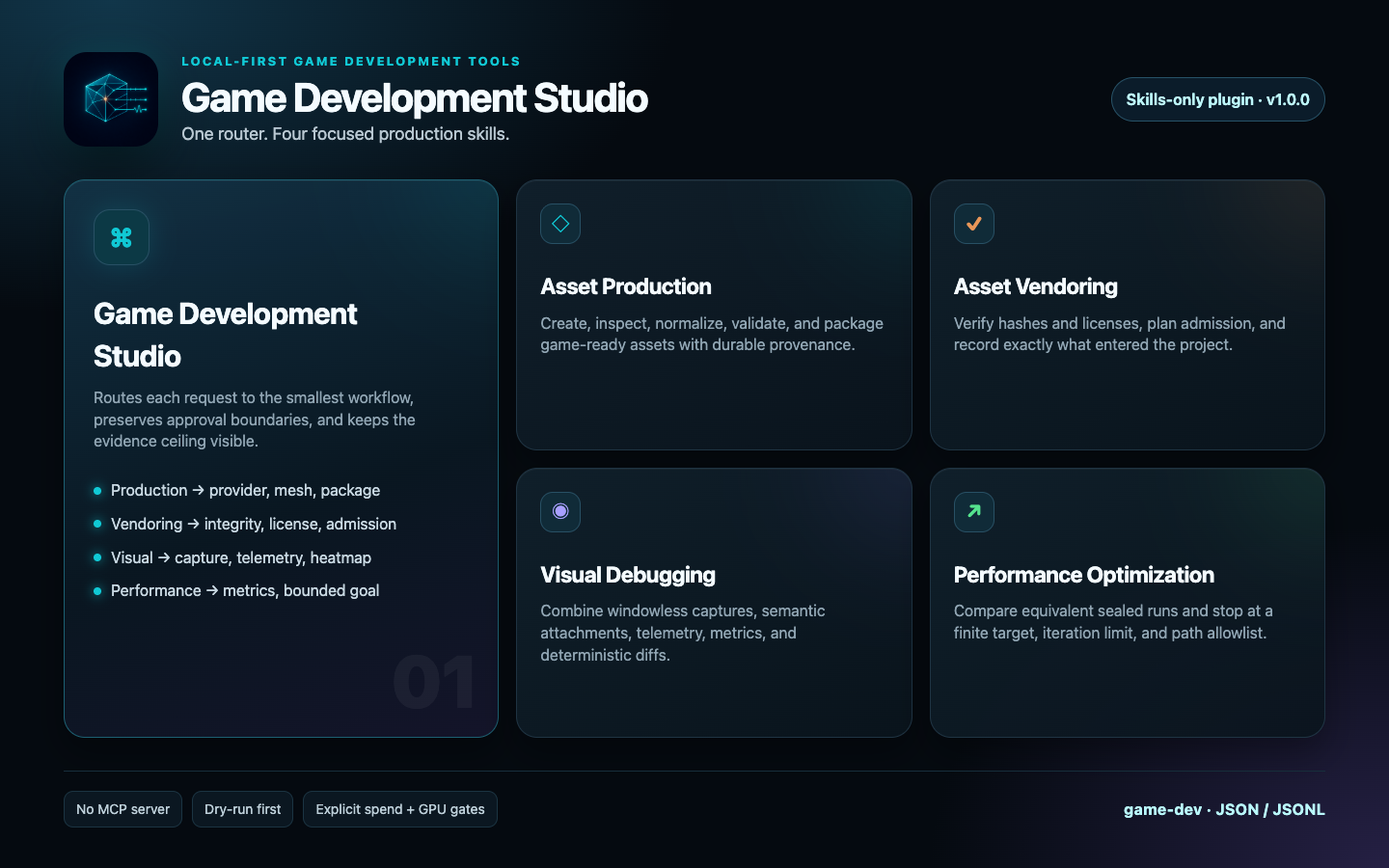
Product composition using the shipped skill names and metadata.
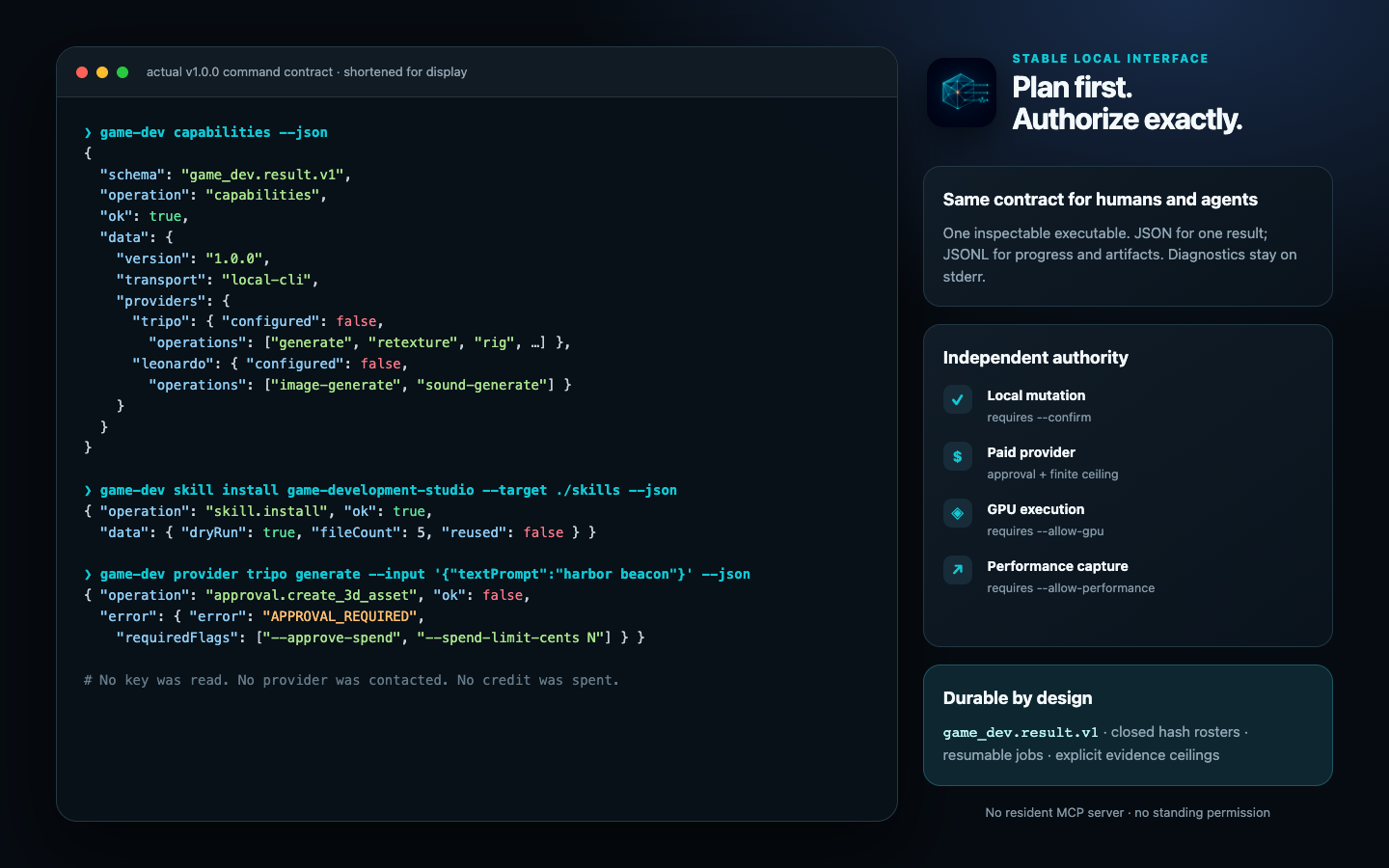
Marketing composition based on actual v1.0.0 CLI output, shortened for display.It illustrates the command contract; it is not a current-run claim.
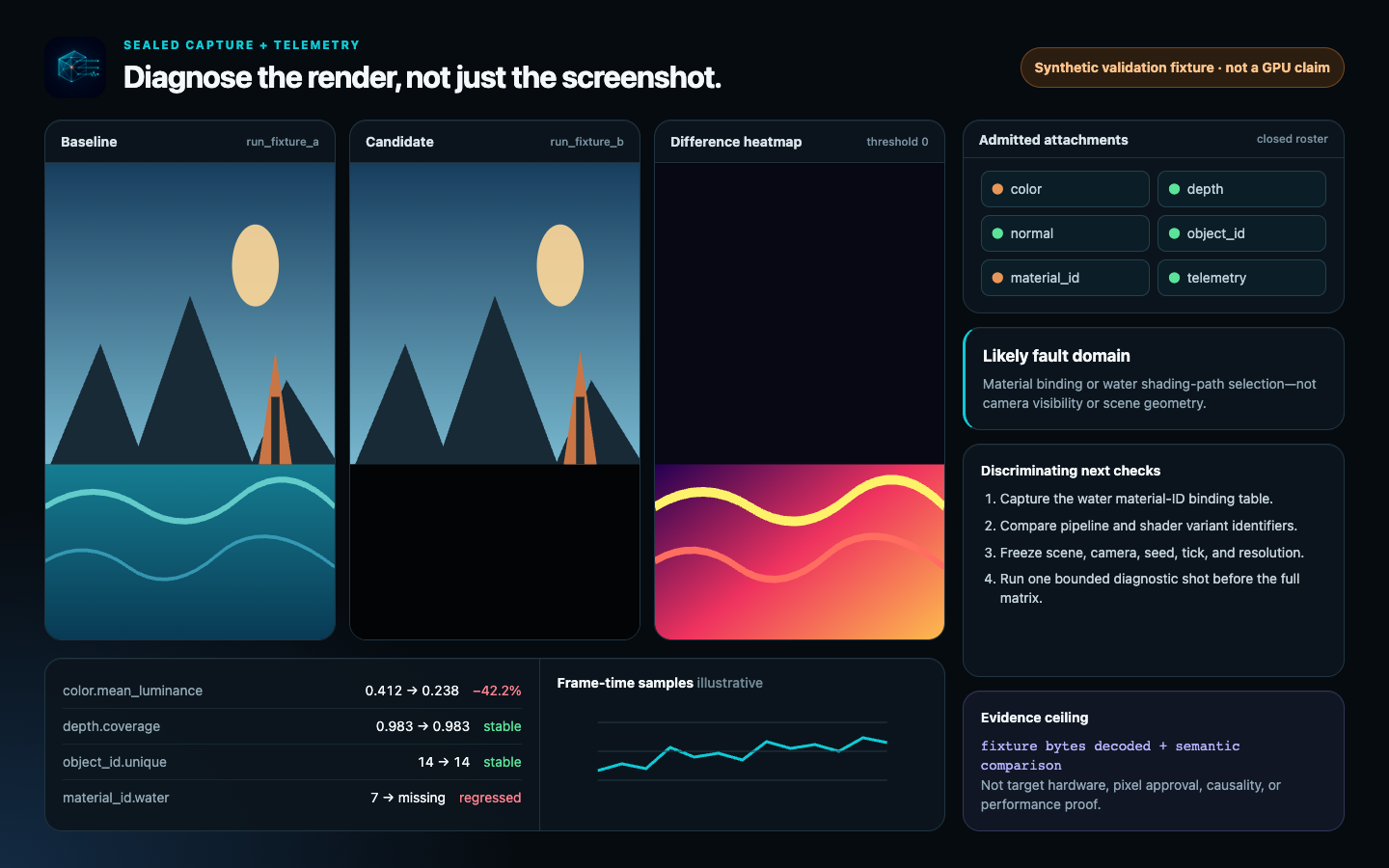
The third image is explicitly a synthetic validation fixture. It demonstratesthe diagnostic layout and evidence language; it is not a target-game capture,hardware GPU result, or performance claim.
Native macOS app
The repository also contains a native SwiftUI companion with four first-classworkspaces: Production, Library & Vendoring, Visual Debugging, and Performance.It presents the existing local game-dev protocol through aNavigationSplitView, system search and toolbar controls, a result inspector,keyboard commands, a dedicated Settings scene, and explicit empty, loading, anderror states. Its complete bundle carries a closed, exact-rostered build of thesame CLI plus a direct Node runtime; it has no publisher-hosted backend.
Provider credentials are entered in masked fields, stored in the macOSKeychain, and shown only as configured or not configured. Paid provider calls,package construction, project vendoring, scenario execution, GPU capture, andhardware-performance collection use one-shot approval sheets. Vendoring andscenario execution are dry-run-first, and changing their planned inputsinvalidates the current approval path. Sensitive operations bind that approvalto the full local runtime-tree digest and execute a separately verified privatesnapshot, rather than trusting an arbitrary global CLI or PATH-selected Node.
From the repository root:
./script/build_and_run.sh --test
./script/build_and_run.sh --build-only
./script/build_and_run.sh          # build and launch
./script/build_and_run.sh --verify # process-level launch check only
The helper producesapps/macos/GameDevelopmentStudio/dist/GameDevelopmentStudio.app with an ad-hocsignature for local development. It is not a Developer ID-signed, notarized, orMac App Store build. The --verify mode finding a live process after twoseconds does not prove window readiness, pixel correctness, workflow behavior,accessibility, or human acceptance.
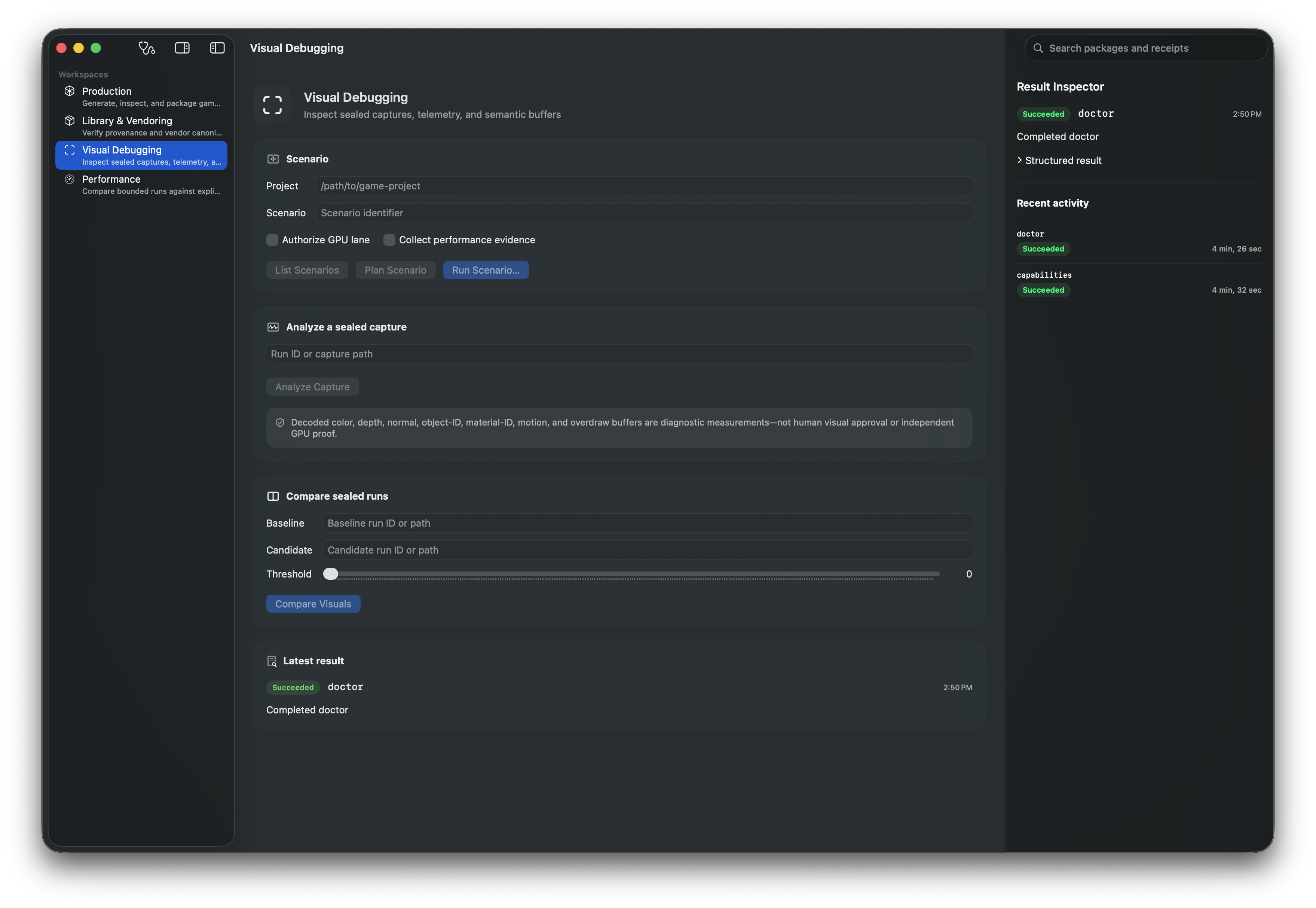
This is a full-resolution capture of one reviewed native macOS 26 runtime state:the Visual Debugging workspace in the default Dark appearance after a successfullocal doctor check. Its byte-level provenance is recorded separately. It doesnot prove a target-game GPU capture, pixel correctness across the app, light-modebehavior, accessibility, performance, signing identity, notarization, or humanacceptance.
See Native macOS app for the architecture, approval andKeychain boundaries, commands, local-bundle status, and exact evidence limits.
Install
From a published npm release:
npm install --global @theisegoria/game-development-studio
game-dev --version
From source:
git clone https://github.com/theisegoria/game-development-studio.git
cd game-development-studio
npm ci
npm run build
node dist/cli.js --help
No provider call is made during installation, build, test, doctor, orcapabilities.
Quick start
Choose a workspace and inspect the local environment:
game-dev capabilities --output-dir ./asset-workspace --json
game-dev doctor --output-dir ./asset-workspace --json
game-dev credentials status --output-dir ./asset-workspace --json
Inspect an existing GLB without invoking Blender or a provider:
game-dev asset inspect ./model.glb --output-dir ./asset-workspace --json
game-dev asset validate ./model.glb --output-dir ./asset-workspace --json
Build and verify a canonical package. package build writes a new package eventhough it has no --confirm flag, so review the resolved source, outputworkspace, name, version, license, and collision behavior before authorizingthat exact invocation:
game-dev package build ./model.glb \
  --name "Signal Beacon" \
  --version 1.0.0 \
  --license CC0-1.0 \
  --output-dir ./asset-workspace \
  --json

game-dev catalog list --output-dir ./asset-workspace --json
game-dev package verify PACKAGE_ID --output-dir ./asset-workspace --json
Project admission is dry-run-first:
game-dev vendor admit PACKAGE_ID --project /path/to/game --json
game-dev vendor admit PACKAGE_ID --project /path/to/game --confirm --json
The second command is a new invocation with explicit write authorization. Aplan does not become standing permission.
Paid provider jobs
Provider routes require game-dev 1.0.2 or newer. The account holder mustconfigure the provider credential outside ChatGPT, Codex, and the pluginconversation, using a local credential mechanism they control. The CLI reads apreconfigured environment value lazily and never accepts a key as a commandargument; the native macOS app can use Keychain. Never paste a key into aconversation, request file, source file, log, screenshot, or support report.
Check presence without revealing the value:
game-dev credentials status --output-dir ./asset-workspace --json
Every paid invocation needs both approval and a finite estimated spend ceiling:
game-dev provider tripo generate \
  --request ./requests/prop.json \
  --approve-spend \
  --spend-limit-cents 100 \
  --output-dir ./asset-workspace \
  --jsonl
These are optional user-operated requests made directly from the local CLI tothe selected provider using the user's own account and API access. Thepublisher runs no proxy, shared account, credential service, resale layer, orprovider job queue. Supported routes are:
- Tripo:
generate,retexture,rig,retarget, andretopologize - Leonardo:
image-generateandsound-generate
The ceiling is a refusal guard based on estimated prices, not a providerinvoice. Provider submission creates a durable local job before polling so aninterruption does not erase what was requested or what may have been charged.Resuming a job requires fresh authorization.
Capture harness
An adapter is a declarative .game-dev/adapter.json owned by the target game.It names scenarios, commands, parameters, declared capabilities, and the runoutput contract. Installing a template and inspecting an adapter do not executethe game.
game-dev adapter templates --json
game-dev adapter install genome-game --project /path/to/game --json
game-dev adapter install genome-game --project /path/to/game --confirm --json
game-dev scenario list --project /path/to/game --json
game-dev scenario plan trident-bay-contract --project /path/to/game --json
Execution requires --confirm. A scenario that declares GPU orhardware-performance capability additionally requires --allow-gpu or--allow-performance for that invocation:
game-dev scenario run trident-bay-windowless-metal \
  --project /path/to/game \
  --request ./capture-parameters.json \
  --confirm \
  --allow-gpu \
  --jsonl
Once the adapter has produced its staging output, the harness validates theclosed artifact roster and hashes it into a sealed run bundle. Typicalattachments include color, depth, normals, object IDs, material IDs, motion,and overdraw, but the adapter declares the exact set.
game-dev capture verify RUN_ID --json
game-dev visual analyze RUN_ID --json
game-dev visual compare BASELINE_RUN CANDIDATE_RUN \
  --threshold 0 \
  --output ./comparison \
  --jsonl
game-dev performance compare BASELINE_RUN CANDIDATE_RUN --stat median --json
See Capture adapters for the manifest and output contract.
Skill suite
The distribution contains five self-contained skills:
game-development-studio: router and shared operating contractgame-asset-production: provider, inspection, normalization, and packaginggame-asset-vendoring: catalog, integrity, migration, and project admissiongame-visual-debugging: adapters, captures, telemetry, and raster evidencegame-performance-optimization: metrics and bounded optimization goals
List the exact packaged bytes:
game-dev skill list --json
Installation is dry-run-first and refuses symlinked targets or drifted existingcopies:
game-dev skill install all --target /path/to/codex/skills --json
game-dev skill install all --target /path/to/codex/skills --confirm --json
Nothing in this repository installs into ~/.codex, Genome, or another gameproject without an explicit confirmed command. The standalone plugin source ispublished separately attheisegoria/game-development-studio-skills.
Machine-readable protocol
--jsonemits exactly onegame_dev.result.v1object to stdout.--jsonlemits orderedgame_dev.event.v1records followed by oneterminal result event.- Logs and diagnostics go to stderr.
- Secrets are redacted from structured errors, receipts, jobs, and URLs.
- Persisted artifacts use atomic replacement and closed hash rosters where theformat promises immutability.
Read CLI protocol before integrating the command with anagent or GUI.
Workspace layout
By default, ASSET_OUTPUT_DIR is ./assets/generated; durable state isunder $ASSET_OUTPUT_DIR/.game-dev.
assets/generated/
├── .jobs/                  legacy-compatible asset job records
└── .game-dev/
    ├── jobs/               durable provider operations
    ├── packages/           canonical game asset packages
    ├── runs/               sealed capture bundles
    └── catalog.sqlite3     rebuildable derived index
Set GAME_DEV_DATA_ROOT to place durable state elsewhere. SeeAsset packages and Architecture.
Trust and evidence
Game Development Studio deliberately distinguishes evidence classes:
- Source inspection proves only what is present in source.
- Typecheck, unit, and contract tests prove those checks in the testedenvironment.
- Blender-backed tests prove the exercised headless Blender workflows.
- A valid capture bundle proves its declared files, hashes, controls, andadapter-reported telemetry.
- Only a real admitted run can support hardware GPU or performance claims.
- None of those automatically proves pixel correctness, causality, signing,notarization, or human visual approval.
Provider tests use local HTTPS fixtures and do not spend credits. Live-provideracceptance, target-hardware captures, and human review remain separate gates.
Development
npm ci
npm run typecheck
npm run lint
npm test
npm run verify
npm pack --dry-run --json
The full local suite may need permission to bind a loopback HTTPS fixture.Blender-gated tests run when Blender is discoverable and are independentlyenforced in CI.
See Contributing, Security,Privacy, and Terms.
License
MIT © 2026 Benjamin Michael Haire. Third-party providers, generated content,source assets, and vendored assets remain subject to their own terms andlicenses.


