
RootCause
RootCause is a retrieval-augmented debugging assistant that ships as an MCP tool. Giveit a bug report, traceback, or code snippet and it retrieves similar historical bug-fixesfrom a FAISS vector index, gates on retrieval confidence, optionally reranks the matcheswith an LLM, and returns a grounded JSON answer — root cause, concrete fix, confidence, andthe examples it used. It runs out of the box against a bundled ~2,000-example samplecorpus; point it at your own corpus by setting two environment variables.
Architecture
flowchart LR
    Q[Bug query] --> E[Embed<br/>qwen3-embedding-8b]
    E --> F[FAISS top-5]
    F --> G{Top score ≥ 0.47?}
    G -- yes --> R[LLM rerank<br/>deepseek-v4-flash]
    R --> C[Build context]
    C --> L[Generate<br/>glm-4.7-flash]
    G -- no --> L[Generate<br/>glm-4.7-flash]
    L --> J["JSON:<br/>root_cause, fix,<br/>confidence, examples_used"]
All retrieval/rerank/generation logic lives in src/core.py. The MCP server(src/rootcause_server.py) and the Streamlit dashboard(src/dashboard.py) are thin callers of that one module, so there is asingle source of truth for the pipeline.
| Component | Model | Notes |
|---|---|---|
| Embedding | qwen/qwen3-embedding-8b |
Must match the model the index was built with (dim 4096) |
| Reranking | deepseek/deepseek-v4-flash |
Reorders top-5 candidates; reasoning effort low |
| Generation | z-ai/glm-4.7-flash |
Grounded JSON answer; reasoning disabled |
| Confidence gate | 0.47 |
Calibrated empirically — see CALIBRATION.md |
Quickstart (PowerShell)
git clone https://github.com/x4ddy/RootCause.git
cd RootCause

python -m venv .venv
.\.venv\Scripts\Activate.ps1
pip install -r requirements.txt

# Configure your OpenRouter key
Copy-Item .env.example .env
# then edit .env and set OPENROUTER_API_KEY=sk-or-v1-...

# Run the MCP server against the bundled sample data — no data prep needed
python src\rootcause_server.py
macOS / Linux: python3 -m venv .venv && source .venv/bin/activate, then cp .env.example .env.
The server speaks MCP over stdio, so it's meant to be launched by an MCP client (seeMCP registration) rather than opened in a browser. The bundled sampleindex (data/sample/) is committed, so retrieval works immediately — you only need theOPENROUTER_API_KEY for the live embedding/generation calls.
Bring your own data
The sample index is built from data/sample/sample_bug_corpus.jsonl byscripts/build_index.py. To rebuild it, or to build an indexfrom your own corpus:
# Rebuild the bundled sample from its JSONL (~2,000 embedding calls, no LLM parsing)
python scripts\build_index.py --input data\sample\sample_bug_corpus.jsonl --output data\sample\sample_corpus.faiss

# Build from your own corpus and point the server/dashboard at it
python scripts\build_index.py --input my_bugs.jsonl --output data\my_corpus.faiss
$env:FAISS_INDEX_PATH="data\my_corpus.faiss"
$env:METADATA_PATH="data\my_corpus_metadata.pkl"
build_index.py auto-detects each input row: rows that are already labeled (havebug_type + issue + fix) are normalized directly with no LLM call; rows that are rawdiffs (title + patches, no labels) are parsed by an LLM into the structured schema. Passmultiple files to --input to mix sources, and --max-samples N to cap rows per file fora cheap dry run when a file needs parsing.
core.py reads FAISS_INDEX_PATH / METADATA_PATH from the environment, defaulting tothe bundled sample — so pointing at a full corpus is two env vars, no code edits. Afterchanging the embedding model or corpus, re-runscripts/calibrate_threshold.py to re-pick theconfidence gate (see CALIBRATION.md).
MCP registration
Register the stdio server with any MCP-compatible client. Adjust the path to wherever youcloned the repo:
{
  "mcpServers": {
    "rootcause": {
      "command": "python",
      "args": ["C:\\path\\to\\RootCause\\src\\rootcause_server.py"],
      "env": {
        "OPENROUTER_API_KEY": "sk-or-v1-your-key-here"
      }
    }
  }
}
The server exposes one tool:
analyze_bug(query: str) -> str # returns JSON: {root_cause, fix, confidence, examples_used}
Dashboard
A Streamlit dashboard is included as a demo/inspection tool on top of the same pipeline(it is not a replacement for the MCP server, which stays the primary integrationpoint):
streamlit run src\dashboard.py
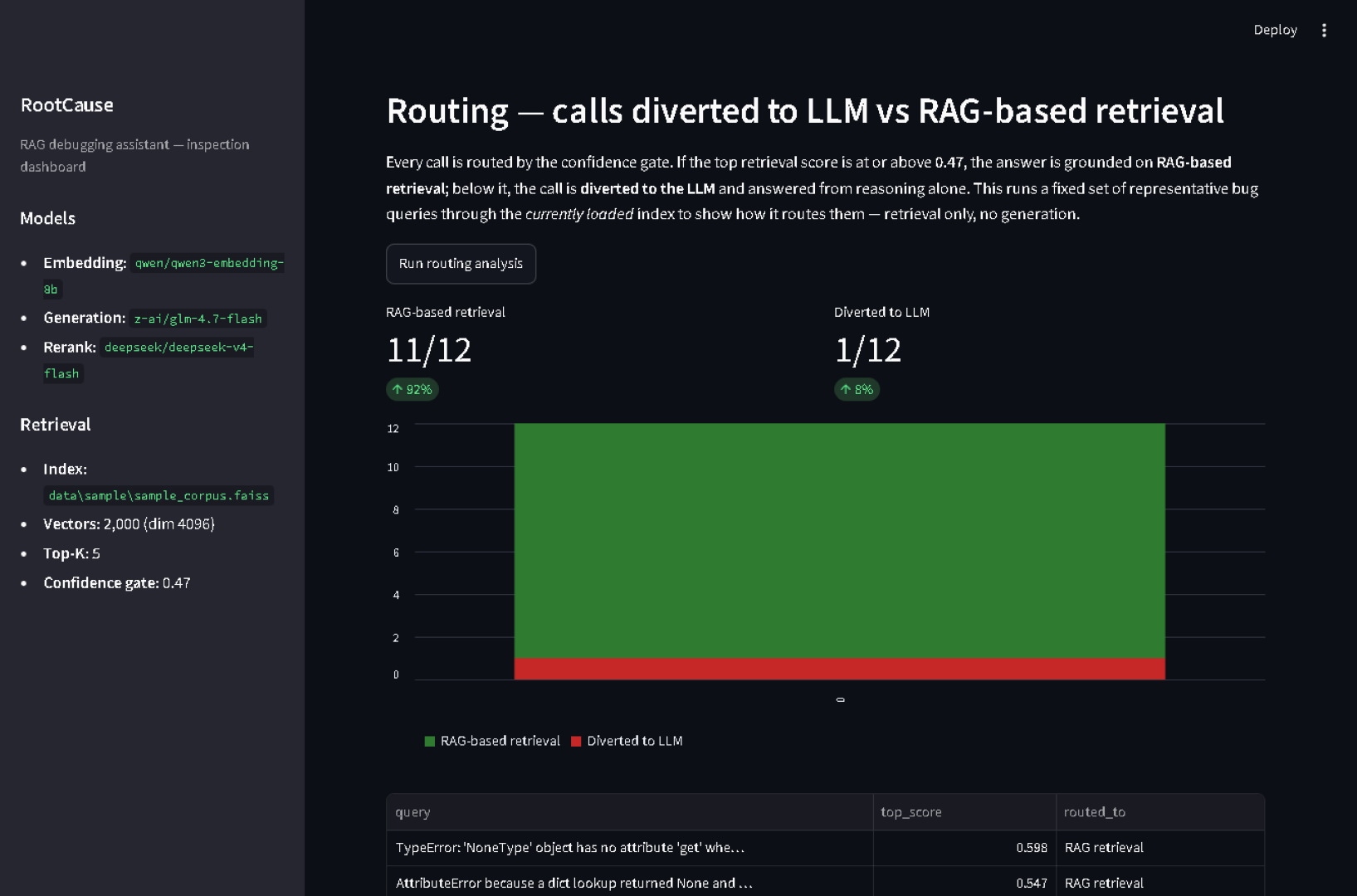
It shows, in one page: the configured models and the loaded index (path + vector count +confidence gate) in the sidebar; a text box + Analyze button that runs the fullembed → retrieve → gate → rerank → generate path and renders the JSON answer plus the rawretrieved candidates and their scores in a table; and an Evaluation section with thetwo charts below.
Evaluation
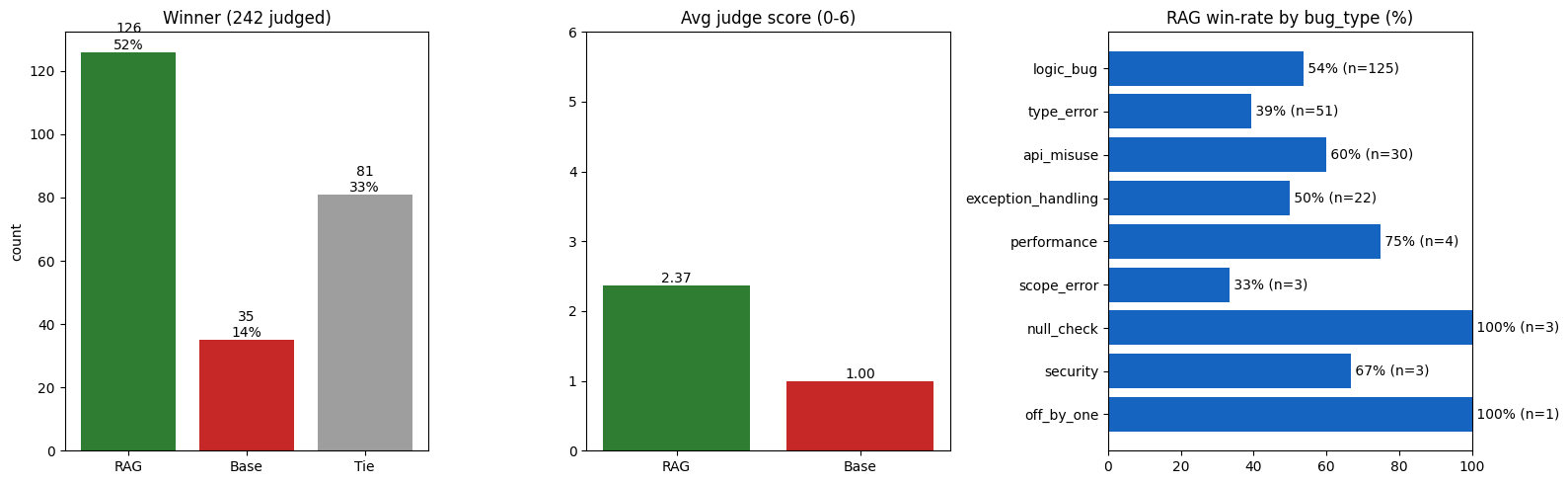
Setup. Answers were generated with z-ai/glm-4.7-flash and judged bydeepseek/deepseek-v4-pro (LLM-as-judge: head-to-head winner vs an LLM-only baseline, plusa 0–6 quality score) on ~240 held-out bugs. The ablation is the confidence gate itself —on (the shipped config: divert weak-retrieval queries to the LLM) vs off (pure RAG:always ground on retrieval).
Confidence gating ON — shipped config. 242 judged: RAG 52% / tie 33% / baseline 14%;average judge score 2.37 vs 1.00.
Confidence gating OFF — pure RAG. 249 judged: RAG 45% / tie 33% / baseline 21%; averagejudge score 2.37 vs 1.37.
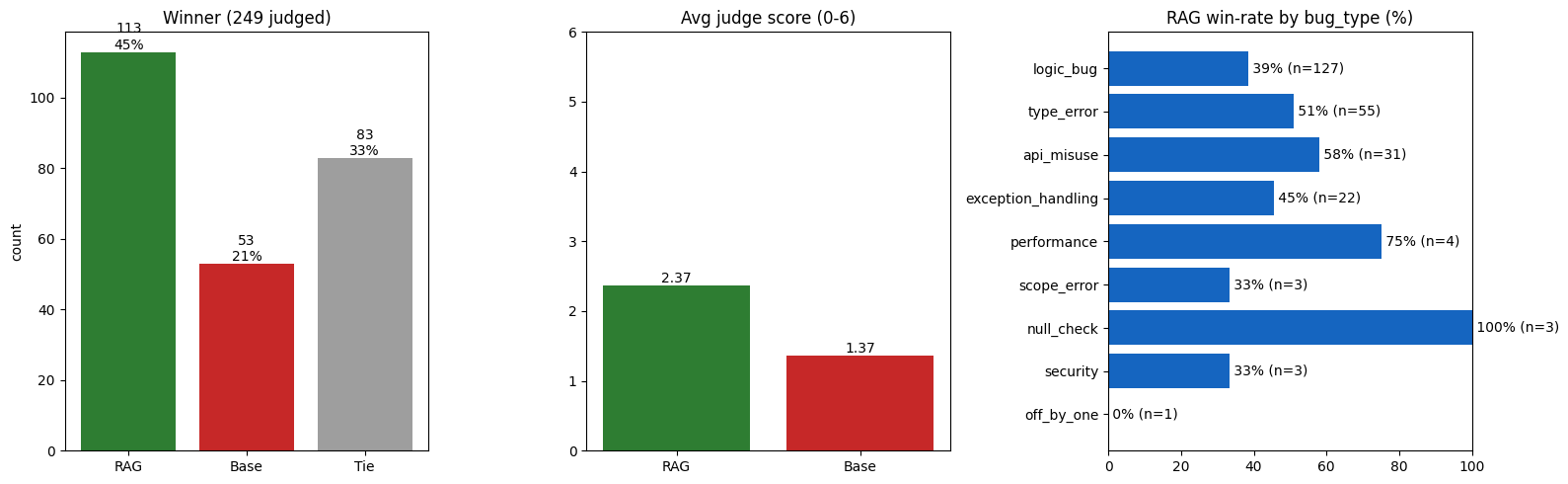
Takeaway. Turning the gate on diverts the weak-retrieval queries to the LLM instead ofgrounding on bad context: the baseline's win share drops 21% → 14% and RAG's rises45% → 52%, while RAG's own average score holds at 2.37. The gate earns its keep byrouting calls, not by retrieving harder.
Routing on the bundled index. Where do calls actually go? Against the bundled2,000-example index, a representative set of 12 bug queries routes as 11/12 (92%)RAG-based retrieval, 1/12 (8%) diverted to the LLM (the one diverted, "loop skips the lastelement", scores 0.434 — just below the 0.47 gate). Reproduce it live in the dashboard'sRouting section.
See CALIBRATION.md for how the 0.47 gate threshold was chosen.
Repo map
RootCause/
  README.md
  LICENSE
  CALIBRATION.md
  .gitignore
  .env.example
  requirements.txt
  src/
    core.py               # shared retrieval + rerank + generation logic
    rootcause_server.py   # MCP server — thin wrapper over core.py
    dashboard.py          # Streamlit inspection dashboard
  scripts/
    build_index.py        # JSONL corpus -> FAISS index (+ optional LLM parsing)
    calibrate_threshold.py# empirical confidence-gate calibration
  data/
    sample/
      sample_bug_corpus.jsonl     # ~2,000 rows, stratified across bug_type
      sample_corpus.faiss         # bundled sample index (committed)
      sample_corpus_metadata.pkl
  images/
    gate-on.png           # eval: confidence gating on (shipped)
    gate-off.png          # eval: confidence gating off (pure RAG)
    routing-chart.png     # calls diverted to LLM vs RAG-based retrieval (dashboard)
  tests/
    test_smoke.py         # index/metadata alignment + one live retrieve() call
Tests
pytest tests\
The alignment check runs with no API key or network. The retrieval check makes a singlelive embedding call and is skipped automatically when OPENROUTER_API_KEY is unset.
License
MIT — see LICENSE. © 2026 Vinesh Sharda.


