
hydroemu-mcp-server
An MCP server that exposes HACC cosmological hydrodynamic simulationemulators — pre-trained SEPIA Gaussian Process models — as tools for anyLLM agent.
The one idea this repo teaches
The science code stays in usual Python. The MCP wrapper only publishes it.
tools/is an ordinary science package. It never imports MCP. The emulatortools live intools/hydro_tools.py; the core SEPIA wrapper is intools/emulator.py.mcp_server/is a ~70-line generic wrapper. It reads one line of config frompyproject.toml, imports the science package, and registers every functionlisted in its__all__as an MCP tool.
[tool.mcp-server]
tool_modules = ["tools"]
Your type hints, Pydantic Field constraints, and docstrings become the toolschema agents see. To build your own server: drop your modules into tools/(or point that one config line at your own package), list the public functionsin __all__, done.
Layout
models/                           Pre-trained SEPIA pickles (copy from CosmoHydro/models/)
tools/
  emulator.py                    Core SEPIA wrapper: lazy load, predict, redshift interpolation
  hydro_tools.py                 The 5 MCP tool functions + ArtifactResult contract
  __init__.py                    __all__ — ONLY these names become tools
mcp_server/                      Generic drop-in wrapper (FastMCP)
tests/test_tools.py              Tools tested as plain Python, no MCP needed
docs/mcp-clients.md              Multi-client setup guide
Parameters
7 parameters total (5 subgrid + 2 cosmology):
| Parameter | Symbol | Range | Units |
|---|---|---|---|
| AGN wind coupling | κ_w | [0.03, 3.0] | — |
| AGN energy efficiency | e_w | [0.001, 0.1] | — |
| BH seed mass | M_seed | [0.5, 50.0] | 10⁶ M☉ |
| Kinetic feedback velocity | v_kin | [0.1, 1.0] | 10⁴ km/s |
| Kinetic feedback efficiency | ε_kin | [0.1, 1.0] | 10¹ |
| Matter density | ω_m | [0.12, 0.155] | — |
| Fluctuation amplitude | σ₈ | [0.7, 0.9] | — |
Design: 110 simulations (400 Mpc/h boxes) from a Latin hypercube design.
Observables
| Observable | Description | Snapshots | z range |
|---|---|---|---|
| GSMF | Galaxy Stellar Mass Function | 11 | 0–2 |
| HMF | Halo Mass Function | 11 | 0–2 |
| fGas | Cluster Gas Fraction | 7 | 0–1.0 |
| CGD | Cluster Gas Density Profile | 5 | 0–0.5 |
| CGED | Cluster Gas Electron Density Profile | 5 | 0–0.5 |
| CPP | Cluster Gas Pressure Profile | 5 | 0–0.5 |
| CTP | Cluster Gas Temperature Profile | 5 | 0–0.5 |
| CEP | Cluster Gas Entropy Profile | 5 | 0–0.5 |
| CEEP | Cluster Electron Entropy Profile | 5 | 0–0.5 |
| CMP | Cluster Gas Metallicity Profile | 5 | 0–0.5 |
| CYP | Cluster Compton-y (tSZ) Profile | 5 | 0–0.5 |
Tools
| tool | what it does |
|---|---|
list_observables() |
list all 11 emulated observables with metadata |
describe_parameters() |
the 7-parameter design space with ranges |
predict_observable(...) |
predict any observable at z=0, write CSV |
predict_observable_redshift(...) |
predict at arbitrary z (interpolated) |
plot_observable_comparison(...) |
two-panel figure: observable + ratio |
Two conventions worth copying into any science MCP server:
- Every tool returns
{status, files, message, metadata}(ArtifactResult). - Arrays move between tools as file paths, never through the agent'scontext window.
Install
conda create -n hydroemu python=3.12 -y
conda activate hydroemu
pip install -e ".[dev]"
pytest                        # tests pass without SEPIA models (fixture data)
Pre-trained models
Copy the trained SEPIA pickles from CosmoHydro/models/ into the models/directory:
cp -r /path/to/CosmoHydro/models/GSMF_multiz models/
cp -r /path/to/CosmoHydro/models/HMF_multiz models/
# ... etc for each observable
Without models, list_observables(), describe_parameters(), andplot_observable_comparison() still work; only predict_observable andpredict_observable_redshift require the pickles.
Run the server
Streamable HTTP — the server is a visible process with a URL:
python -m mcp_server --transport streamable-http --port 8000
Clients connect to http://127.0.0.1:8000/mcp. Stop the server withCtrl+C (Ctrl+Z only suspends it, leaving the port taken — if thathappens, just start the server again: it detects a leftover mcp_serverholding the port and clears it automatically).
To use this server from Claude Code, the Claude desktop app, Codex, Cursor,or any other MCP client — see docs/mcp-clients.md;a checked-in .mcp.json already wires it into Claude Code.
Architecture
This server follows the same architecture asspectra-mcp-server:
Emulator Plots
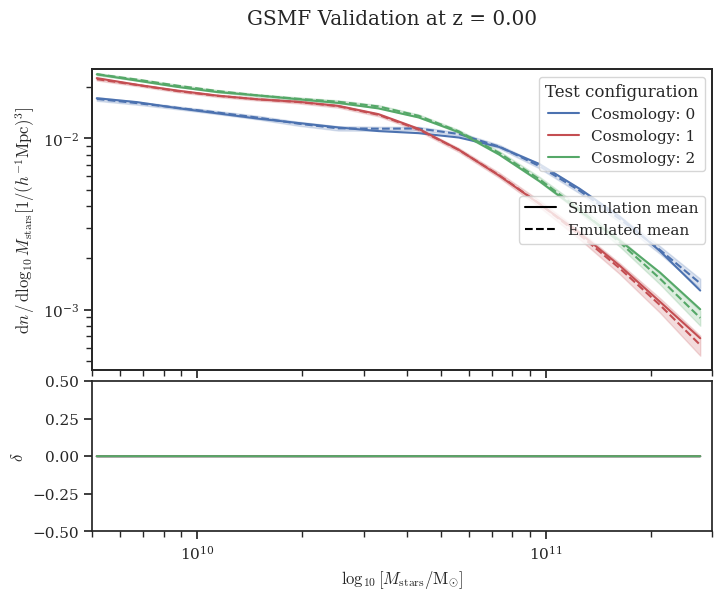
See the full gallery for 24 validation, sensitivity, andcomparison plots from the CosmoHydro training notebooks. Highlights:
 |
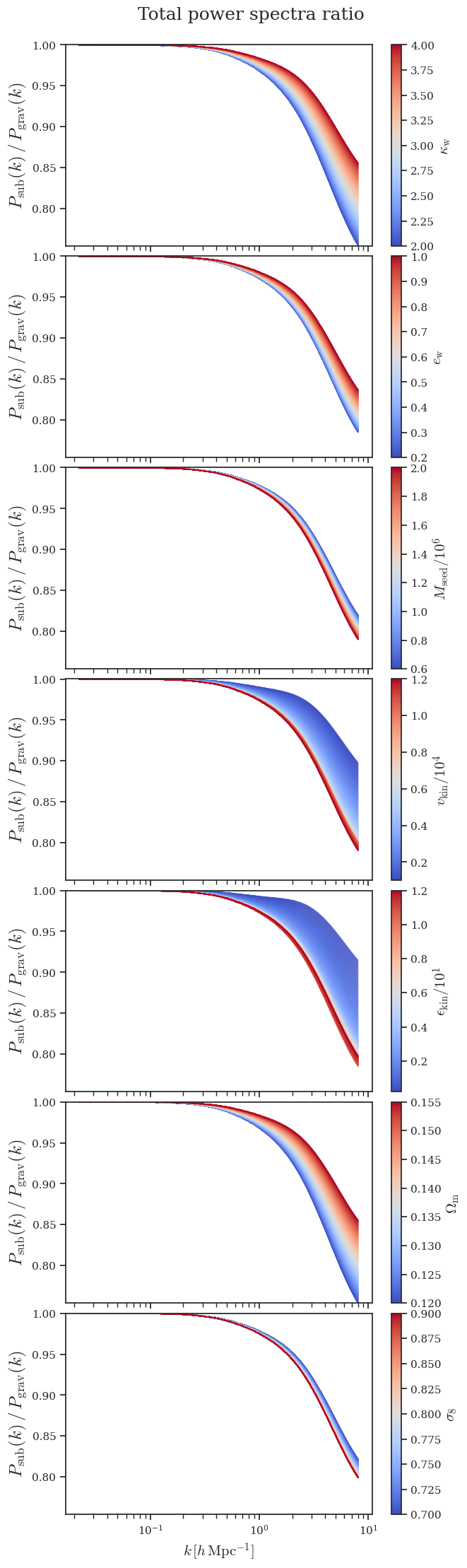 |
| GSMF: emulator vs held-out simulations | P(k) suppression: per-parameter sensitivity |
Architecture (detailed)
mcp_server/is a generic drop-in MCP wrapper (copy between repos)tools/contains the domain-specific science functionspyproject.toml[tool.mcp-server]config wires them together- All SEPIA imports are lazy (inside functions, not at module scope)
- Models are loaded on first use and cached for subsequent calls


