
Containarium — Agent Runtime
Open-source agent runtime · SSH-native isolation · eBPF egress policy · Kubernetes + LXC · MCP-native CLI · GPU passthrough
The open-source, self-hostable agent runtime for AI agents.Each agent gets a persistent, SSH-reachable box with per-tenant network isolation — no kube-apiserver token, no host access, no cross-tenant leakage.
Bring your own agent — Cursor, Claude Code, OpenCode, your own MCP client.We run the box.
agent: "create me a sandbox called 'blog'"           → containarium create
agent: "wire up SSH so I can reach it"               → containarium ssh-config sync
agent: "install Caddy on :8080 inside the box"       → shell_exec (via agent-box MCP)
agent: "expose that on blog.example.com"             → containarium expose-port

curl https://blog.example.com → hello world


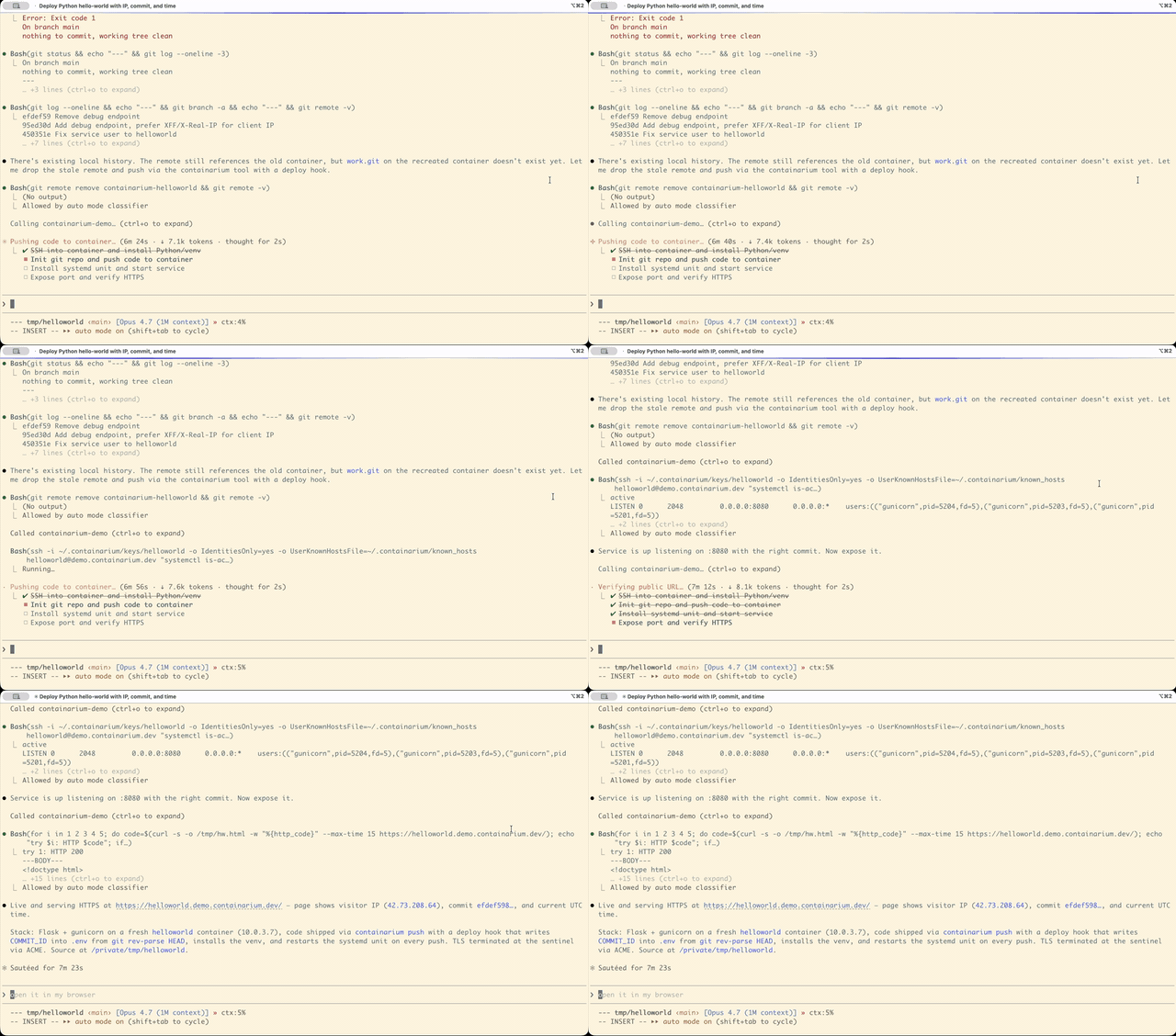
🌐 Project site: containarium.dev · 🎬 55s demo: youtu.be/IBDDD_tb8FY · 🚀 Live app: helloworld.demo.containarium.dev
Why an agent runtime?
AI agents are increasingly the primary user of dev infrastructure. Theywant to build, install, deploy, and verify — not on the human's laptop(too noisy, too risky, too local) but on a persistent, isolated runtime that's:
- Persistent: state survives between agent runs.
- Isolated: a misbehaving install doesn't touch your machine or your cluster.
- Real: a full Linux environment with
systemd, real networking,and the ability to host things on the open internet. - Driven by structured tools: not by an agent typing commands into aTTY hoping nothing scrolls off-screen, but by MCP — typed,bounded, safe.
- Blast-radius-bounded: the agent holds an SSH key, not akube-apiserver token. It can't reach the cluster control plane, thehost OS, or other tenants' boxes.
That's the runtime Containarium gives you. It runs as a self-hostedplatform on LXC or Kubernetes, exposes its admin surface over MCP, andships a second MCP server that lives inside the box so the agent canshell_exec and edit files directly.
You bring the agent. We run the box.
Quick start
1. Self-host on a fresh Ubuntu VM (5 minutes)
curl -fsSL https://raw.githubusercontent.com/footprintai/containarium/main/hacks/install.sh \
  | sudo bash
That installs Containarium + Incus + dependencies, starts the daemon,and gives you a working API at http://localhost:8080.
2. Create your first box
sudo containarium create alice --ssh-key ~/.ssh/id_ed25519.pub
sudo containarium list
3. Wire up SSH so ssh alice just works
containarium ssh-config sync
# Adds entries to ~/.containarium/ssh_config.
# Then add ONE line to ~/.ssh/config:
#     Include ~/.containarium/ssh_config
ssh alice  # connects through the sentinel
4. Point your agent at the box
In ~/.cursor/mcp.json or ~/.claude.json:
{
  "mcpServers": {
    "containarium-box": {
      "command": "ssh",
      "args": ["alice", "agent-box"]
    }
  }
}
Now Claude Code, Cursor, or any MCP-speaking agent can callshell_exec, read_file, write_file, list_directory,move_file, delete_file directly inside Alice's container.
5. Make it reachable on a public hostname
containarium expose-port alice \
  --container-port 8080 \
  --domain blog.example.com
Caddy on the sentinel terminates TLS for blog.example.com andforwards to alice-container:8080. curl https://blog.example.comhits whatever Alice has serving on port 8080.
The four primitives
Every action in Containarium has a CLI verb (canonical) AND an MCP tool(thin wrapper that delegates to the same Go function). SeeCLAUDE.md for the convention.
agent-box — in-the-box MCP server
Runs inside every container. Reached over stdio (typically wrapped bySSH on the client side). Exposes Linux-native operations:
| Tool | What it does |
|---|---|
shell_exec |
Run a shell command, capture stdout/stderr/exit, bounded by timeout (default 30s, max 10min) and 256 KiB output cap |
read_file |
Byte range OR head=N lines OR tail=N lines |
write_file |
Atomic write with mkdirp (temp + rename) |
list_directory |
Type/size/mtime, hidden filtering |
move_file |
Atomic rename with mkdirp on destination |
delete_file |
Single-file remove (refuses directories so recursive deletes go via shell_exec where blast radius is explicit) |
Resources (read-only data the agent fetches via MCP resources/read):
| URI | What it returns |
|---|---|
containarium://ci-context |
JSON metadata about the current CI run (PR number, commit SHA, failing test, etc.) when the box was kept alive by the FootprintAI/containarium-run GitHub Action after a failed CI run. Returns {"available": false} on non-CI boxes so callers never have to special-case errors. |
containarium://ci-prompt |
Static markdown playbook telling agents how to debug a failing CI run inside this box (what to read first, how to iterate, what not to do). Same body on every box; pair with ci-context for the per-run data. |
Optional sandbox: when AGENTBOX_ROOT is set, every file-ops path isresolved against that root with a boundary-aware prefix check. Defaultunset = no constraint. Seeinternal/agentbox/ for the Go implementation.
mcp-server — platform MCP server
Runs on the host. Exposes outside-the-box admin operations:create_container, list_containers, delete_container,start_container, stop_container, expose_port, get_metrics,get_system_info. See cmd/mcp-server/.
containarium CLI
Same surface as the platform MCP, plus deeper administration. Top-levelverbs:
containarium create        Create a new container
containarium list          List all containers
containarium delete        Delete a container
containarium expose-port   Expose container:port on a public hostname
containarium ssh-config    Generate self-contained ssh_config
containarium route         Manage proxy routes (low-level)
containarium passthrough   Manage TCP/UDP passthrough rules
containarium token         Issue JWT tokens for the API
containarium info          System info
containarium version       Print version
Run containarium <verb> --help for full options.
Sentinel — sshpiper + Caddy + PROXY-protocol
The sentinel is a tiny always-on VM (e2-micro on GCP free tier works)that:
- Receives SSH on port 22 (sshpiper routes to the right backend byusername).
- Receives HTTPS on 443 (Caddy with TLS-passthrough orPROXY-protocol-aware forwarding to backend Caddy).
- Survives spot-VM termination on the backend with a maintenance page.
- Holds the static IP / DNS A-record so backends can be ephemeral.
See docs/SENTINEL-DESIGN.md for the fulldesign.
Architecture
        Agent (Cursor / Claude Code / OpenCode)
            │
            │ JWT (access; tt=access, jti, scopes)
            │ MCP over stdio  ──┐
            │                   │ ┌── refresh ──> POST /v1/tokens/refresh
            v                   ▼ │                  (single-use; old jti revoked)
        ssh user@box  → sshpiper → agent-box (in container)
            │
            │ HTTPS  (mTLS upstream; PROXY-protocol v2)
            v
        Sentinel (e2-micro, always-on)
        ├── sshpiper (port 22)            : routes by username; fail2ban per-user
        ├── Caddy + PROXY-protocol (443)  : routes by hostname / SNI suffix
        └── /wake/ source-IP allowlist    : trusted-proxy only
            │
            v
        +-------------------------------------------------+
        | Backend VM (spot or bare-metal GPU node)        |
        |                                                 |
        |  Incus (LXC) ── containers                      |
        |    ├── alice-container    : SSH + agent-box     |
        |    │   └── /run/secrets/* : tmpfs, 0440 alice   |
        |    └── bob-container      : ZFS-backed storage  |
        |                                                 |
        |  Containarium daemon                            |
        |    ├── JWT auth (iss/aud/jti/scopes)            |
        |    ├── Admin RBAC + container-owner authz       |
        |    ├── Image-digest gate (REQUIRE + VERIFY)     |
        |    ├── Secrets ── Postgres (envelope-encrypted) |
        |    │              │                             |
        |    │              v                             |
        |    │           KMS ── Vault Transit / GCP KMS   |
        |    │           (master key retirable post-cutover)
        |    └── Audit log ── Postgres + SHA-256 hash     |
        |                     chain (verify CLI)          |
        +-------------------------------------------------+
A single sentinel can front multiple backend VMs — a "pool" — and asingle deployment can run multiple pools (each isolated). Seedocs/MULTI-POOL.md.
Security control surface (all opt-in via env, default-off forupgrade safety; see docs/security/OPERATOR-SECURITY-RUNBOOK.md):
| Env var | Layer | Effect |
|---|---|---|
CONTAINARIUM_REQUIRE_IMAGE_DIGEST=true |
API | refuse images without @sha256:<64hex> |
CONTAINARIUM_VERIFY_IMAGE_DIGEST=true |
API | verify digest against the registry index (pre- + post-pull) |
CONTAINARIUM_ALLOWED_IMAGE_REGISTRIES |
API | restrict which simplestreams remotes the daemon will pull from |
CONTAINARIUM_KMS_BACKEND={none,inproc,vault,gcp} |
Secrets | envelope-encrypt DEKs through an external KMS |
CONTAINARIUM_REQUIRE_ENVELOPE=true |
Secrets | refuse legacy master-key-only rows (Phase E retirement gate) |
CONTAINARIUM_POSTGRES_URL_FILE / _PASSWORD_FILE |
Secrets | DB creds from disk rather than env |
CONTAINARIUM_WAKE_TRUSTED_PROXIES |
Sentinel | source-IP allowlist for /wake/ |
OTEL_BEARER_REQUIRED=true |
Telemetry | collector rejects un-bearered OTLP submissions |
How it's different
vs. SaaS-only sandboxes (e2b, Modal, Replit)
These give you sandboxes for AI agents, but only as hosted SaaS:
- Self-hostability: Containarium runs on your own infrastructure(a $5 VM, your homelab, your enterprise data center). e2b, Modal,and Replit are SaaS-only — your code, your data, and your customersgo through their compute.
- License: Apache 2.0, no CLA. Fork it, sell it, run it.
- Surface: full Linux containers with
systemd, real networknamespaces, GPU passthrough. Not a process-per-call sandbox. - Transport: MCP-native from day one, not a custom SDK with MCPbolted on.
vs. Docker AI Sandboxes (sbx)
Docker's sbx run claude and Containarium both call themselves"AI sandboxes," but they sit on opposite ends of the same spectrum:
- Locality:
sbxruns the sandbox on the developer's laptop(microVM, host-isolation). Containarium runs the sandbox on a VMyou host (LXC, multi-tenant, public-internet reachable via thesentinel). - Persistence:
sbxis session-shaped (workspace mount, nodocumented "give me a box that survives reboot and has ahostname"). Containarium containers persist indefinitely, withZFS snapshots and 30-day retention. - Public reach:
containarium expose-port alice --domain blog.example.comis one verb.sbxis laptop-local; nopublic-hostname story. - Agent surface:
sbxis CLI-first (sbx run <agent>).Containarium is MCP-native — two MCP servers (in-the-boxagent-box+ platformmcp-server) plus the same surface viaCLI, SSH, REST/gRPC, and a web UI. - License:
sbxCLI is free; team policy (Docker Admin Console)is a paid subscription. Containarium is Apache 2.0 — includingthe audit log, RBAC, KMS integrations, and everything else onthis page.
If you're stopping an agent from rm -rf-ing the laptop it'srunning on, sbx is the lighter tool. If you're giving your agent(or your customer's agent) a persistent Linux box on the publicinternet, Containarium is the shape.
vs. OSS Kubernetes agent runtimes (agent-sandbox, OpenShell)
kubernetes-sigs/agent-sandboxand NVIDIA/OpenShell are theclosest open-source peers on Kubernetes:
- SSH-native vs. exec-based: both agent-sandbox and OpenShell reachthe sandbox via
kubectl execor a proprietary client, which requiresthe agent to hold a kube-apiserver token or cluster credentials.Containarium reaches the pod over SSH through sshpiper — the agent hasno path to the cluster control plane at all. - MCP-native: agent-sandbox and OpenShell expose REST APIs or customSDKs. Containarium's
agent-boxMCP server runs inside the box,reachable over SSH stdio — any MCP-speaking agent (Claude Code, Cursor,OpenCode) works with zero client library. - LXC + K8s, one CLI: Containarium runs on either Incus/LXC orKubernetes behind the same
containariumCLI and--runtimeflag. Youswitch backends without changing anything for the agent. - eBPF egress policy: Containarium enforces per-tenant egressallowlists at the kernel level via TC_INGRESS eBPF programs.agent-sandbox has NetworkPolicy; OpenShell has eBPF but isNVIDIA-stack-specific. Neither offers a portable, per-tenant eBPFallowlist across LXC and K8s backends.
vs. dev environment platforms (Codespaces, Gitpod, Coder)
Those are persistent IDEs. Containarium is a persistent box —agent-driven, not developer-driven, no IDE assumption, SSH-as-the-API:
- Containarium environments are reached by SSH and MCP. Any IDE works(Vim, JetBrains Remote, VS Code Remote, Cursor's remote dev — yourcall).
- Cost: no per-hour billing in the OSS path. Self-host costs are justyour underlying VM.
- Persistence: containers survive indefinitely; Codespaces auto-deleteafter inactivity.
vs. application container platforms (Docker, Kubernetes)
LXC is a system container, not an application container. Eachcontainer has systemd, a real init, real users, real package managers,real sudo. You can run Docker inside a Containarium container; thereverse isn't really a thing.
If your agent is going to apt install half a Linux distro, editconfig files in /etc, run a database, and reboot — LXC is the rightshape. If your agent runs a single Python process, Docker or Modal isfine.
It isn't either/or: Containarium can run a box as a pod in aKubernetes cluster you already operate — same SSH-native agent contract,no kube-apiserver token in the agent's hands. Switch with--runtime=k8s. See the Kubernetes backend section below.
What's in the box
Beyond the agent-native primitives, Containarium ships:
Multi-OS
- Ubuntu 24.04 LTS (default)
- Rocky Linux 9 (dev/test)
- RHEL 9 (production)
- Windows Server VMs via QEMU/KVM with RDP — seedocs/WINDOWS-VM-SETUP.md
GPU passthrough
For ML/AI agent workflows. Works with NVIDIA RTX 3090, RTX 4090, andsimilar. PCI-level passthrough so the container sees the GPU directly.Tested on bare-metal GPU nodes connected to the sentinel via tunnel.
Multi-backend
A single sentinel can front:
- GCP spot VMs: cost-effective cloud backends with auto-recoveryon preemption.
- Bare-metal GPU nodes: any Linux box you can SSH to; reaches thesentinel via outbound tunnel.
- Windows VMs: live alongside Linux backends.
All containers from all backends appear in a single unified API.
Kubernetes backend (experimental)
Beyond the LXC/Incus backend, Containarium can run a box as a pod in aKubernetes cluster you already operate — reached over SSH exactly likean LXC box, so an agent can't tell which substrate it landed on. Thedaemon reconciles a per-tenant namespace + StatefulSet + headless Service
- default-deny NetworkPolicy, and programs the sshpiper gateway (the
PipeCRD) sossh <tenant>@<gateway>routes to the right pod.
The pitch isn't "another way to run pods" — it's giving an agent ahardened, SSH-native foothold in your cluster without handing it akube-apiserver token: the box runs with automountServiceAccountToken: false and satisfies the restricted Pod Security profile. Compare thisto kubectl exec-based runtimes where the agent necessarily holds clustercredentials.
Runtime selection (no recompile needed):
# LXC/Incus (default)
containarium daemon

# Kubernetes — uses in-cluster config or KUBECONFIG
CONTAINARIUM_RUNTIME=k8s containarium daemon
# or
containarium daemon --runtime=k8s
Both backends share the same CLI, MCP tools, JWT auth, and REST/gRPC API.GPU passthrough is supported on K8s via nvidia.com/gpu resource limits.Local bring-up takes under 5 minutes with kind — seedocs/KIND-QUICKSTART.md.
Design, topology, and BYO-cluster integration:docs/K8S-AGENT-BOX-RUNTIME-DESIGN.md.
Web UI
A basic dashboard at /webui/ for users who'd rather not type CLI:container list, lifecycle controls, metrics, browser-based terminal.Polished UI is intentionally a cloud-product concern — the OSS web UIis functional, not opinionated.
Persistent storage (ZFS)
Containers survive VM restarts and spot termination. ZFS handlescompression, snapshots (daily by default, 30-day retention), andchecksums.
Sentinel HA
The sentinel itself is e2-micro (free tier). It:
- Detects spot preemption in ~10s, serves a maintenance page.
- Restarts spot VMs automatically (~85s total recovery).
- Holds the static IP, so DNS doesn't change as backends rotate.
Monitoring & observability
VictoriaMetrics + Grafana auto-provisioned. Per-container CPU,memory, disk, network. Alerting via webhooks. SSH audit logs peruser.
Security primitives
- Unprivileged LXC containers: container root ≠ host root.
- Per-user proxy accounts:
/usr/sbin/nologinon the sentinel,users can only proxy through to their container. - fail2ban per-user: an attack on Alice's account doesn't banBob.
- ClamAV + Trivy scanning across all backends.
- AppArmor profiles per container.
- AGENTBOX_ROOT sandbox to constrain agent-box file ops at runtime.
Zero-trust controls (rolled out across the v0.17 → unreleased line; see docs/security/OPERATOR-SECURITY-RUNBOOK.md):
- JWT with
iss/aud/jti/tt/scopes: 32-byte minimumsecret enforced at startup; refresh tokens are single-use; jti-basedrevocation; per-tool MCP scopes propagate to server-side gates. - Admin RBAC + per-container ownership on the API surface; clusterops admin-only, container ops owner-only.
- KMS envelope encryption for tenant secrets (Vault Transit or GCPCloud KMS), with a migration tool and master-key retirement gate.
- tmpfs
--delivery=filefor secrets that shouldn't be visible in/proc/<pid>/environ. - Audit log with SHA-256 hash chain +
containarium audit verifyto detect tampering. - Image-registry allowlist + pre-pull simplestreams digestverification + post-pull
volatile.base_imagedefense-in-depthfor supply-chain hardening. SECURITY.mdwith a 90-day coordinated-disclosure window;gosec/govulncheck/trivyrunning in CI.
CLI reference (essentials)
Container lifecycle
# Create (Ubuntu 24.04, default)
containarium create alice --ssh-key ~/.ssh/id_ed25519.pub

# Create with options
containarium create ml-dev \
  --ssh-key ~/.ssh/id_ed25519.pub \
  --gpu 0 \
  --stack gpu \
  --memory 16GB \
  --cpu 4

# Lifecycle
containarium list
containarium info
containarium start alice
containarium stop alice
containarium delete alice
Networking
# Expose a container port on a public hostname
containarium expose-port alice \
  --container-port 8080 \
  --domain blog.example.com

# Lower-level route management
containarium route add api.example.com --target 10.0.3.42:3000
containarium route list
containarium route delete api.example.com

# Raw TCP/UDP passthrough (no TLS termination)
containarium passthrough add --port 50051 \
  --target-ip 10.0.3.150 --target-port 50051
SSH config
# Print to stdout (preview)
containarium ssh-config show

# Write to ~/.containarium/ssh_config (one-line `Include` to wire in)
containarium ssh-config sync
containarium ssh-config sync --sentinel sentinel.example.com  # via sentinel
containarium ssh-config sync --identity ~/.ssh/containarium_ed25519
Authentication
# Issue an access + refresh pair (CLI-only; never exposed via API).
# Access tokens are short-lived (default 15 min) and authenticate the
# API. Refresh tokens are long-lived and single-use — exchange via
# POST /v1/tokens/refresh for a new pair.
containarium token generate \
  --username admin \
  --roles admin \
  --secret-file /etc/containarium/jwt.secret

# Use the access token
curl -H "Authorization: Bearer <access-token>" http://localhost:8080/v1/containers

# Inspect a token's claims (jti, scopes, expiry, validation)
containarium token inspect <token> --secret-file /etc/containarium/jwt.secret

# Revoke a leaked token by jti (idempotent; reads from `audit query`
# or `token inspect`)
containarium token revoke <jti> --reason "leak_2026_05_22"
containarium token list-revoked

# Mint a least-privilege token for an agent with only the scopes it
# needs — server-side gates enforce this even if the agent ignores
# the filter.
containarium token generate \
  --username alice-agent \
  --scopes containers:read,containers:write \
  --secret-file /etc/containarium/jwt.secret
See docs/security/OPERATOR-SECURITY-RUNBOOK.mdfor the full token lifecycle, leak-response playbook, and the agentleast-privilege scope catalog.
Deployment
Manual install (recommended for getting started)
curl -fsSL https://raw.githubusercontent.com/footprintai/containarium/main/hacks/install.sh \
  | sudo bash
See hacks/README.md for what the script does.
Terraform (recommended for production)
cd terraform/gce
cp examples/single-server-spot.tfvars terraform.tfvars
vim terraform.tfvars   # set project_id, admin_ssh_keys, allowed_ssh_sources
terraform init
terraform apply
See terraform/gce/README.md for variables.
System requirements
- Host OS: Ubuntu 24.04 LTS or later (containers can be anysupported OS).
- Incus 6.19+ required for Docker-in-LXC support. Ubuntu 24.04'sdefault repos ship 6.0.0 which has an AppArmor bug(CVE-2025-52881);use the Zabbly Incus repository forcurrent builds.
- ZFS kernel module (for disk quotas).
- Kernel modules:
overlay,br_netfilter,nf_nat(Docker incontainers needs these).
# Quick Incus install via Zabbly
curl -fsSL https://pkgs.zabbly.com/key.asc | \
  sudo gpg --dearmor -o /usr/share/keyrings/zabbly-incus.gpg
echo 'deb [signed-by=/usr/share/keyrings/zabbly-incus.gpg] \
  https://pkgs.zabbly.com/incus/stable noble main' | \
  sudo tee /etc/apt/sources.list.d/zabbly-incus-stable.list
sudo apt update
sudo apt install incus incus-tools incus-client
incus --version  # 6.19 or later
API
Containarium exposes:
- REST API at
http://localhost:8080(gRPC-gateway over the gRPCservice, JWT auth) - gRPC at
:50051(mTLS, primarily used by the CLI) - Two MCP servers:
mcp-server(platform) andagent-box(in-the-box)
OpenAPI / Swagger UI athttp://localhost:8080/swagger-ui/.
Token-issuance is CLI-only by design; the daemon does not have an"issue token via API" endpoint, because if it did, anyone with APIaccess could mint admin tokens.
Hardening notes
SSH key hygiene
- Each user gets their own keypair. Never share keys between users— sharing breaks revocation, audit, and per-user fail2ban.
- The same key can authenticate to both the sentinel proxy account andthe container. That's the supported flow: simpler for users, nosecurity loss because the proxy account is
nologinand only routesthrough. - To rotate: user generates a new key, admin replaces the
authorized_keyscontent in the container.
Agent-box sandbox
If you're running an untrusted agent, set AGENTBOX_ROOT to a projectdirectory:
# In the container
export AGENTBOX_ROOT=/srv/project
agent-box   # all file ops now constrained to /srv/project
shell_exec is intentionally not constrained beyond the LXC containerboundary itself — by design, that's the tool's contract. If you needtighter isolation, run agent-box in a more restrictive container (e.g.nested LXC, or chroot the user account further).
Network
- Backend VMs have no public IP by default; they reach out viaCloud NAT and accept inbound only via sshpiper.
- Sentinel allowlist: configure
allowed_ssh_sourcesin Terraform(or firewall rules manually) to lock down who can hit port 22.
Comparison FAQ
Why not Docker / Podman?Docker is for application containers. Containarium uses LXC systemcontainers — full Linux OS per container, real systemd, native SSH,Docker-in-LXC works, persistent filesystem. If your agent willapt install and reboot, you want LXC.
Why not Kubernetes?K8s orchestrates application containers across nodes — that's theinfrastructure layer. Containarium is the agent runtime that runs ontop of Kubernetes (or LXC), giving each agent a persistent, SSH-nativebox without handing it cluster credentials. If you're already on K8s,run containarium daemon --runtime=k8s and use your existing cluster asthe backend. See the Kubernetes backendsection and docs/KIND-QUICKSTART.md.
Why not Vagrant?Vagrant orchestrates VMs on a developer's local machine. Containariumhosts environments on shared remote infrastructure for many agents.
Why not Dev Containers / VS Code Remote Containers?Dev Containers are project-scoped, IDE-coupled, single-developer.Containarium gives many users (or many of one user's agents) their ownpersistent boxes on shared infrastructure, IDE-agnostic.
Why not Codespaces / Gitpod?Browser-IDE-as-a-Service, per-hour billed, vendor-locked. Containariumis self-hosted, persistent, SSH/MCP-based, no per-hour billing in OSS.
Why not e2b / Modal / Daytona?Closest peers — sandboxes for AI agents. They're SaaS-only andtypically optimize for short-lived, process-per-call execution.Containarium is self-hostable, MCP-native, and gives you fullpersistent Linux boxes. Pick e2b if you want hosted-only andephemeral; pick Containarium if you want self-hosted, persistent,and your data on your infra.
Why LXC at all?
- Each container runs a full Linux OS with
systemd. - SSH access is first-class.
- Docker-in-LXC works (vs. fragile Docker-in-Docker).
- Real persistent filesystem, real users, real
sudo. - "Feels like a VM" for the agent — same surface area as a managedcloud VM, fraction of the resource cost.
Use cases
- AI-agent sandboxes (the lead): Cursor, Claude Code, Cline,OpenCode, custom agents — all reach the same MCP surface.
- Shared developer environments: many developers, one host, SSHjump server with per-user isolation.
- ML / GPU experimentation: GPU passthrough into LXC.
- Education, bootcamps, workshops: per-student isolated Linuxwith no per-student VM.
- CI / build infrastructure: long-lived build hosts that keepcaches warm across runs.
- Demo / testing infrastructure: spin up a real Linux env, test,tear down.
In the wild
Where Containarium has been demonstrated live:
- 2026-06-04 — AI Agent Night, Taipei. When the grand-prizegiveaway (a custom vibe-keyboard) hit a snag — the event had no wayto run the lucky draw — we fired up Containarium and vibe-coded alucky-draw picker on the spot to save the giveaway. Still live:lucky-draw.demo.containarium.dev.
Demoed Containarium somewhere? Open a PR and add it here.
Status
- Production-deployed on GCP (multi-region) and bare-metal GPUnodes.
- APIs are stable (protobuf-defined with gRPC-gateway).
- Apache 2.0, no CLA, accepting community PRs.
- Active maintenance: see commit history on
mainand recentreleases.
Roadmap
- Shipped (2026-06): Kubernetes backend— run a box as a pod in a cluster you operate, reached over SSH like an LXCbox, with the sshpiper gateway, default-deny NetworkPolicy, CSI storage, and
nvidia.com/gpupassthrough. Selected at runtime via--runtime=k8s(norecompile). End-to-end validated onkind; 5-minute local bring-up indocs/KIND-QUICKSTART.md. See alsodocs/K8S-AGENT-BOX-RUNTIME-DESIGN.md. - Q2 2026 (in flight):
agent-boxMCP,ssh-configCLI,expose-portCLI, demo recording. - Q3 2026:
agent-boxtier-2 (MCP Roots, background processmanagement), demo-driven docs and examples. - Q4 2026: OSS v1.0 cut — stable API surface, contributionguide.
If you want to drive an item, open an issue or PR — community work iswelcome and we triage weekly.
Contributing
- Read CLAUDE.md for the CLI-first principle (every newplatform action lands as
containarium <verb>first; MCP wraps it). - Check existing issues and PRs.
- Add tests for new features.
- Update docs if user-visible behavior changes.
No CLA. Apache 2.0 means you can use, modify, and redistribute. Wewelcome PRs that align with the project's positioning and rejectthose that don't (e.g. "let me add multi-tenancy to the OSS daemon"goes into the cloud repo discussion, not here).
License
Apache License 2.0 — see LICENSE.
Acknowledgments
- Incus — modern LXC manager.
- sshpiper — SSH reverse proxy.
- mcp-go — Go MCP server library.
- Caddy — TLS / reverse proxy withPROXY-protocol support.
- Cobra — CLI framework.
- Terraform — infrastructure as code.
Support
- Project site: containarium.dev — overview, hosted cloud, GitHub Action for CI, PR previews.
- Documentation: docs/ directory.
- Issues: GitHub Issues.
- Demo video: 55s walkthrough on YouTube.
- Live demo app: helloworld.demo.containarium.dev.
- Organization: FootprintAI.


